The Short Answer
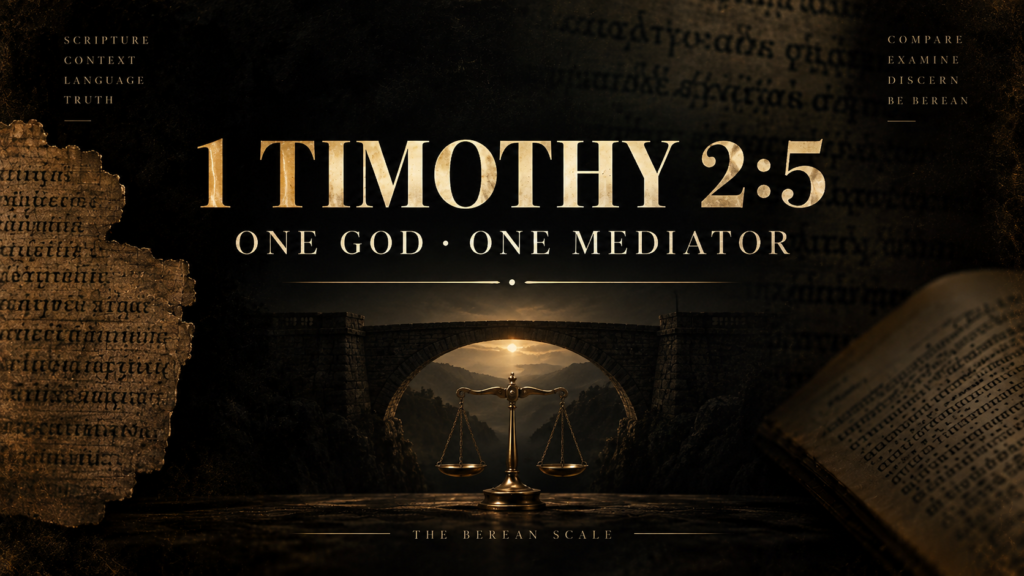
First Timothy 2:5 explicitly identifies “one God” and “one mediator between God and mankind,” and it identifies that mediator as “the man Messiah Yeshua.”
Paul’s wording clearly distinguishes the mediator from the God toward whom the mediation takes place. The verse does not explicitly say that Yeshua is the “one God,” nor does it explain the relationship in later Trinitarian categories such as one divine essence shared by multiple persons. Whether Yeshua can nevertheless share divine identity with the one God is a broader theological question that must be argued from the rest of Scripture rather than assumed from this sentence alone. Let’s put the text on the scale.
Read 1 Timothy 2:1–6 Before Building the Doctrine
We cannot isolate verse 5 from the surrounding argument. Paul is writing to Timothy with instructions for the congregation.
In verses 1 through 4, Paul urges that prayers be made for all people, including kings and those in authority, so that believers may lead peaceful lives. Why? Because this is good and acceptable in the sight of “God our Savior, who desires all men to be saved and to come to the knowledge of the truth.”
Verse 5 is the theological foundation for that command. All people can be saved because there is only one God over all people, and only one bridge to reach Him. Then verse 6 tells us how the mediator built that bridge: “who gave Himself as a ransom for all.”
What Does the Greek Actually Say?
The Greek of 1 Timothy 2:5 is structurally precise:
A literal rendering is: “For [there is] one God, and one mediator of God and of men, a man, Messiah Yeshua.”
The key phrases are:
- εἷς θεός (heis theos) — one God
- εἷς μεσίτης (heis mesitēs) — one mediator
- ἄνθρωπος Χριστὸς Ἰησοῦς (anthrōpos Christos Iēsous) — man, Messiah Yeshua
The sentence presents three distinguishable elements: the one God, mankind, and the single mediator between them. Yeshua is explicitly identified as that mediator and explicitly described as anthrōpos—a human being. What additional conclusions may be drawn about His identity or preexistence must come from the wider biblical witness.
Who Is “the One God”?
Paul’s language belongs naturally within Israel’s monotheistic confession that God is one. Elsewhere Paul explicitly identifies “the one God” as the Father. In 1 Corinthians 8:6 he writes, “for us there is one God, the Father, from whom are all things … and one Lord, Yeshua Messiah.” Ephesians 4:6 likewise speaks of “one God and Father of all.”
That wider Pauline usage strongly supports understanding the “one God” of 1 Timothy 2:5 as the Father. The verse itself, however, does not add the word “Father,” so that identification should be recognized as a contextual conclusion from Paul’s broader usage rather than something stated in this sentence alone.
What Does “Mediator” Mean?
The Greek word is mesitēs. It is used only six times in the New Testament. It means an arbitrator, a go-between, or one who intervenes to restore peace between two parties or establish a covenant.
In Galatians 3:19, Paul mentions that the Torah was ordained through angels by the agency of a mediator (Moses). Moses stood between Yahweh and Israel. In Hebrews, Yeshua is called the mediator of a new and better covenant. A mediator represents the interests of one party to the other. Yeshua perfectly represents Yahweh’s authority to mankind, and perfectly represents mankind’s ransom to Yahweh.
Why Does Paul Call Yeshua “the Man”?
Paul deliberately includes the word anthrōpos—man or human being. At minimum, the wording places Yeshua firmly within the humanity He represents.
That fits the wider New Testament emphasis on His genuine humanity. Hebrews 2:17 says He was made like His brothers in all things so that He could become a merciful and faithful high priest. First Timothy 2:6 then immediately connects His mediatorial role with His giving of Himself as a ransom for all.
The verse therefore leaves no room for treating Yeshua’s humanity as merely apparent. But the word anthrōpos by itself does not answer every question about His preexistence or divine status.
Can Someone Mediate Between Two Parties and Also Be One of Them?
This is one of the central questions raised by the verse. A mediator necessarily functions between parties, and Paul explicitly describes Yeshua as the mediator “between God and mankind.” At the level of the sentence, the mediator is therefore distinguished from the God toward whom He mediates and from the humanity He represents.
That grammatical distinction is significant. But grammar alone does not settle whether the mediator could also share some broader divine identity with God. Trinitarian theology answers yes by distinguishing person, nature, and mediatorial role. The biblical-monotheist reading understands the distinction more straightforwardly: the one God is one party, mankind is the other, and Yeshua is the Messiah appointed between them.
What we should not do is pretend that 1 Timothy 2:5 itself explains that later metaphysical question. It does not.
Does This Verse Deny the Deity of Yeshua?
Some interpreters argue that because Paul explicitly calls Yeshua “man” and separates Him from the “one God,” this verse proves Yeshua never possessed pre-creation glory or divine nature.
That is an overreach. The verse explicitly affirms His humanity and His mediatorial role. But affirming His humanity in the act of ransom does not automatically erase what the rest of the New Testament says about His origin or exaltation. As we saw in John 17:5, Yeshua possessed glory with the Father before the world existed. First Timothy 2:5 defines His role in salvation; it is not an exhaustive biography of His entire nature.
The Strongest Trinitarian Reading
A fair study must present the strongest opposing case. Trinitarian interpreters agree that Yeshua is genuinely distinct from the Father and genuinely human. They therefore do not read the distinction between God and mediator as meaning that Yeshua is the same person as the Father.
Instead, they understand the Son as one divine person who possesses both a divine and a human nature. On this reading, Yeshua can mediate between God and humanity precisely because He truly shares humanity while also sharing the divine nature. Paul’s description of Him as “the man Messiah Yeshua” is therefore understood as emphasizing His incarnate mediatorial role rather than denying His deity.
Trinitarian interpreters then appeal to the wider New Testament—including passages such as John 1:1, John 17:5, Philippians 2:6, and John 20:28—to argue that 1 Timothy 2:5 cannot be intended as a complete statement of everything Yeshua is.
That is a serious theological synthesis. But it remains important to distinguish the synthesis from what 1 Timothy 2:5 itself explicitly states.
How Does 1 Timothy 2:5 Compare With John 17:3?
First Timothy 2:5 bears a striking resemblance to the distinction we examined in John 17:3.
In John 17:3, Yeshua directly addresses the Father as “the only true God” and distinguishes Himself as Yeshua Messiah whom the Father sent. In 1 Timothy 2:5, Paul speaks of “one God” and then distinguishes from that God the mediator, “the man Messiah Yeshua.”
A biblical-monotheist reading sees the two passages as mutually reinforcing: the Father is the one God, while Yeshua is His Messiah, Son, and mediator. Trinitarian interpreters agree that Father and Son are personally distinct but argue that this distinction does not exclude the Son from sharing the one divine identity. The texts therefore establish distinction clearly; how that distinction relates to divine identity remains the theological question.
What About John 1:1 and John 20:28?
We cannot build a theology by allowing one passage to erase another. John 1:1 describes the Word with the language of theos, and in John 20:28 Thomas directly addresses the resurrected Yeshua as “My Lord and my God.” Those texts must be given their full weight.
A biblical-agency reading points out that Scripture can apply divine titles to authorized representatives without thereby identifying those representatives as Yahweh Himself. Exodus 7:1, for example, says Yahweh made Moses elohim to Pharaoh, and John 10:34–36 brings Psalm 82 into the discussion of divine-title language. On this reading, Thomas’s confession can be understood within Yeshua’s supreme authority as Yahweh’s exalted Messiah and representative.
Trinitarian interpreters understand John 1:1 and John 20:28 differently. They see those passages as evidence that Yeshua genuinely shares deity and therefore read 1 Timothy 2:5 as distinguishing the Son’s mediatorial person and role from the Father without excluding Him from divine identity.
First Timothy 2:5 does not resolve that entire Johannine debate for us. What it does give us clearly is the structure of Paul’s statement: one God, mankind, and one mediator between them—the man Messiah Yeshua.
What the Text Explicitly Says
First Timothy 2:5 explicitly tells us several things:
- There is one God.
- There is one mediator between God and mankind.
- That mediator is explicitly identified as a man, Messiah Yeshua.
- The mediator gave Himself as a ransom (v. 6).
We must let those statements stand exactly as they are written. Paul does not say “the mediator is the one God.”
Reasonable Inference
The most straightforward biblical-monotheist reading is that Paul understands the “one God” in continuity with the one God whom he elsewhere explicitly identifies as the Father, while Yeshua is the uniquely appointed Messiah and mediator through whom reconciliation and ransom are accomplished.
On that reading, the distinction is more than merely a difference in tasks: the Father is the God from whom salvation originates, while Yeshua is the Messiah through whom that salvation is mediated. Trinitarian theology understands the same distinction differently, as a distinction of persons and roles within the one divine being. First Timothy 2:5 itself states the distinction but does not supply the later metaphysical categories used to explain it.
The Berean Verdict
First Timothy 2:5 gives us one of the New Testament’s clearest statements about the structure of mediation: there is “one God,” there is humanity, and there is “one mediator between God and mankind, the man Messiah Yeshua.”
Those distinctions are explicit. Paul does not call the mediator “the one God” in this sentence. He identifies Yeshua as the mediator and calls Him a man. Verse 6 then explains what this mediator did: He gave Himself as a ransom for all.
Within Paul’s wider language, where “one God” is explicitly identified as the Father, the biblical-monotheist reading is straightforward: the Father is the one God, and Yeshua is His uniquely appointed Messiah and mediator. That reading requires no denial of Yeshua’s preexistence, exaltation, authority, or indispensable role in salvation.
Trinitarian theology offers a broader synthesis: Father and Son are distinct persons who share one divine nature, while the incarnate Son mediates as the genuinely human Messiah. Texts such as John 1:1 and John 20:28 are central to that argument. But those categories are not stated in 1 Timothy 2:5 itself; they are brought to the verse from a wider theological synthesis.
So we should let Paul’s sentence retain its own shape. One God. Humanity. One mediator between them. The man Messiah Yeshua.
Put every claim on the scale. Test the words. Read the context. Compare Scripture with Scripture. And stop where the text stops. ⚖️📖
Discussion
1 Comment
Test the claim with Scripture. Address the text and the argument, not the person. Comments may be held for moderation.
Keep it Berean: cite the text when possible, make the argument clearly, and keep disagreement respectful.