The Short Answer
John 17:3 explicitly identifies the Father as the “only true God” and Yeshua as the Messiah He sent.
Yeshua is praying directly to the Father. He identifies the Father as “the only true God” and distinguishes Himself as Yeshua Messiah whom the Father sent. The verse does not explicitly teach that Yeshua and the Father are the same being, nor does it identify Yeshua as Yahweh. Let’s weigh the text on the scale and see what it actually says.
Read the Prayer Before Building the Doctrine
Before jumping into theological debates, we have to establish what is happening in the text. John 17 is a prayer.
In John 17:1, Yeshua lifts His eyes to heaven and says, “Father, the hour has come; glorify Your Son, that the Son may glorify You.”
He is not speaking to the crowds. He is not speaking in parables. He is praying directly to the Father. The chapter records Yeshua addressing His Father, and when we reach verse 3, the “You” being addressed is the Father.
What Does the Greek Actually Say?
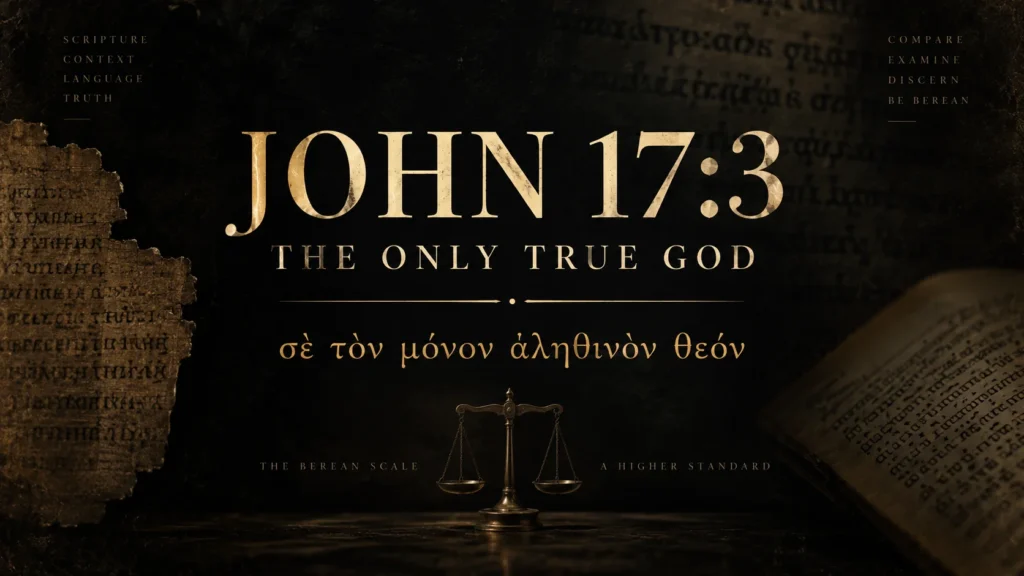
In John 17:3, Yeshua says:
A literal rendering of the verse is: “This is eternal life, that they may know You, the only true God, and Yeshua Messiah whom You have sent.”
The Greek phrase is: se ton monon alēthinon theon.
- se — You (the Father)
- ton monon — the only
- alēthinon — true
- theon — God
The grammar is clear about the immediate referent. The pronoun se (“You”) refers to the Father, and the phrase ton monon alēthinon theon (“the only true God”) is applied directly to Him. Yeshua then distinguishes Himself as “Yeshua Messiah whom You sent.” Whether this wording also excludes Yeshua from sharing divine identity is the theological question that must be argued from the wider context rather than assumed from the phrase alone.
Does “Only” Exclude Everyone Else?
The Greek adjective monos, appearing here as monon, is exclusive in ordinary usage. Yeshua addresses the Father as “the only true God” and then distinguishes Himself in the same sentence as Yeshua Messiah whom the Father sent. The immediate wording therefore places the designation “the only true God” directly upon the Father.
The debated question is what theological conclusion should be drawn from that exclusivity. The biblical-monotheist reading understands the statement straightforwardly: the Father alone is the one true God, while Yeshua is His Messiah and Son. Trinitarian interpreters argue that the Father can be called the only true God without excluding the Son from the one divine identity. That broader claim cannot be settled merely by defining monon; it has to be tested against the rest of John.
This is where the Shema and the wider biblical witness become important. Deuteronomy 6:4 establishes the foundational confession that Yahweh is one. Within a biblical-monotheist reading, John 17:3 fits naturally within that framework: the Father is identified as “the only true God,” while Yeshua is identified as the Messiah He sent. The debated question is how John’s wider presentation of Yeshua relates to that monotheism.
What About John 17:5? (The Glory Before the World)
We cannot cherry-pick verses. Just two verses later, Yeshua makes a massive claim.
In John 17:5, Yeshua prays: “Now, Father, glorify Me together with Yourself, with the glory which I had with You before the world was.”
John 17:5 strongly supports a reading in which Yeshua personally possessed glory with the Father before the world existed. That is the most straightforward reading of “the glory which I had with You before the world was.” Some interpreters understand the language proleptically—as glory ordained for Him beforehand—but that is an interpretive argument rather than the surface reading of the sentence.
As we examined in our John 8:58 study, existing before Abraham—or even before the world—is not the same claim as being Yahweh. Exaltation is not identity. Yeshua had glory with God, which maintains the distinction between them.
The Sender and the Sent
The immediate context of John 17 repeatedly presents Yeshua as receiving authority, work, words, and mission from the Father:
- The Father gave Him authority over all flesh (v. 2).
- Yeshua completed the work the Father gave Him to do (v. 4).
- The disciples belonged to the Father and were given to Yeshua (v. 6).
- Yeshua gave them the words the Father gave Him (v. 8).
- Yeshua repeatedly describes Himself as the one the Father sent (vv. 3, 8, 18, 21, 23, 25).
The pattern is difficult to miss. The Father is consistently presented as the source of the authority and mission Yeshua carries out. A biblical-agency reading understands this as genuine derived authority: Yahweh commissions His Messiah, and Yeshua faithfully accomplishes the work entrusted to Him. Whether that relationship is also compatible with an eternal shared divine essence is a further theological question rather than something the language of sending and giving explicitly states.
What About John 20:28? (“My Lord and My God”)
One of the strongest objections to this reading comes from the end of the same Gospel.
Thomas directly addresses Yeshua with the words “My Lord and my God” (ho kyrios mou kai ho theos mou). That language must be given its full weight. A biblical-agency reading points to passages where elohim or theos can be applied to figures other than Yahweh without identifying those figures as Yahweh Himself. John 10:34–36, where Yeshua appeals to Psalm 82, is relevant to that discussion. Trinitarian interpreters, however, understand Thomas’s confession as a direct identification of Yeshua with deity in the fullest sense.
John 20:28 therefore cannot simply be dismissed by appealing to agency. It must be weighed alongside John 17:3 and the Gospel’s wider presentation of the Father and the Son.
The Strongest Trinitarian Reading
A fair study must present the strongest opposing case. Trinitarian interpreters read John 17:3 within the Gospel’s broader Christology and understand the Father and the Son as distinct persons who share the one divine being. On that reading, calling the Father “the only true God” distinguishes Him from false gods without excluding the Son from the divine identity.
They appeal especially to texts such as John 1:1, John 17:5, and John 20:28. Because Yeshua speaks of glory He had with the Father before the world existed and Thomas directly addresses Him as “my God,” they argue that John’s Gospel does not permit “only true God” to be interpreted as a denial of the Son’s deity.
That is a serious theological synthesis and must be weighed fairly. But it remains important to distinguish that synthesis from the explicit wording of John 17:3 itself.
What the Text Explicitly Says
John 17 explicitly tells us several things:
- Yeshua is praying to the Father.
- Yeshua calls the Father “the only true God.”
- Yeshua calls Himself the Messiah whom the Father sent.
- The Father gave Yeshua His authority, works, and words.
- Yeshua speaks of the glory He had with the Father before the world existed.
We should let all of these statements carry their full weight without using one to erase another.
Reasonable Inference
Eternal life is described in relational terms: knowing the Father as the only true God and knowing Yeshua Messiah whom He sent. The verse therefore gives Yeshua an indispensable place in salvation while continuing to distinguish Him from the Father.
The most straightforward biblical-monotheist reading is that Yeshua identifies the Father as the one true God while identifying Himself as the Messiah sent by Him. Within the wider biblical witness, this coheres naturally with passages identifying the Father as the one God. Whether John intends the phrase to exclude Yeshua from divine identity altogether remains the central debated question.
The Berean Verdict
John 17:3 gives us unusually direct language. Yeshua is praying to the Father, and He addresses that Father as “the only true God.” In the same sentence, He distinguishes Himself as “Yeshua Messiah whom You have sent.” Those statements are explicit and should be allowed to stand exactly as written.
John 17 does not permit us to reduce Yeshua to an ordinary human messenger. Verse 5 speaks of glory He had with the Father before the world existed, and the chapter repeatedly presents Him as the uniquely commissioned Son through whom eternal life is given. Those claims must carry their full weight as well.
The biblical-monotheist reading therefore sees a consistent distinction: the Father is the only true God, while Yeshua is His uniquely exalted, commissioned Messiah and Son. Trinitarian interpreters argue that “only true God” identifies the Father without excluding the Son from the divine identity, appealing especially to the wider Johannine witness, including John 1:1, John 17:5, and John 20:28.
John 17:3 itself does not explicitly say that the Father and Yeshua are “one God,” “one being,” or “one essence.” Neither does the verse explain how John 20:28 should be integrated into its statement. Those conclusions require theological synthesis beyond the wording of this verse.
So we should not weaken John 17:5 to protect biblical monotheism, and we should not rewrite John 17:3 to protect a theological system. Put every statement on the scale. Test the words. Read the context. Compare Scripture with Scripture. And stop where the text stops. ⚖️📖
Discussion
4 Comments
Test the claim with Scripture. Address the text and the argument, not the person. Comments may be held for moderation.
Keep it Berean: cite the text when possible, make the argument clearly, and keep disagreement respectful.