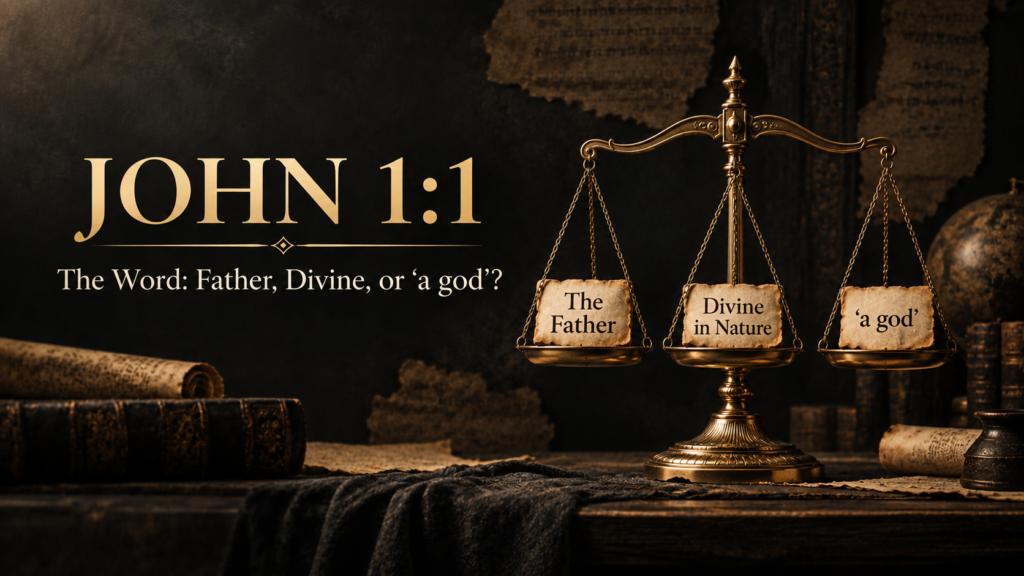
John’s opening sentence is among the most discussed lines in Scripture:
En archē ēn ho logos, kai ho logos ēn pros ton theon, kai theos ēn ho logos.
In sequence, the clauses read: “In the beginning was the Word”; “and the Word was with God”; “and the Word was God.” They belong together. The first concerns the Word’s existence, the second the Word’s relation to God, and the third what may be said about the Word. John presents the Word in an exceptionally elevated way. The question is whether he identifies the Word as the same person as the Father, describes the Word in an exceptionally strong divine category, or calls him a lesser divine being.
Read the whole prologue before isolating one clause
John 1:1–18 is the Gospel’s prologue. Its opening intentionally recalls Genesis: “in the beginning,” creation, life, light, and darkness (Genesis 1:1–5). John contrasts things that came to be with the Word, who already was when the beginning in view arrived.
The claim develops quickly. All things came to be through the Word, and nothing that has come to be came to be apart from him (John 1:3). The world came to be through him; the true light came into the world; some did not receive him, but those who did were given authority to become children of God (1:9–13).
Verse 14 prevents reducing the Logos to an impersonal utterance: “the Word became flesh and dwelt among us.” Verses 15–17 identify this manifestation with Yeshua Messiah. Verse 18 distinguishes the unseen God from the one who makes God known, the one in closest fellowship with the Father. There is a significant textual variant in verse 18: manuscripts support readings equivalent to “the unique Son” and “the unique God.” Either reading preserves distinction between the revealer and the Father.
The later Gospel maintains both distinction and exalted status. The Son does what he sees the Father doing and is to be honored as the Father is honored (John 5:19–23). He speaks of coming from God and returning to the Father (John 8:42; 16:27–28). In John 17:1–5, Yeshua addresses the Father as “you” while speaking of glory shared before the world existed.
The three Greek clauses of John 1:1
“In the beginning was the Word”
En archē ēn ho logos uses the imperfect verb ēn, “was.” John also uses forms of ginomai, “come to be” or “become,” for creation and for the Word becoming flesh. The contrast matters: when the beginning in view arrived, the Word already was. This strongly supports preexistence, though grammar alone does not provide a complete philosophical account of timelessness.
Logos can mean word, speech, message, account, or reason. Its range is too broad for one English gloss to settle John’s meaning. Jewish Wisdom traditions offer meaningful parallels: Wisdom is associated with God’s creative work and revelation (Proverbs 8:22–31; Wisdom of Solomon 7:22–27; 9:1–2). But overlapping themes do not prove that John directly borrowed from Wisdom literature, Philo, Stoicism, or the Targums.
“The Word was with God”
Pros ton theon is conventionally translated “with God.” Pros with the accusative can express movement toward, orientation, relation, or presence. Here “with God” is well supported, but it means more than physical nearness: it presents the Word in relation to God. A minority proposal renders it “Godward,” stressing orientation toward God. That cautions against a merely spatial reading, but “with God” remains the most broadly supported translation in this context.
This clause strongly weighs against one misunderstanding: reading the Word as simply the same person as the God with whom he was is difficult to reconcile with the sentence’s wording. Verse 2 repeats the point: “He was in the beginning with God.” Classical Trinitarian theology does not normally say that the Word is the Father; it distinguishes Father and Son while affirming one divine being or essence.
“The Word was God”
The final clause is kai theos ēn ho logos. The articular noun ho logos, “the Word,” is the grammatical subject. Theos, “God,” is the predicate nominative and appears before the verb. John is saying something about the Word; the clause is not naturally reversible as “God was the Word.”
The missing article before theos must be handled carefully. Greek has no indefinite article corresponding to English “a,” so an anarthrous noun does not automatically mean “a god.” Nor does article absence mechanically require the adjective “divine.” Word order, syntax, discourse, and context must be considered together.
Appeals to “Colwell’s rule” are often overstated. Colwell observed that definite predicate nominatives before the verb often lack the article; he did not prove that every preverbal anarthrous predicate is definite. Philip Harner’s influential analysis argued that many constructions of this kind are primarily qualitative. That is not a mechanical rule, but it fits this clause well: John emphasizes what the Word is.
What does theos ēn ho logos most likely mean?
The clauses make complementary claims: the Word already existed at the beginning, was in relation with God, and was theos. Thus “the Word was God” remains defensible, provided readers do not turn it into “the Word was the Father.” The second clause has already distinguished the Word from ton theon.
A qualitative explanation is especially fitting: the Word is characterized by what belongs to God. The paraphrase “what God was, the Word was” can clarify this, though it is interpretation rather than a replacement translation. Language about the Word sharing “divine identity” or “divine reality” is a theological paraphrase drawn from the clause in its wider canonical setting; it is not the lexical meaning of anarthrous theos by itself. “The Word was divine” may communicate the qualitative emphasis, but modern English can make “divine” sound merely heavenly, godlike, or semi-divine. The prologue calls for more than that reduced sense.
John 1:3 is central. Everything that came into being came into being through the Word. This creation-through language presents the Word in a mediating role, while the preceding clauses and the wider prologue strongly support distinction between the Word and God; John does not say that the Word and God are the same person. The passage strongly places the Word on the creator side of the contrast rather than among the things described as coming to be. Therefore, a created intermediary or lesser divine being is difficult to reconcile with the universal scope of “all things,” even though that conclusion is an inference from the syntax and context rather than a separately stated formula. Colossians 1:15–17 and Hebrews 1:1–4 offer important parallels, though each has its own argument.
The strongest alternative readings
The Word/Wisdom-personification reading deserves serious consideration. Logos can refer to God’s word, wisdom, reason, or self-expression, and Scripture can personify Wisdom. On this view, John poetically describes Yahweh’s creative self-expression and saving purpose becoming embodied in Yeshua. This properly resists importing later creedal formulas directly into John 1:1.
Its difficulty is the prologue’s accumulated portrayal. The Word is with God, is presented as the means through whom creation came to be, comes into the world, is rejected or received, becomes flesh, and makes God known. Masculine pronouns alone do not prove personal preexistence, since logos is grammatically masculine. Yet the sustained narrative agency makes a merely impersonal reading increasingly strained.
A non-Nicene high-Christology reading may affirm a personal, preexistent, uniquely divine agent distinct from Yahweh or the Father without claiming that John teaches the later formula of one essence and three persons. It accounts for the distinction of 1:1b, preexistence in 1:1a, and creative agency in 1:3. But it must still explain the force of theos and the Word’s placement on the creator side of John’s contrast.
The translation “the Word was a god” correctly recognizes that the Word is distinct from ton theon and that anarthrous predicates can sometimes be indefinite. But neither point establishes the conclusion. The absence of an article does not require “a”; the word order strongly favors qualitative force; and a lesser divine being fits poorly in a Jewish-monotheistic creation prologue where all created things came to be through the Word. This reading’s argument for distinction is stronger than its positive argument for an indefinite translation.
Textual and grammatical notes
The Greek text cited here follows the Society of Biblical Literature Greek New Testament, edited by Michael W. Holmes. In John 1:18, the SBLGNT reads monogenēs theos, “unique God,” while a significant manuscript tradition reads ho monogenēs huios, “the unique Son.” The variant matters for how explicitly verse 18 applies theos to the revealer, but neither reading erases the Father-revealer distinction in the verse.
For the grammatical discussion, see E. C. Colwell, “A Definite Rule for the Use of the Article in the Greek New Testament,” Journal of Biblical Literature 52 (1933): 12–21, and Philip B. Harner, “Qualitative Anarthrous Predicate Nouns: Mark 15:39 and John 1:1,” Journal of Biblical Literature 92 (1973): 75–87. Neither study supplies a mechanical rule that settles every anarthrous predicate noun. For the recent minority “Godward” proposal concerning pros ton theon, see the discussion published by Brill; it is a serious proposal but not the conventional reading.
What is explicit, inferred, and debated?
- Explicit: the Word already was in the beginning, was with God, was theos, was active in the coming-to-be of all things, became flesh, and makes the unseen God known.
- Reasonable inference: the Word is not the same person as the Father, because he is with God and reveals the Father. He is preexistent, uniquely active in creation, and described in an exceptionally elevated divine category.
- Reasonable inference: theos in John 1:1c is best understood qualitatively, affirming far more than merely godlike status while preserving the distinction in 1:1b.
- Debated synthesis: whether John’s language entails the full Nicene formulation of one divine essence subsisting in three distinct persons. John 1:1 is major evidence for that theology, but it does not use the terms Trinity, one essence, person, or hypostasis.
Berean verdict
John 1:1 does not naturally identify the Word as the same person as the Father. Pros ton theon strongly indicates a distinction and relation, and verse 2 reinforces it. But the third clause does not naturally reduce the Word to a merely exalted creature. Its grammar and the whole prologue most naturally present the Word as theos in an exceptionally strong divine sense.
“The Word was God” is therefore accurate when explained without collapsing the Word into the Father. “The Word was divine” can serve as an explanatory paraphrase, but may sound too weak in modern English. “The Word was a god” is grammatically possible in the abstract, yet neither required by the missing article nor persuasive within John’s creation-centered, Jewish-monotheistic context.
John presents Yeshua as the incarnate, preexistent Word: distinct from the Father and described in terms that place him uniquely on the creator side of the prologue’s contrast. Classical Trinitarian theology provides a coherent synthesis of these claims, but its later technical language should not be treated as though it appears explicitly in one Greek clause. For related Johannine questions, compare John 17:3 and the “only true God”, John 10:30 and Father-Son unity, and John 8:58. For further comparison of divine language applied to the Son while maintaining distinction from God, see Hebrews 1:8 and 1 Corinthians 8:6.
Discussion
1 Comment
Test the claim with Scripture. Address the text and the argument, not the person. Comments may be held for moderation.
Keep it Berean: cite the text when possible, make the argument clearly, and keep disagreement respectful.