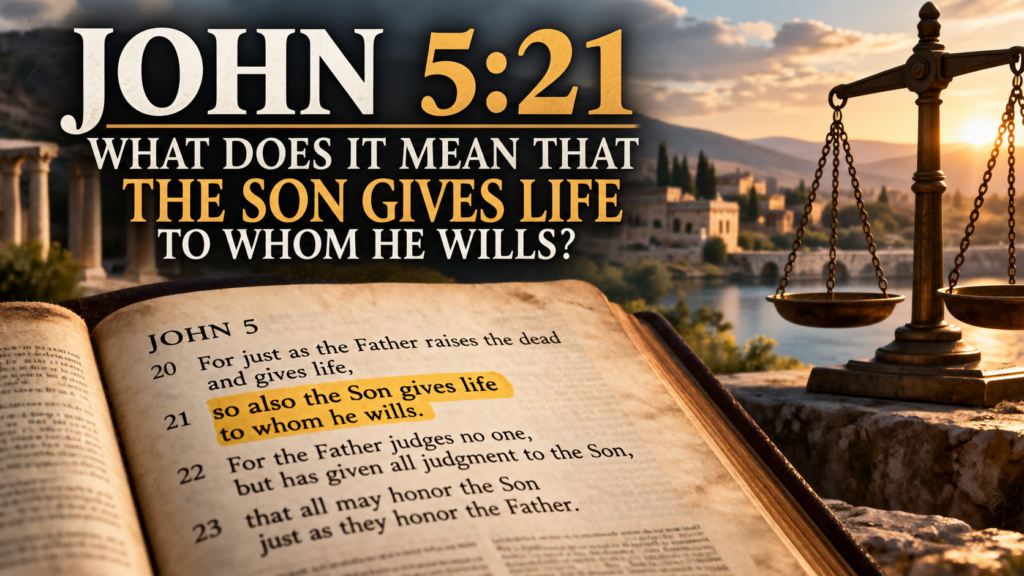
What does it mean that “the Son gives life to whom he wills”? In John 5:21, Yeshua is not presented as a passive channel who merely reports that Yahweh gives life. He personally gives life and personally wills the persons to whom he gives it. Yet the statement belongs to a discourse that repeatedly locates the Son’s action in his relationship with the Father: the Father shows, sends, and gives; the Son sees, does, gives life, judges, and carries out the Sender’s will. The verse therefore teaches real personal authority, but it does not authorize us to isolate that authority from the Father-Son relationship John immediately explains.
John 5:21 within John 5:19–30
The setting is Yeshua’s Sabbath healing and his declaration that his Father continues working. His answer in John 5:19–30 is not that he is a rival to the Father, nor that he is merely another religious teacher. It explains an exceptional relation between Father and Son. The opening claim holds two truths together: the Son cannot act “from himself,” yet whatever the Father does, the Son likewise does. A companion study examines that governing statement more closely: What does “the Son can do nothing by himself” mean?
The argument then unfolds in sequence. The Father loves the Son and shows him all that he does; greater works will follow (vv. 19–20). The first named work is giving life (v. 21). The Father has given judgment to the Son so that all may honor the Son as they honor the Father (vv. 22–23). Hearing the Son’s word and believing the Father who sent him brings present passage from death to life (vv. 24–25). The Father gave the Son to have life in himself and gave him authority to execute judgment (vv. 26–27). Finally, all in the tombs will hear the Son’s voice and come out (vv. 28–29). Verse 30 returns to the opening qualification: the Son does not seek his own will but the will of the One who sent him.
John 5:21 must be read inside that whole movement. It neither erases the Son’s genuine authority nor makes his life-giving work an action originating in separation from the Father.
What the verse explicitly says
“For just as the Father raises the dead and gives life, so also the Son gives life to whom he wills.”
Four claims are explicit. First, the Father raises the dead. Second, the Father gives life. Third, the Son likewise gives life. Fourth, the Son gives life to those whom he wills. The Greek verb zōopoiei means “gives life,” “makes alive,” or “causes to live.” It is present active indicative and is used of both Father and Son in the same sentence. John therefore draws a direct comparison between their life-giving activity.
The phrase hous thelei, “whom he wills” or “whom he wishes,” assigns willing to the Son. Hous identifies the persons who receive life; thelei is a present-tense verb with the Son as its subject. Grammatically, the Son is not an impersonal instrument. He truly wills and truly gives life.
But grammar also has limits. The phrase does not state that the Son’s will originates independently of the Father, that it could oppose the Father’s will, or that the Son’s authority has no received relation to the Father. Nor does John 5:21 itself call Yeshua Yahweh, define Father-Son ontology, say the Son possesses life independently of the Father, or say that “whom he wills” means autonomous action. Those conclusions must be argued, if at all, from the wider discourse and wider biblical synthesis.
“Just as … so also”: a strong correspondence
The construction hōsper gar … houtōs kai means “for just as … so also.” It is not a loose comparison: as the Father raises and gives life, so also the Son gives life. John is attributing to the Son a work that corresponds closely to the Father’s own work. Verse 19 has already stated the same pattern in broader terms: whatever the Father does, the Son likewise does.
That correspondence is extraordinary, but verse 19 also says that the Son cannot act aph’ heautou, “from himself” or “on his own.” The first statement concerns the Son’s action in relation to the Father; the second declares the comprehensive scope of the Son’s corresponding works. Neither clause should be used to cancel the other. The Father’s showing does not mean the Son does nothing. The Son’s doing whatever the Father does does not mean that John has identified Father and Son as the same person.
Verse 20 adds that the Father loves the Son and shows him all that he himself does. Life-giving is among the greater works that will cause amazement. Then verses 22, 26, and 27 repeatedly use the language of the Father’s gift: he gives all judgment to the Son, gives the Son to have life in himself, and gives him authority to execute judgment. These are not incidental qualifications; they are part of the same argument.
John 5:26 is especially decisive: just as the Father has life in himself, he gave the Son also to have life in himself. This strongly supports the conclusion that the Son’s life-giving capacity is received from the Father within the relationship described here. It does not say when that giving occurred or explain its metaphysical manner. Trinitarian readers may understand it as eternal filial relation, or as that relation expressed in the Son’s mission. Biblical-monotheist readers may understand it as uniquely granted messianic authority. The verse explicitly states the grant; it does not itself settle those accounts of the grant. See the focused discussion of what it means that the Father granted the Son life in himself.
Life now and resurrection later
The discourse develops verse 21 in two connected ways. In John 5:24–25, the person who hears Yeshua’s word and believes the One who sent him has eternal life and has passed from death to life. The hour is “coming and now is”: the dead hear the Son’s voice and live. In this immediate setting, John speaks of a present reality—eternal life received through hearing the Son and believing the Father who sent him. The life-giving work cannot be reduced to a future event only.
John 5:28–29 then speaks differently: an hour is coming when all who are in the tombs will hear his voice and come out, some to resurrection of life and some to resurrection of judgment. This is explicitly future and bodily in scope. The literary connection matters. The voice that presently brings people from death to life will finally summon every person from the tombs. John presents these as linked dimensions of the Son’s life-giving authority, not unrelated powers.
Other passages reinforce the pattern. In John 6, Yeshua promises to raise believers on the last day, while eternal life is already the possession of those who believe. In John 11:25–26, he identifies himself as the resurrection and the life. Interpreters may debate whether John 5:21 initially emphasizes spiritual vivification or bodily resurrection, but the following verses develop both. The broad meaning of zōopoiei should not be artificially narrowed to one dimension.
Life from the Father through the Son
John’s Gospel consistently gives Yeshua an exceptional personal role in eternal life. Life is associated with the Word in John 1:4. Yeshua gives water that becomes a spring leading to eternal life (4:14), gives eternal life to his sheep (10:27–28), and grants eternal life under authority given by the Father (17:2–3). John’s stated purpose is that readers may believe Yeshua is the Messiah, the Son of God, and have life in his name (20:31).
At the same time, the Gospel repeatedly preserves the Father-Son order. The Father loves the Son and has given all things into his hand (3:35). The Father draws people, and the Son raises believers on the last day (6:40, 44, 54). In John 17:2, the Father gives the Son authority over all flesh so that the Son may give eternal life to all whom the Father has given him. That is an important parallel: received authority and authentic personal exercise of authority are not opposites.
John also controls any reading of “whom he wills” that implies competing autonomy. In 5:30, Yeshua says he does not seek his own will but the will of the One who sent him. In 6:38, he came down from heaven not to do his own will but the Sender’s will. In 8:28–29, he does nothing from himself but speaks what the Father taught him; in 12:49–50, the Father gave him a command concerning what to say. These texts portray profound and perfect alignment, not a Son acting in opposition to the Father. They do not make the Son’s willing unreal; they define its relation to the Father’s will.
Yahweh’s life-giving work and the Tanakh background
The Tanakh provides weighty theological background. Yahweh declares, “I kill and I make alive” in Deuteronomy 32:39. Hannah says that Yahweh brings down to Sheol and raises up (1 Samuel 2:6). The king of Israel’s reaction in 2 Kings 5:7 likewise reflects the conviction that ultimate power over life belongs to God. Isaiah 26:19 anticipates the dead living, and Daniel 12:2 foresees those sleeping in the dust awakening to divergent outcomes. Ezekiel 37 supplies powerful resurrection imagery, although its immediate vision concerns Israel’s restoration.
John 5:21 does not directly quote these passages, and it should not be claimed that every life-giving text is a direct allusion. Still, they form the scriptural world in which raising the dead and making alive are marks of Yahweh’s unique sovereignty. In that setting, John’s ascription of life-giving authority to Yeshua—and of a future universal resurrection at his voice—is theologically momentous. It reasonably supports the inference that Yeshua exercises a divine prerogative. The further claim that this necessarily proves Yeshua is Yahweh himself is a larger Christological conclusion, not a sentence found in verse 21.
The strongest high-Christology reading
A Trinitarian or high-Christology reading rightly insists that John 5 cannot be reduced to generic agency. The Son does whatever the Father does; he personally gives life to whom he wills; the Father gives all judgment to him; and all are to honor the Son just as they honor the Father. His own voice gives life now and will call all the dead from their tombs. John 5:26 then says that the Son has life in himself in a “just as … so also” correspondence with the Father’s life in himself.
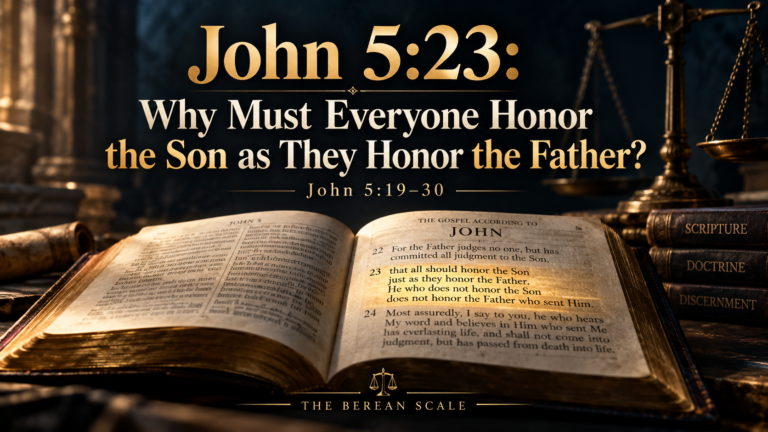
Read alongside the Tanakh’s association of life and resurrection with Yahweh, these claims carry unusual force. This reading concludes that the Son is uniquely included within the divine identity while remaining personally distinct from the Father. The Father’s giving and sending do not, on this account, indicate creaturehood; they may express eternal filial relation and/or the Father-Son relation as displayed in the Son’s saving mission. The demand for honor is particularly important; explore its full context in John 5:23 and honoring the Son as the Father.
This case is a cumulative inference, not a claim that verse 21 alone uses later terms such as “one essence.” It properly challenges any interpretation that makes Yeshua merely an ordinary prophet. A prophet may announce Yahweh’s life-giving work, but John says far more: the Son himself gives life, judges, possesses life in himself by the Father’s grant, receives required honor, and summons the universal resurrection.
The strongest delegated-authority reading
The biblical-monotheist or delegated-authority reading also rests on explicit features of the discourse. The Son cannot act from himself; the Father shows him what he does; the Father gives judgment, life in himself, and authority to judge; the Father sends the Son; and the Son seeks the Sender’s will. The discourse therefore repeatedly presents the Father as the giver, sender, and source of the authority the Son exercises.
On this reading, “whom he wills” expresses genuine personal authority exercised within the Father’s will, revelation, and commission. John 17:2 shows precisely this pattern: Father-given authority over all flesh is truly exercised by the Son in giving eternal life. Personal volition need not mean self-originating authority apart from the Father. John 5:30 and 6:38 directly oppose treating the Son’s will as an independent rival to the Father’s.
This reading has its own serious burden. It must not describe Yeshua’s role as ordinary, temporary, or impersonal. The Son does not merely request that Yahweh raise the dead. He does what the Father does, gives life, has life in himself through the Father’s grant, judges, receives universal honor, and calls every dead person from the tomb. Whether this unparalleled received authority is compatible with full ontological equality, or instead indicates a distinct subordinate being, cannot be decided by thelei alone.
Berean verdict
What the text explicitly establishes: the Father raises the dead and gives life; the Son likewise gives life to whom he wills; the Father gave the Son life in himself and authority to judge; the Son does not act from himself but seeks the Sender’s will; and the Son’s voice brings present life and will summon those in the tombs.
What reasonably follows: Yeshua possesses real personal volition and extraordinary life-giving authority. His work corresponds profoundly to the Father’s work, and the Tanakh background makes that attribution weighty. He cannot faithfully be reduced to an ordinary messenger.
What remains debated: whether this correspondence entails shared divine essence or uniquely exalted received authority; and whether the Father’s grant in verse 26 describes eternal generation, messianic commissioning, or another filial relation.
Therefore, “the Son gives life to whom he wills” means that Yeshua personally and authoritatively gives life to the persons he wills. The phrase conveys real volition, not passive instrumentality. Yet John’s own context simultaneously places this authority within the Son’s reception from, dependence upon, and perfect alignment with the Father. John 5:21 establishes unique life-giving authority and profound Father-Son correspondence. By itself, it does not say that Yeshua is Yahweh, define ontological equality, claim life independent of the Father, or portray the Son’s will as autonomous opposition. Those are conclusions of broader Christological synthesis, where competing systems begin rather than where this verse ends.
Discussion
Join the Discussion
Test the claim with Scripture. Address the text and the argument, not the person. Comments may be held for moderation.
Keep it Berean: cite the text when possible, make the argument clearly, and keep disagreement respectful.