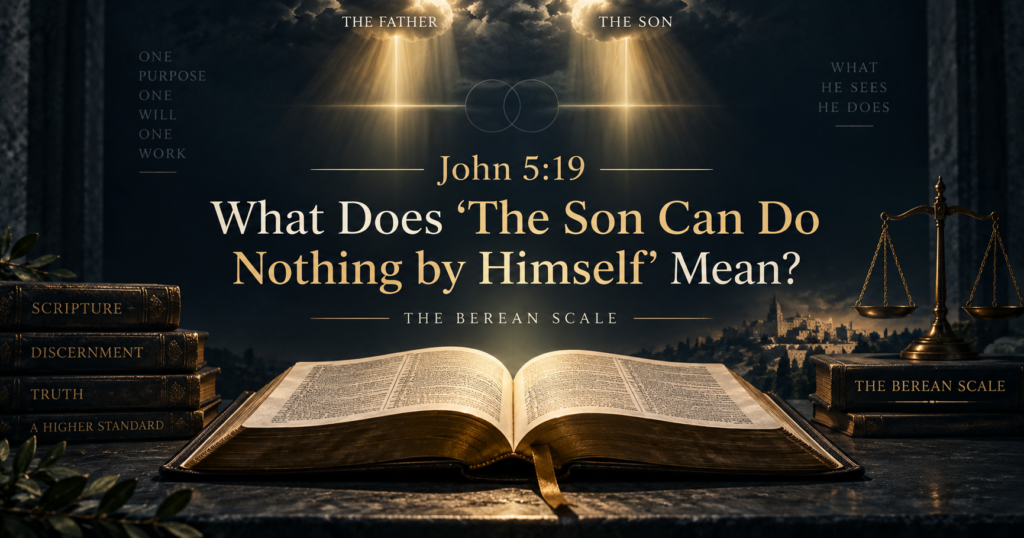
Does Yeshua’s statement that “the Son can do nothing by himself” portray limitation, perfect unity with the Father, or both? John 5:16–30 requires both sides to remain in view. Yeshua explicitly denies acting independently of the Father, yet immediately claims an extraordinary correspondence with the Father’s works. The discourse gives the Son authority to give life, execute judgment, summon the dead, and receive honor corresponding to the honor given the Father.
John 5:19 therefore does not support an autonomous Son acting alongside Yahweh as a rival. Neither does it reduce the Son to an ordinary prophet performing occasional delegated signs. The Father shows, gives, sends, and wills; the Son sees, receives, hears, acts, judges, and seeks the Sender’s will. Yet that real asymmetry stands alongside claims of exceptional scope.
The Sabbath controversy sets the question
The discourse begins with Yeshua’s Sabbath healing. His opponents persecute him for doing these things on the Sabbath (John 5:16). His reply is striking: “My Father is working until now, and I am working” (v. 17). He grounds his work in the Father’s continuing work. The immediate issue is whether Yeshua’s work may correspond directly to the Father’s work, even on the Sabbath.
John 5:18 reports why the opposition intensified: Yeshua was calling God his own Father, “making himself equal with God.” Care is needed. This is not a direct quotation in which Yeshua says, “I am equal with God,” but John’s narration of why his opponents sought to kill him. One should not dismiss it as a wholly false accusation; neither should verse 18 alone settle every later doctrinal question. Yeshua’s response in verses 19–30 supplies the terms by which the claim must be weighed.
His response does not repeat the word “equal.” Instead, it describes Father and Son through seeing and being shown, giving and receiving, sending and being sent, hearing and judging, willing and obeying. The answer both intensifies and qualifies the controversy: Yeshua’s works are inseparably related to the Father’s work, but they do not originate as independent action.
John 5:19 makes two coordinated claims
In close translation, verse 19 says: “The Son is not able to do anything from himself, unless he sees the Father doing something; for whatever that one does, these things the Son likewise does.” The first clause is ou dynatai … poiein aph’ heautou ouden: the Son “is not able … to do anything from himself.” Aph’ heautou, “from himself,” excludes action undertaken from an independent source or initiative.
This is no minor disclaimer. John 5:30 repeats it nearly verbatim: “I can do nothing from myself.” Yeshua judges “as I hear,” and his judgment is just because he seeks not his own will but the will of the One who sent him. In context, “from myself” concerns judgment, hearing, purpose, and the Sender’s will. The Son’s non-independence is explicit.
Grammar alone, however, does not tell us why the Son cannot act from himself. The negated verb establishes inability to act independently, but not whether its cause is creaturely deficiency, the obedience of the incarnate Messiah, an eternal Father-Son relation, or what later Trinitarian theology calls inseparable operations. Such explanations must be argued from wider context, not inserted into one verb.
The Son acts only as he “sees” the Father acting. Blepē connects the Son’s work to the Father’s, but the verse does not define the mode of seeing. It may be revelatory perception, perfect filial knowledge, or language of observing and enacting the Father’s purpose. It should not be forced into a merely visual, temporal sequence.
The second half must carry equal weight: ha gar an ekeinos poiē, tauta kai ho huios homoiōs poiei, “whatever that one does, these things the Son also does likewise.” “Whatever” is expansive, and homoiōs means “likewise” or “in the same way.” The Son does not merely receive isolated assignments; he does what the Father does in genuine, comprehensive correspondence.
Yet “whatever” and “likewise” are not technical philosophical terms for “one essence.” They do not, by grammar alone, state the later Nicene term homoousios or explain every distinction between Father and Son. They do establish that ordinary prophetic agency is too small a category if it means only occasional miracles at divine command. The following verses explain the correspondence through life, judgment, and honor.
The works of life, judgment, and honor
Verse 20 says that the Father loves the Son, shows him all that he does, and will show greater works that cause the hearers to marvel. The Father’s showing is part of the source-and-reception pattern: the Father reveals his works to the Son, and the Son carries them out.
Verse 21 develops this through comparison: “Just as the Father raises the dead and gives them life, so also the Son gives life to whom he wishes.” The Greek pattern hōsper … houtōs kai establishes deliberate correspondence, not loose resemblance. Raising the dead and giving life are works closely associated with Yahweh’s authority in Israel’s Scriptures. John places the Son’s life-giving action directly alongside the Father’s.
The Son’s statement that he gives life “to whom he wishes” cannot erase verses 19 and 30. It does not portray a competing will against the Father. The discourse has denied action “from himself” and closes by saying that Yeshua seeks the Sender’s will. It holds together true Sonly action and complete Father-directedness, not passivity or autonomy.
Verses 22–23 add judgment and honor. The Father has given all judgment to the Son, “so that all may honor the Son just as they honor the Father.” Here kathōs, “just as,” demands real correspondence. Honor to the Son is not optional representative respect, for whoever does not honor the Son does not honor the Father who sent him.
The wording does not identify Father and Son as the same person. The Father gives judgment; the Son executes it. The Father sends; the Son is sent. But honor of the Son is inseparably tied to honor of the Father. Whether this requires identical worship, equal honor of distinct divine persons, or honor of the Father through his uniquely authorized Son remains disputed. The explicit point is firmer: one cannot claim to honor the Father while withholding the honor John 5 requires for the Son.
Life in himself and the Son’s just judgment
John 5:24–30 completes the argument. Those who hear Yeshua’s word and believe the One who sent him already have eternal life. The dead will hear the voice of the Son of God and live (v. 25). Verses 28–29 widen the horizon: all in the tombs will hear his voice and come out, some to resurrection of life and others to resurrection of judgment. The Son’s authority is not confined to healing one man on the Sabbath; his voice has a universal resurrection role.
Verse 26 offers another balanced comparison: “Just as the Father has life in himself, so he gave the Son also to have life in himself.” The Son possesses life “in himself,” while the verse explicitly says the Father gave this to him. It joins a remarkable comparison with real Father-to-Son giving.
The verse does not state when this giving occurred. Trinitarian interpreters may understand eternal communication of life within the Father-Son relation; others connect it with Messiah’s mission or incarnate office. Neither conclusion follows directly from the grammar. The verse plainly excludes both a self-originating Son detached from the Father and a merely ordinary man with no exceptional life-giving authority.
Verse 27 says the Father gave the Son authority to execute judgment because he is Son of Man. The title may evoke Daniel 7’s humanlike ruler receiving dominion, though the phrase alone does not settle that connection. Verse 30 returns to the controlling principle: Yeshua judges as he hears, does nothing from himself, and seeks the Sender’s will. His dependence is not an embarrassment to explain away; it is why his judgment is just.
A recurring Johannine pattern
John 5 is not isolated. Yeshua says his teaching belongs to the One who sent him and seeks the Sender’s glory (John 7:16–18). He does nothing from himself but speaks as the Father taught him, always doing what pleases the Father (8:28–29). In John 12:49–50, the Father gives him command concerning what to say; John 14:10 says his words are not spoken “from myself,” while the Father abiding in him does his works.
This pattern prevents treating Father-source and Son-reception language as empty rhetoric. John 14:28, “the Father is greater than I,” and John 20:17, where the risen Yeshua speaks of “my God,” preserve an asymmetry that cannot be ignored. They do not provide a complete ontology, but they warn against converting unity into personal identity or total symmetry. For a closer treatment, see what “the Father is greater than I” means in John 14:28.
Other Johannine texts raise the level at which John 5 must be synthesized. John 1:1–3 distinguishes the Word from God while speaking of the Word in exalted terms; John 17:5 speaks of glory with the Father before the world existed; and Thomas addresses the risen Yeshua as “my Lord and my God” in John 20:28. These cannot bypass John 5’s dependence language, nor may John 5 neutralize them. See the focused studies on John 1:1 and Thomas’s confession in John 20:28.
The strongest competing readings
The strongest Trinitarian reading argues that “the Son can do nothing from himself” is not inability caused by inferiority, but the impossibility of independent or contrary action within the eternal relation of Father and Son. The Son does whatever the Father does; he gives life, judges all, possesses life in himself, and receives honor corresponding to the Father’s honor. The Father’s showing and giving express ordered personal relations, not a difference in divine essence or evidence that the Son is a creature.
This reading gains support when John 5 is read with John 1:1–3, John 10:30, John 17:5, John 20:28, Philippians 2:6–11, and Hebrews 1. It can say that high Son-language and Father-Son distinction coexist in the New Testament. Yet John 5 itself does not use “one essence,” “eternal generation,” or “inseparable operations.” These are theological syntheses, not direct translations of individual phrases. Nor may a Trinitarian reading collapse Father and Son into one person. For the related question of unity in John 10:30, see this study of “I and the Father are one.”
The strongest Father-alone or divine-agency reading begins with the discourse’s repeated direction. The Father works, loves, shows, gives judgment, gives life in himself, gives authority, sends, and possesses the will the Son seeks. The Son sees, receives, hears, judges accordingly, and does not seek his own will. On this reading, Yeshua is Yahweh’s incomparable, uniquely authorized Messiah. He exercises genuine life-giving and judicial authority, but as authority received from the Father rather than as an independent equal.
This reading rightly refuses to minimize the Father-source pattern and fits Paul’s distinction between the one God, the Father, “from whom are all things,” and the one Lord, Yeshua Messiah, “through whom are all things” (1 Corinthians 8:6), though Paul does not settle John 5 by himself. But it must give full force to “whatever the Father does,” the Son’s giving life to whom he wishes, the universal resurrection summons, and honor of the Son as the Father is honored. Calling Yeshua merely a human prophet does not represent this discourse adequately.
What John 5 establishes—and what it does not
John 5 explicitly says that the Son does nothing from himself; the Father shows, gives, and sends; the Son gives life, executes judgment, and summons the dead; and all must honor the Son just as they honor the Father. It also distinguishes Father and Son as interacting subjects rather than identifying them as the same person.
A strong contextual inference follows: John excludes autonomous rivalry with the Father while presenting a Father-Son relationship far beyond normal discipleship. Dependence and extraordinary authority are not competing details but the argument’s inseparable emphases.
What remains debated is the full theological account: whether the Father’s giving in verse 26 refers to eternal generation, messianic commission, incarnation, or more than one dimension; whether correspondence of works entails equality of essence; and whether verse 23 requires later formulations about identical worship. These questions matter, but neither half of John 5:19 may be silenced.
Berean verdict: neither independent nor ordinary
John 5:19 means that Yeshua does not act independently from the Father. John 5:30 confirms that this includes hearing, judging, and seeking the will of the One who sent him. Read plainly, the passage teaches real Father-Son asymmetry.
Yet the same discourse assigns the Son unparalleled correspondence with the Father’s works: he gives life, calls all the dead from their tombs, executes universal judgment, has life in himself by the Father’s gift, and must be honored in correspondence with the Father. A simplistic inferiority reading isolates verse 19a. A simplistic equality reading minimizes the Father’s showing, giving, sending, and will.
The text stops short of later technical formulas while demanding more than low Christology. John 5 presents Yeshua as neither an autonomous rival to Yahweh nor an ordinary agent. He is the Father’s uniquely authorized Son, acting in complete dependence on the Father within the relationship and mission described in this passage, whose works and honor are bound to the Father’s in a way John describes with remarkable force.
Discussion
Join the Discussion
Test the claim with Scripture. Address the text and the argument, not the person. Comments may be held for moderation.
Keep it Berean: cite the text when possible, make the argument clearly, and keep disagreement respectful.