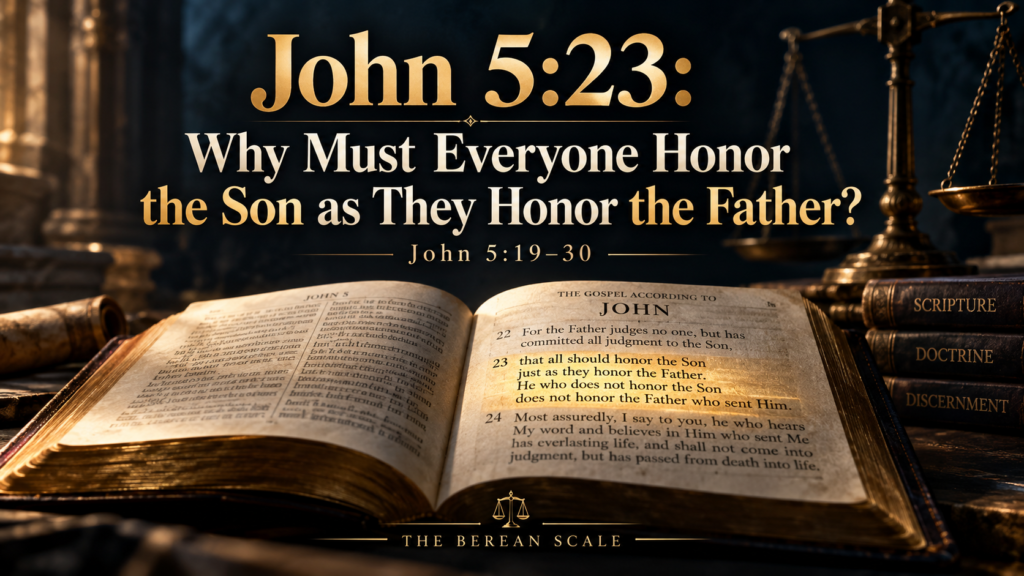
John 5:23 belongs to Yeshua’s answer after a Sabbath healing and the dispute that followed it (John 5:16–18). His opponents understood his reference to God as his own Father as making a claim to equality with God. That reaction matters as narrative context, but it must not replace Yeshua’s own explanation in verses 19–30. The discourse both heightens the Son’s status and repeatedly distinguishes him from the Father.
The central claim is striking: “The Father judges no one, but He has given all judgment to the Son, so that all will honor the Son even as they honor the Father” (John 5:22–23, NASB 1995). Why must all honor the Son in this manner? John’s immediate answer is not simply, “because the Son is honored.” The Father has entrusted His life-giving and final-judgment work to the Son. Yet the same paragraph says the Son does not act from himself, receives from the Father, and seeks the will of the One who sent him. John 5 therefore requires exceptionally high honor for the Son without presenting him as an independent rival to the Father.
The one argument of John 5:19–30
The paragraph moves in a deliberate sequence. The Son does what he sees the Father doing (vv. 19–20). The Father raises the dead and gives life, and the Son gives life to whom he wills (v. 21). The Father gives all judgment to the Son, so that all may honor the Son as they honor the Father (vv. 22–23). Hearing the Son and believing the One who sent him brings eternal life (v. 24). The dead hear the voice of the Son of God and live (v. 25). The Father gives the Son to have life in himself and gives him authority to execute judgment because he is Son of Man (vv. 26–27). Finally, all in the tombs hear his voice and come forth, either to life or judgment (vv. 28–29). The unit closes as it began: Yeshua can do nothing from himself, but judges according to what he hears and seeks the will of the One who sent him (v. 30).
This structure prevents two opposite mistakes. First, “the Son can do nothing from Himself” does not describe a powerless or ordinary figure. Its immediate explanation is that “whatever the Father does, these things the Son also does in the same way” (v. 19). The works under discussion include giving life and executing final judgment. Second, the Son’s extraordinary works do not erase the Father–Son relation. The Father loves the Son, shows him His works, gives judgment, gives life-in-himself, grants authority, and sends him. The Son acts in complete correspondence with the Father, not independently from Him. For a closer examination of that framing statement, see What “the Son Can Do Nothing by Himself” means in John 5:19.
Thus John does not set before us two competing gods, nor does he reduce Yeshua to a messenger who may be ignored without consequence. The Father’s own work is being enacted through His Son, and the Father has made response to that Son decisive.
What John 5:22–23 directly says
The immediate syntax is important. Verse 22 says that the Father “has given all judgment to the Son.” Verse 23 begins with hina, “so that” or “in order that”: “so that all will honor the Son even as they honor the Father.” The most natural reading is that the purpose clause explains the preceding grant of judgment. The Father has assigned final judgment to the Son so that all may honor the Son.
This does not mean judgment is merely a public-relations device. In verses 21–29, judgment belongs with resurrection, life, and the final division between those raised to life and those raised to judgment. When the Son publicly exercises this authority, his God-given place in Yahweh’s saving and judicial work is revealed to all. The intended honor is therefore not optional courtesy offered to a respected teacher.
The scope is also universal. John uses pantes, “all,” and supplies no qualifier limiting the honor to a temporary ceremony, private devotion, or a narrow sphere of religious practice. The following sentence is equally decisive: “He who does not honor the Son does not honor the Father who sent Him.” No one may claim to honor the Father while rejecting the Son whom the Father sent and appointed. In John’s argument, rejection of Yeshua is not faithfulness to God by another route; it is dishonor toward the Father Himself.
At the same time, “the Father judges no one” should be read in its discourse setting. John’s emphatic point is that the Father has entrusted all judgment to the Son. It should not be used to cancel every other biblical statement that speaks of God judging. John 5 assigns final judgment to the Son with unmistakable force; it does not invite us to flatten the Bible’s wider language about divine judgment.
Honor “just as”: what the Greek requires
John 5:23 reads, hina pantes timōsin ton huion kathōs timōsin ton patera: “so that all may honor the Son just as they honor the Father.” The verb timaō means to honor—to treat as weighty, valuable, and worthy of due recognition. It should not be reduced to politeness. Yet the verse does not use the usual Greek terms often translated “worship,” such as proskyneō or latreuō. The weight of the honor comes from its context: universal resurrection, life-giving, final judgment, and the refusal-to-honor-Son/refusal-to-honor-Father warning.
Kathōs means “just as,” “as,” or “according as.” The same verb governs both objects: all are to honor the Son kathōs they honor the Father. This is a real, direct correspondence. It does not naturally mean “honor the Son in some faintly similar way.” A reading that makes the Son’s honor lesser, optional, or merely ceremonial does not fit the grammar or the surrounding claims.
But kathōs does not itself say “the same person,” “the same essence,” or “identical deity.” Those terms are not hidden in the conjunction. The basis of the correspondence must be argued from the whole passage. John 17:22–23 is a useful caution: Yeshua prays that his disciples may be one kathōs he and the Father are one. The comparison is profound and real, but the grammar alone does not define the precise ontology of everyone compared. Likewise, John 5:23 requires corresponding honor; it does not, by the word kathōs alone, settle every later metaphysical question.
The repeated giving language must also remain in view. The Father dedōken, “has given,” all judgment to the Son (v. 22). He edōken, “gave,” the Son to have life in himself (v. 26), and gave him authority to execute judgment (v. 27). These verbs plainly describe the Father as giver. They do not specify when or how these grants relate to the Son’s preexistence or nature. But neither may they be treated as empty wording because they complicate a preferred theological system.
Verse 26 is especially weighty. Just as the Father has life in Himself, He gave the Son also to have life in himself. The Son is not portrayed as merely receiving moment-by-moment biological life from outside himself; he has life “in himself.” Still, John explicitly attributes that possession to the Father’s gift. Verse 27 adds that authority to judge is given “because He is the Son of Man.” This likely belongs to Yeshua’s messianic vocation and may recall Daniel 7:13–14, where the human-like Son of Man receives dominion from the Ancient of Days. That background is plausible, not an explicit quotation in John 5.
The strongest high-Christology reading
The Trinitarian reading has substantial textual force. In Israel’s Scriptures, giving life, raising the dead, and executing final judgment belong to Yahweh’s rule. John gives these works to the Son: he does whatever the Father does; he gives life to whom he wills; all who are in the tombs hear his voice; and all must honor him as they honor the Father. The cumulative case is stronger than a claim about one Greek word. It is difficult to regard such universal and unqualified honor, attached to divine-scale works, as the honor due merely to an elevated creature.
On this reading, the Father’s showing, giving, and sending do not imply that the Son is created. They express the ordered Father–Son relation and the Son’s mission. The Father is the source and sender; the Son perfectly shares, reveals, and accomplishes the Father’s life-giving work. John 10:30–36 similarly joins strong unity language—“I and the Father are one”—with Yeshua’s description of himself as the one sanctified and sent by the Father. Unity and mission coexist; neither statement should be used to silence the other. See also the study of John 10:30.
Philippians 2:9–11 and Hebrews 1 are relevant canonical comparisons. Philippians combines God’s exaltation of Yeshua, universal confession of him as Lord, and glory to God the Father. Hebrews 1 makes exceptionally high claims concerning the Son while also speaking of “God, Your God.” These passages do not duplicate John 5’s argument, but they show that early Christian writings could hold together universal homage, extraordinary claims about the Son, and an ordered relation to the Father.
The limitation is equally important. John 5 does not explicitly say, “the Son is Yahweh,” “the Son is the Father,” “the Son has the same essence as the Father,” or “the Son is uncreated.” Those may be conclusions within a broader Trinitarian synthesis, but they are not the direct vocabulary of this paragraph. The Father-to-Son grants are part of John’s presentation, not details to be explained away.
The strongest delegated-authority reading
The biblical-agency reading begins with language John himself emphasizes. The Father loves and shows the Son (v. 20), gives him judgment (v. 22), gives him life in himself (v. 26), gives authority to judge (v. 27), and sends him (vv. 23–24, 30). The Son does not act from himself and seeks the Sender’s will (vv. 19, 30). On this reading, Yahweh has appointed Yeshua as His definitive eschatological agent. Because the Son perfectly bears out the Father’s will and authority, honoring the Son honors the Sender; dishonoring him dishonors the Sender.
John elsewhere supplies this representative pattern. In John 13:20, receiving one sent by Yeshua is receiving Yeshua, and receiving Yeshua is receiving the One who sent him. John 12:44–50 likewise ties believing and seeing Yeshua to believing and seeing the One who sent him. Such texts show that sender and sent one are not competitors. The Father is honored through the Son He has authorized.
This reading rightly refuses to make the Father’s grants superficial. Psalm 2 and Psalm 110:1 provide categories of a royal Messiah receiving authority from Yahweh. Daniel 7 provides the stronger possible background of the Son of Man receiving everlasting dominion, glory, and service from the Ancient of Days. Yet these comparisons are illuminating inferences, not texts explicitly cited by John 5.
Its weakness appears if “agency” is made a minimizing label. Ordinary agency analogies do not adequately explain the full scope of John 5: the Son does whatever the Father does, gives life to whom he wills, has life in himself, raises every dead person by his voice, and receives honor corresponding to the Father’s honor. John does not permit Yeshua to be treated as a replaceable prophet or merely honored human representative. He is the Father’s unique Son and the decisive bearer of the Father’s life-giving and judicial work.
Wider Johannine balance
John 8:28–29 closely parallels John 5: Yeshua says he does nothing from himself but speaks as the Father taught him, while the One who sent him remains with him. John 14:28, “the Father is greater than I,” likewise contributes to the Gospel’s real asymmetry. It cannot, however, cancel John 5’s declarations about the Son’s works, judgment, resurrection, and required honor. For its immediate setting and scope, see What “the Father Is Greater Than I” means.
John 17:1–3 is also essential. The Father is addressed as “the only true God,” and Yeshua is identified as the Messiah sent by Him. This confirms personal distinction and mission. It does not authorize rejection of the Son, since John 5 makes honoring the Father inseparable from honoring the Son. The Gospel’s witness must be read together: the Father is the sender and ultimate source; the Son is His uniquely authorized, life-giving, judging self-revelation.
First Corinthians 15:24–28 similarly describes eschatological order: the Messiah reigns until all things are subjected, and the Son is then subjected to the One who subjected all things to him. This is not a direct commentary on John 5:23, but it reinforces the importance of preserving Father–Son distinction when describing the Son’s exalted reign.
Berean verdict
John 5 explicitly establishes that the Father gives the Son all judgment; all must honor the Son just as they honor the Father; dishonoring the Son dishonors the Father who sent him; the Son gives life, raises the dead, and judges humanity; and the Son does not act independently from the Father but fulfills the Sender’s will.
A reasonable inference is that the purpose clause in verse 23 most directly explains the delegation in verse 22. The Father has made the Son the public and final judge so that all recognize and honor the Son’s uniquely exalted role. This is far beyond routine respect for an emissary.
What remains debated is whether this corresponding honor necessarily entails shared divine essence, how the Father’s grant of life-in-himself relates to the Son’s eternal status or earthly mission, and whether Daniel 7 is John 5:27’s intended background. Those conclusions require broader synthesis; they do not arise from kathōs alone.
Why, then, must everyone honor the Son as they honor the Father? Because the Father has entrusted His own life-giving and final-judgment work to the Son and has made honoring this sent Son inseparable from honoring Himself. John 5 presents an exceptionally high Christology while preserving the Father as the One who gives, sends, and whose will the Son perfectly fulfills. A low reading that reduces Yeshua to an ordinary agent fails the passage. So does a reading that ignores its stated Father–Son order.
Discussion
1 Comment
Test the claim with Scripture. Address the text and the argument, not the person. Comments may be held for moderation.
Keep it Berean: cite the text when possible, make the argument clearly, and keep disagreement respectful.