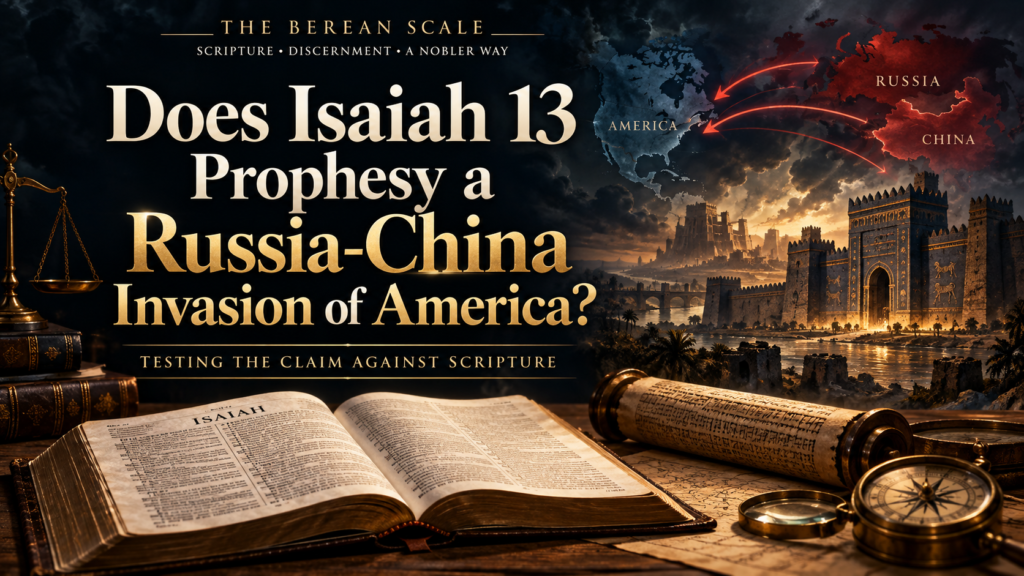
This review examines “Enemy At The Gates – December 9, 2019,” published by The Master’s Voice Prophecy Blog and associated with Celestial. The title presents December 9, 2019 as the date of the claimed message, while the page URL reflects publication on December 18, 2019. Those are not the same claim and should not be treated as such.
The source presents an alarming interpretation of Isaiah 13. It identifies Isaiah’s Babylon with “Mystery Babylon,” understood as America, and foresees a sudden Russia-China-led attack involving covert positioning, cyber access, technological targeting, fire, nuclear destruction, captivity, and exile. It speaks in the form of direct divine speech and attributes the message to the Lord Jesus Christ.
The question is not whether Yahweh judges pride, violence, idolatry, and national arrogance. Scripture plainly teaches that he does. Nor is it whether China and Russia pose real military, intelligence, nuclear, and cyber-security concerns. They do. The narrower question is whether Isaiah 13 itself identifies America as Babylon, identifies Russia and China as the attackers, or foretells the source’s detailed invasion scenario. A vivid warning should not be dismissed merely because it is disturbing; neither should it be accepted as divine revelation merely because it is vivid.
Isaiah 13 identifies Babylon, not an unnamed modern nation
The controlling statement appears at the opening: Isaiah 13:1 calls the chapter a massaʾ, an oracle or prophetic pronouncement, “concerning Babylon.” That heading is not decorative. It identifies the object of the judgment before the chapter describes banners, armies, terror, darkened lights, and devastation. The chapter returns to the same subject near its end: Babylon is called “the glory of kingdoms” and “the beauty of Chaldean pride” (Isaiah 13:19), followed by its coming desolation (vv. 20–22).
The reference to Chaldean splendor is particularly important. In the received text, Babylon and the Chaldeans belong together in the ancient Mesopotamian setting. Isaiah 13 gives no internal signal that “Babylon” is being redefined as a later Western nation. A reader may argue that Babylon later becomes a pattern or symbol in Scripture, but that is a further canonical argument. It is not the direct statement of Isaiah 13.
The literary setting supports this conclusion. Isaiah 13 opens the collection of oracles concerning nations in Isaiah 13–23. Isaiah 14:1–23 continues the Babylon-centered material: Yahweh shows compassion to Jacob, gives Israel rest from oppression, and supplies a taunt against the king of Babylon. Only afterward, in Isaiah 14:24–27, does the text begin a distinct declaration concerning Assyria. The structure cautions against flattening every oracle into one modern geopolitical prediction.
Other passages within Isaiah and the wider canon reinforce the ancient frame. Isaiah 21:1–10 announces Babylon’s fall and names Elam and Media in the military setting. Isaiah 44:28–45:13 names Cyrus as Yahweh’s instrument in connection with Jerusalem’s rebuilding and the release of exiles. Jeremiah 50–51 repeatedly identifies its target as Babylon and the land of the Chaldeans, while also calling for the kings of the Medes. Daniel 5:28–31 places the fall of Belshazzar’s kingdom in relation to the Medes and Persians.
Historically, Cyrus captured Babylon in 539 BCE. That event does not settle every interpretive question about Isaiah 13’s elevated imagery, but it strongly coheres with the chapter’s Babylon-Media setting. The first and most text-controlled reading, therefore, is that Isaiah’s oracle concerns ancient Babylon. Anyone transferring its named subject to America bears the burden of showing why the text itself requires that transfer.
The Medes are named; Russia and China are not
Isaiah 13:2–5 portrays Yahweh raising a banner, summoning warriors, and mustering “a multitude of kingdoms, of nations gathered together.” They come from a distant land as weapons of his indignation. The broad language teaches Yahweh’s sovereignty over military powers. Verse 3 calls the forces his “consecrated ones.” The underlying verb, qadash, means to set apart or consecrate for a purpose. In this context, it does not make the invaders morally righteous, covenant-faithful, or exemplary. Yahweh can commission foreign forces for judgment without approving every aim and act of those forces.
But the oracle becomes more specific in verse 17: “Behold, I am stirring up the Medes against them.” The Hebrew designation Madai means Media or the Medes, an ancient ethnic-geographical people. Its lexical sense does not encode Russia, China, or a later coalition. Isaiah 21:2 likewise names Media, alongside Elam, in the context of Babylon’s fall. Jeremiah 51:11 and 51:28 summon the kings of the Medes against Babylon. Daniel 5 connects Babylon’s lost kingdom to the Medes and Persians.
The source’s Russia-China mapping therefore cannot be presented as Isaiah 13’s direct meaning. “Kingdoms,” “nations,” and “a distant land” in verses 4–5 do not erase the explicit identification in verse 17. Broad military imagery and a named attacking people can stand together. The chapter gives no lexical, historical, or contextual path from the Medes to Russia and China.
There is a valid general principle here: Yahweh is sovereign over nations and may use foreign powers as instruments of judgment. Scripture demonstrates that principle in many settings. Yet a general principle requires additional warrant before it is applied to a particular modern target, enemy, method, and timetable. It does not authorize readers to identify any feared contemporary adversary with the Medes simply because that adversary is militarily powerful.
Does “the day of Yahweh” require a modern end-times fulfillment?
Isaiah 13:6–16 should not be softened. The day of Yahweh is near; fear, anguish, wrath, desolation, scattering, and violent overthrow fill the oracle. Verses 10–13 describe darkened heavenly lights, judgment on evil and pride, the scarcity of people, and the shaking of heaven and earth. The scale is severe and universal in tone. Verse 11 uses tevel, a term that can mean the world or inhabited earth, in Yahweh’s declaration that he will punish the world for its evil.
That language is one reason some readers see more than the initial capture of Babylon in view. Babylon fell to Cyrus, but it did not immediately become uninhabited in every literal and exhaustive sense. Isaiah 13:20–22 has therefore been understood in several ways: as language describing long-term desolation through Babylon’s successive decline, as prophetic rhetoric of total overthrow, as a telescoped judgment, or as including an ultimate horizon beyond the historical event. This is a real interpretive difficulty and should not be concealed.
Still, “the day of Yahweh” does not, by itself, prove a twenty-first-century fulfillment. In prophetic literature, the phrase identifies Yahweh’s decisive intervention in judgment. Isaiah had already used day-of-Yahweh language to describe Yahweh humbling lofty human pride (Isaiah 2:10–22). Joel also combines day-of-Yahweh judgment with cosmic-darkening imagery (Joel 2:1–11, 30–31). Such imagery can contribute to final-judgment expectation, but it also functions within historical oracles of divine judgment.
Thus, the elevated language in Isaiah 13 must be interpreted alongside—not detached from—the chapter’s heading concerning Babylon, its description of Chaldean pride, and its explicit naming of the Medes. The language may invite a discussion of patterns, typology, or ultimate judgment. It does not provide a codebook by which wealth, military reach, moral corruption, or international influence automatically identifies a present nation as Babylon.
The strongest future-Babylon reading and its limits
The strongest opposing reading deserves a fair hearing. A futurist or dual-horizon interpretation argues that Isaiah 13:10–13 and 19–22 sound larger than Babylon’s initial conquest. On this view, historical Babylon is the immediate referent, but its judgment also anticipates the final day of Yahweh. Prophetic perspective may telescope a near judgment and an ultimate judgment without supplying a full chronological explanation between them.
Revelation 17–18 makes this broader question significant. It uses “Babylon the Great” as imagery for a wealthy, idolatrous, persecuting city or power that faces divine judgment. Interpreters have variously identified Revelation’s Babylon with first-century Rome, a transhistorical anti-God imperial and commercial order, a future city or empire, or a blended historical-eschatological symbol. Some who favor an American identification point to wealth, global commercial influence, luxury, cultural reach, and catastrophic judgment imagery. Others note that some interpreters understand “Babylon” in 1 Peter 5:13 as a coded reference to Rome.
Those observations show why the subject is debated. They do not establish the source’s conclusion. Scripture never says, “Babylon the Great is the United States.” Wealth, sin, trade, power, military reach, and liability to judgment are not unique national identifiers. Many empires and cities have displayed such features. Typological resemblance may suggest a pattern, but resemblance alone cannot prove identity.
Most importantly, even if a reader accepts a dual horizon in Isaiah 13, the explicit identifiers remain Babylon and the Medes. Neither Isaiah 13 nor Revelation 17–18 identifies America, Russia, China, a North American invasion route, aircraft carriers, cyber implants, biometric targeting, or nuclear destruction of the United States. A future-Babylon theory may remain a debated theological synthesis; it cannot carry the detailed modern scenario without further biblical and factual evidence.
What the source’s biblical applications establish—and what they do not
Isaiah 13 supports a narrow but serious claim: Babylon faces terrifying judgment under Yahweh’s authority, and Yahweh musters foreign military forces as instruments in that judgment. It also supports a general warning about arrogant wickedness, pride, and false security. Those are real biblical truths in the source’s warning.
However, the claim that America will receive “the exact punishment” of ancient Babylon for the same sins goes beyond the text. Yahweh’s judgment of nations is a biblical reality, but that general reality is not evidence that one modern nation occupies Babylon’s place in Isaiah’s oracle. Scripture does not teach American immunity from judgment; neither does Isaiah 13 identify America as its target.
The assertion that Russia, China, and their allies are Isaiah’s Medes is unsupported by the chapter and contradicted when offered as its plain identification. Isaiah names the Medes. It does not name Russia or China. Similarly, applying the chapter’s military terror to a covert invasion of the United States imports the modern target, attackers, means, and timing into the oracle.
Predictions of missiles, bombing, nuclear detonations, nationwide captivity, exile, irradiated uninhabitability, and a systematic hunt for Americans through biometrics are not deductions established by Isaiah 13, Isaiah 14, Jeremiah 50–51, Daniel 5, or Revelation 17–18. They stand as separate claimed revelations and forecasts. The fact that a prediction is joined to a biblical warning does not make the prediction a biblical conclusion.
That distinction avoids two errors. It is wrong to say that America could never face divine judgment or military danger. It is also wrong to treat the possibility of judgment or danger as proof that this specific prophecy has named the right nation, attackers, method, and outcome.
What public evidence does and does not show
Claims about current overflights, naval positioning, compromised systems, biometric databases, and invasion plans require evidence beyond the intensity of prophetic speech. The public record supports serious vigilance. The Office of the Director of National Intelligence’s 2026 Annual Threat Assessment identifies China and Russia as substantial military, intelligence, cyber, and strategic challenges. The Department of Defense also documents China’s expanding military and nuclear capacities and its counter-intervention posture, particularly in the Indo-Pacific.
Cyber concerns are also genuine. A joint CISA advisory on Volt Typhoon documents PRC-linked compromise and long-term persistence in portions of U.S. critical infrastructure. U.S. authorities have also treated foreign acquisition of bulk sensitive information—including biometric, genomic, health, financial, and geolocation data—as a national-security concern. These facts justify prudent cyber defense, sober policy, and protection of personal data.
But documented capability is not proof of a completed secret plan. Public evidence does not establish that Russian or Chinese aircraft are presently flying undetected over American airspace; that hostile fleets have covertly encircled the nation for an imminent invasion; that every publicly discovered cyber intrusion is merely a deliberate decoy; or that “all the faces of America” are tagged in a foreign system for an invasion-era campaign of hunting and killing. Such claims are publicly unverified. Their secrecy may make them difficult to investigate, but difficulty of verification is not positive evidence that they are true.
Likewise, nuclear and long-range strike capabilities establish grave potential danger, not intent, timing, immunity from retaliation, divine authorization, or an inevitable attack. Public assessments describe adversaries seeking advantage while attempting to avoid direct war. That is materially different from evidence of a decided Russia-China plan to depopulate, occupy, and render the United States uninhabitable.
How Scripture requires alleged prophecy to be tested
The source’s direct attribution to Yeshua raises the standard of care; it does not authenticate itself. Deuteronomy 13:1–5 teaches that even a sign or apparent fulfillment does not validate a voice that leads people away from covenant faithfulness to Yahweh. Predictive drama is not the sole test.
Deuteronomy 18:20–22 treats presumptuous speech in Yahweh’s name with utmost seriousness. When a definite prediction fails to occur, that is a decisive negative test. Yet an invasion prediction without a stated date cannot presently be declared fulfilled or false simply because years have passed. Open-ended timing does not make a claim stronger; it prevents the claim from functioning as present confirmation and delays meaningful outcome testing.
Jeremiah 23:9–32 and Ezekiel 13:1–16 warn that people can claim visions, dreams, and divine speech that Yahweh did not give. Matthew 7:15–23 warns that prophesying in Yeshua’s name is not self-validating; fruit matters. First John 4:1–6 commands believers to test the spirits, with doctrinal confession concerning Yeshua central to John’s stated test. First Thessalonians 5:19–22 protects against opposite errors: believers must not despise prophecies, but they must test everything and hold fast to what is good.
Vivid imagery, emotional force, first-person divine speech, and “thus says Yahweh” are not independent evidence of divine origin. A responsible response examines doctrinal fidelity, truthful handling of Scripture, demonstrated fruit, factual reliability, and the outcome of predictions as they become genuinely testable. For a broader scriptural framework, see How Scripture Tests Prophetic Claims.
What is explicit, inferred, debated, and unproven
- Explicit in Isaiah 13: The oracle concerns Babylon; Yahweh musters forces; the day of Yahweh frames Babylon’s judgment; the Medes are the named people Yahweh stirs against Babylon; Babylon is associated with Chaldean splendor and faces devastating overthrow.
- Reasonable inference: Isaiah’s initial referent is ancient Babylon in an ancient Medo-Persian setting; Yahweh judges arrogant powers and rules over foreign armies; China and Russia present serious strategic and cyber-security concerns that warrant sober vigilance.
- Debated interpretation: Whether Isaiah 13’s cosmic and desolation language is judgment idiom focused on Babylon, a long-range portrayal of Babylon’s decline, or a dual-horizon anticipation of final judgment; and whether Revelation’s Babylon refers to Rome, a transhistorical system, a future power, or a combination.
- Unsupported by the text: America as Isaiah 13’s Babylon; Russia and China as the Medes; an Isaiah 13 prediction of a Russia-China invasion of the United States; and an exact American replay of Babylon’s punishment.
- Externally unverified: Current undetected hostile overflights, covert military encirclement, universal foreign biometric tagging, hidden total-system control, known cyber breaches as intentional decoys, and an already decided invasion and nuclear-destruction plan.
“Not established” does not mean a nation cannot be judged, a threat cannot arise, or evidence can never emerge. It means the source has not shown that Isaiah 13 proves these particular identifications and predictions.
Berean verdict
Isaiah 13 is a sobering oracle of Yahweh’s judgment on Babylon. It explicitly names the Medes as the force Yahweh will stir up against it. The source is right to take divine judgment, human pride, national vulnerability, and genuine security threats seriously.
But the America-as-Babylon claim fails when presented as the direct meaning of Isaiah 13. The chapter identifies Babylon and the Medes, not America, Russia, China, or a modern invasion coalition. A future or dual-horizon interpretation would not provide those missing identifications. The detailed scenario of sudden invasion, nuclear destruction, biometric targeting, captivity, and exile remains unproven by the cited Scriptures and publicly unverified as a factual forecast.
This study is part of The Berean Scale’s ongoing review of The Master’s Voice Prophecy Blog and its claimed revelations, including related reviews of America-as-Babylon claims and Russia-China predictions. The fitting response is prayer, repentance, truthfulness, ordinary prudence, and careful discernment—not fear-driven certainty and not contemptuous dismissal. Isaiah 13 cannot responsibly be used as proof that America is modern Babylon or that Russia, China, and their allies will suddenly invade and destroy it.

Discussion
Join the Discussion
Test the claim with Scripture. Address the text and the argument, not the person. Comments may be held for moderation.
Keep it Berean: cite the text when possible, make the argument clearly, and keep disagreement respectful.