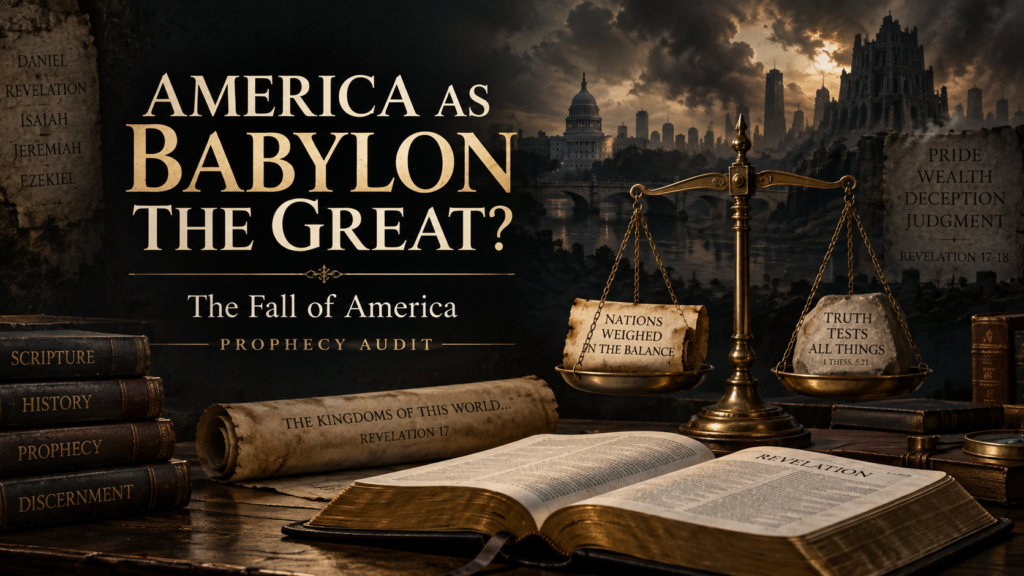
The Fall of America,” published by The Master’s Voice Prophecy Blog, presents itself as a divine warning: America is said to be Babylon the Great, facing a catastrophic collapse assisted from within and carried out through a Russian-led invasion. This is not merely a broad warning that nations can fall under Yahweh’s judgment. It joins that warning to specific public predictions: Russian troops and three unnamed allies entering through the Rocky and Appalachian mountains; television coverage of the invasion; foreign nationals leaving while American citizens cannot; bank closures; martial law; searches and seizures; children taken as government property; prisoner releases; complicit leaders taking shelter underground; and, afterward, an Israel left without American help.
The distinction between dates matters. The source page is dated June 9, 2019, while it says the revelation was received July 25, 2015. The page preserves the author’s claim about 2015, but this review did not establish independent contemporaneous evidence that the complete wording was publicly documented then. That does not settle the claim’s truth or falsehood. It does mean the dates should not be treated as interchangeable.
This review tests the claims separately. A warning about sin may be biblically sound while attached geopolitical forecasts are not. Scripture must first be read in context; then concrete predictions must be compared with public reality rather than matched loosely to any later war, economic trouble, emergency declaration, or political conflict.
How Scripture requires prophetic claims to be tested
The New Testament does not authorize either contempt or credulity. Believers are told not to quench prophecy, but to test everything and hold fast to what is good (1 Thessalonians 5:19–22). Likewise, 1 John 4:1 commands testing because many false prophets have gone out into the world. The question is not whether a message is emotionally powerful, politically alarming, or full of biblical language. The question is whether it is faithful to Yahweh’s revealed word and whether its factual claims bear examination.
Deuteronomy 13:1–5 establishes that even a striking sign does not validate a message that draws people away from faithfulness to God. Deuteronomy 18:20–22 warns gravely against presumptuous speech in Yahweh’s name. Application requires care: some judgment warnings are expressly conditional, some visions are symbolic, and some claims are too vague to test. Jeremiah 18:7–10 and Jonah 3:4–10 show that Yahweh may relent from announced judgment when people turn from evil. But conditionality cannot simply be added later to protect a prediction that did not occur. The source encourages prayer, which is right, but it does not clearly make its invasion, travel-ban, bank, child-seizure, or conspiracy claims conditional.
This audit therefore distinguishes four levels: what Scripture says directly; what follows from its context; what is debated interpretation; and what is private revelation or unsupported factual assertion. For a fuller method, see How Scripture Tests Prophetic Claims: A Berean Framework for Discernment.
Does Revelation identify America as Babylon the Great?
Revelation 17–18 supplies the central biblical material. The woman bears the name “Babylon the Great” (Babylōn hē megalē), sits in relation to kings and peoples, is associated with luxury, violence, and the blood of Yahweh’s servants, and rides the beast. Revelation 17:18 identifies her as “the great city” that has dominion over the kings of the earth. Revelation 18 announces her fall, calls Yahweh’s people to come out of her so they do not share in her sins and plagues, and depicts kings, merchants, and mariners lamenting the sudden destruction of a city from whose luxury they profited.
Those are the text’s data. Revelation was sent to seven assemblies in the first-century Roman world (Revelation 1:1–4, 11), and it communicates through visions saturated with Old Testament images. Wealth, international commerce, military influence, and moral corruption therefore cannot by themselves identify a modern country. Many societies have displayed such traits.
The strongest historically grounded reading identifies Babylon principally with Rome. Rome held imperial power in John’s world; it was a great city with far-reaching authority, commercial wealth, and a record of persecuting believers. The seven mountains or hills (orē hepta) naturally evoke Rome’s familiar seven hills. The likely coded use of “Babylon” for Rome in 1 Peter 5:13 strengthens that case. Yet Revelation itself also says the seven mountains are seven kings (Revelation 17:9–10). The symbol cannot be reduced to a bare geographical riddle, and the scale of Babylon’s final judgment may lead readers to see Rome as both an immediate referent and a pattern reaching beyond it.
Other major readings deserve fair hearing. Some futurists expect a final literal city or imperial center of anti-Yahweh power. Others understand Babylon as a transhistorical system of idolatrous political, economic, and religious power, with Rome as its first-century embodiment. Historicist traditions have often identified Babylon with papal Rome. These positions differ substantially, but none requires America to be Babylon the Great.
An America-as-Babylon reading has a limited moral point: America’s wealth, global commercial reach, military power, and real moral failures can make it an example of Babylon-like patterns. Revelation’s warning may rightly confront Americans, as it confronts every people. But a moral analogy is not an identification. Revelation never names America, North America, the Rocky Mountains, the Appalachians, Russian invaders, banking closures, or an evacuation of the United States. Revelation 18:4 and 18:8 do not explicitly predict America’s fall.
Jeremiah’s Babylon and Ezekiel’s commission
Jeremiah 50–51 must first be allowed to address its own subject: the Babylonian empire that had devastated Judah and Jerusalem. In Jeremiah 51:45, Yahweh calls his people to leave that Babylon. Revelation deliberately echoes Jeremiah’s language of departure, sudden downfall, smoke, commercial lament, and judgment. That literary relationship is important. Yet reuse of Babylon imagery does not erase Jeremiah’s historical referent or authorize the assignment of every Babylon passage to a present nation without textual argument.
The appeal to Ezekiel 2 also proves too much. Ezekiel 2:1–3:15 records Yahweh’s commission of Ezekiel to speak to rebellious Israel. The prophet receives a scroll of lamentation, mourning, and woe, and is commanded to speak Yahweh’s words whether his hearers respond or refuse. This supports the general truth that Yahweh commissioned Ezekiel despite opposition. It does not create a transferable credential by which any later speaker establishes divine authority merely by citing Ezekiel.
Images of commandos, batons, crowns, underground rooms, and inherited political plans are private impressions, not conclusions drawn from the immediate meaning of Jeremiah, Ezekiel, or Revelation. They may explain why the source’s author believes these things, but they do not establish accusations against governments or leaders. Such claims require independently corroborated evidence proportionate to their seriousness.
Ezekiel 9 does not describe Russian armies
Ezekiel 9 belongs within Ezekiel 8–11, a temple-vision sequence centered on Jerusalem. Ezekiel sees abominations in and around the temple; Yahweh identifies the city’s guilt; those who grieve and groan over its abominations are marked; judgment begins at the sanctuary; and Yahweh’s glory departs from Jerusalem. This setting is not incidental background. It defines the vision’s subject.
Six armed figures come from the direction of the upper gate, while a seventh man clothed in linen marks those mourning Jerusalem’s sins before judgment proceeds (Ezekiel 9:1–11). The source claims that the “six men” will be Russian troops in their thousands. But the passage does not call them Russians, troops, nations, or armies. It gives no numerical formula by which six vision figures become innumerable soldiers. The Hebrew keli mappats refers to a destructive weapon or instrument; it does not identify modern commandos, national forces, or a Russian military operation.
A limited application is legitimate. Ezekiel 9 warns that Yahweh takes idolatry, injustice, and religious hypocrisy seriously, and that outward association with sacred things does not secure the unrepentant. But that application does not permit Jerusalem to become America or the six vision figures to become Russian troops. This is not simply an uncertain interpretation. It contradicts the passage’s stated setting and redefines its figures without textual warrant.
Ezekiel 38–39, Gog, Russia, and American mountains
Ezekiel 38–39 follows restoration promises in Ezekiel 36–37. The oracle concerns Gog’s attack against a restored people of Israel gathered from nations, dwelling in the land Yahweh calls his own. The repeated geographical markers matter: Gog comes against Israel and falls on “the mountains of Israel” (Ezekiel 38:8, 16, 18; 39:2, 4). Readers debate Gog’s historical background, timing, and eschatological function, but the text does not leave the invaded land undefined.
Some prophecy systems associate Gog with a future Russia-led alliance, often by appealing to rosh, Meshech, and Tubal. This association is disputed. Rosh is commonly translated “chief” in the phrase “chief prince of Meshech and Tubal,” while Meshech and Tubal are ordinarily associated with ancient Anatolia. Resemblance between names such as Meshech and Moscow, or Tubal and Tobolsk, does not establish a linguistic or historical identification.
Even if one adopted a future Russia-led reading of Gog, it would not prove an invasion of America. Ezekiel does not name Russia, the United States, three unnamed allied states, American borders, radar evasion, the Rocky Mountains, or the Appalachians. Revelation 20 later uses Gog and Magog in an eschatological scene, but it likewise does not provide a Russian route into North America. The Rocky-and-Appalachian scenario is private revelation, not biblical exposition.
What happened to the concrete predictions?
Specific public predictions should be tested specifically. As of the stated research cutoff of September 23, 2026, no publicly documented Russian-led ground invasion of the United States has occurred, much less one with three unnamed allies entering through the Rocky and Appalachian mountains. No corresponding event has appeared across major international news networks in the universal manner predicted. Public reporting and official research on Russia’s military activity, including Congressional Research Service material on Russia’s war against Ukraine, do not document the claimed American invasion.
No nationwide order has been documented under which foreign nationals may generally leave the United States while U.S. citizens, including naturalized citizens, are generally barred from departure. Nor has there been a nationwide banking shutdown in which banks broadly ceased operating and dispensed little money. Individual bank failures, temporary branch closures, market instability, and ordinary withdrawal limits are not the predicted nationwide event.
Likewise, no documented nationwide martial-law regime has imposed the general search-and-seizure system described by the source. Emergency declarations and FEMA disaster responses are legally distinct from martial law; they do not by themselves establish military rule or the suspension of ordinary constitutional protections. No verified national policy has treated children of citizens or naturalized families as government property. Nor has there been a blanket exoneration, pardon, and repatriation of undefined “CIA watch-list” prisoners. The public Department of Justice prisoner-transfer program is treaty-based, case-specific, and consent-based, not the predicted system.
The allegation that American leaders knowingly arranged national destruction and withdrew underground for that purpose is especially grave. No proportionate public evidence has been supplied: no records, named participants, credible witnesses, or independent corroboration sufficient for a claim of that magnitude. Private imagery cannot carry that evidentiary burden. The forecast concerning Israel also depends on America first suffering the described collapse. Since that prerequisite has not occurred in the predicted form, the later Israel scenario remains unverified.
The source supplies no clear deadline, so it is not possible to say every future-oriented statement has become logically impossible. But its language of an impending crisis created a reasonable near-term expectation. That expectation has not been vindicated by the predicted composite event. General instability, wars, disasters, immigration disputes, bank failures, or emergency orders should not be retrofitted as fulfillment.
Biblical concern, disputed questions, and a Berean verdict
Scripture explicitly teaches that Yahweh judges idolatrous, violent, exploitative powers; that Babylon falls under his judgment; and that his people must not share in Babylon’s sins. It also explicitly places Ezekiel 9 in Jerusalem’s judgment and Ezekiel 38–39 in an assault against restored Israel. Christians may reasonably apply Revelation’s moral warning to America and every other society. No nation’s wealth, military strength, influence, or religious language exempts it from judgment.
Babylon’s final scope remains debated among Rome-centered, futurist, symbolic, and historicist readings. Gog’s precise eschatological role is also debated. But those debates do not justify certainty where Scripture does not identify America, Russia, American mountain routes, or the predicted domestic-crisis details.
Berean verdict: the source’s call to take sin and divine judgment seriously reflects a broad biblical concern. Its identification of America as Babylon the Great is unproven by Scripture. Its use of Ezekiel 9 and Ezekiel 38 to predict Russian troops invading America conflicts with those passages’ stated contexts. Its concrete predictions of invasion, restricted travel, bank shutdowns, martial law, child seizure, prisoner release, and elite complicity remain unverified and have not occurred in the publicly described nationwide form.
Readers need not panic or embrace partisan suspicion. They should test every claim, refuse unsupported accusations, pray for governing authorities and vulnerable people, repent of real evil, and anchor their hope in Yeshua rather than geopolitical speculation.
This study is part of The Berean Scale’s ongoing review of The Master’s Voice Prophecy Blog and its claimed revelations.
Discussion
Join the Discussion
Test the claim with Scripture. Address the text and the argument, not the person. Comments may be held for moderation.
Keep it Berean: cite the text when possible, make the argument clearly, and keep disagreement respectful.