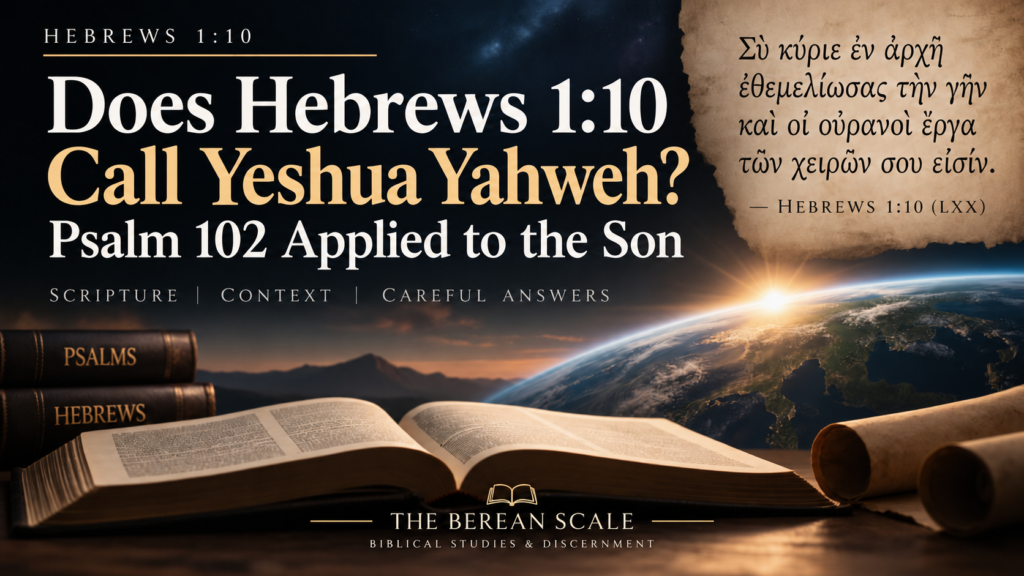
Hebrews 1:10–12 cites words from Psalm 102:25–27: “You, Lord, in the beginning founded the earth, and the heavens are the works of your hands.” In the Hebrew Psalm, this is creator-and-endurance language addressed to Yahweh. Hebrews places it inside an argument that the Son is superior to angels. The question is therefore not minor: when Hebrews uses this Psalm, does it directly address Yeshua with words originally directed to Yahweh? Or does it describe Yahweh’s work through his appointed agent? Could the author be re-voicing the Psalm in a more qualified messianic way?
The controlling issue is the quotation’s addressee within Hebrews itself. Later doctrinal language should not be imported into a single citation as though Hebrews had already stated every later formula. But neither should theological tension make us soften the actual grammar. We must ask: in Hebrews 1, who is being addressed when the writer says, “You, Lord, founded the earth”?
Hebrews 1:5–14 contrasts the Son with angels
Hebrews 1:10–12 is part of a sustained catena, or chain, of Scripture quotations. The chapter has already given the Son an exceptional place. Yahweh has spoken in a Son, appointed him heir of all things, made the ages through him, and identified him as the radiance of God’s glory and the exact expression of his being. The Son also sustains all things and, having made purification for sins, sits at the Majesty’s right hand (Hebrews 1:1–3). This is not the presentation of an ordinary human messenger.
Beginning in verse 5, the immediate concern is the Son’s relation to angels. Verse 7 says, pros men tous angelous legei, “with reference to angels he says,” and quotes language describing angels as winds and servants. Verse 8 deliberately turns: pros de ton huion, “but concerning the Son.” The contrast is structural, not accidental. Angels are servants; the Son is the royal Son whom angels are commanded to honor.
Hebrews 1:8–9 first quotes Psalm 45. The words are direct address: the Son’s throne endures, he loves righteousness, and “God, your God,” has anointed him. That final phrase matters. It distinguishes the Son from the one called his God. For a closer examination of that immediate quotation, see Does Hebrews 1:8 Say the Father Calls the Son “God”?
Then verse 10 begins simply with kai, “and”: “And, You, Lord, in the beginning founded the earth.” There is no new formula such as “but concerning God,” no stated shift from the Son, and no new contrast partner. Kai by itself does not mechanically prove that every preceding syntactical feature must continue. Yet in this unbroken Son-side of the catena, continuation is the normal literary reading. Verses 8–12 most naturally comprise successive scriptural statements concerning—and, in the quoted wording, addressed to—the Son.
Psalm 102 originally addresses Yahweh
This conclusion becomes more significant when Psalm 102 is read in its own setting. In the Masoretic Hebrew text, Psalm 102 is the prayer of an afflicted worshiper. He cries to Yahweh, laments his frailty, pleads for Zion’s restoration, and contrasts his own shortened days with Yahweh’s enduring existence. Yahweh is named repeatedly in the Psalm’s larger context.
The closing confession belongs to that prayer: “Of old you laid the foundation of the earth, and the heavens are the work of your hands.” Creation will perish, wear out, and be changed. But the one addressed remains, and his years have no end. The Psalm is not, in its historical setting, an oracle spoken to an earthly Davidic king. Its creator language concerns Yahweh.
That point needs careful wording. The divine name YHWH does not occur in the exact line quoted in Hebrews 1:10, and Hebrews does not print the Tetragrammaton. Nor does kyrie, “O Lord,” automatically equal YHWH in every Greek sentence. But here kyrie stands within a quotation from a Psalm whose wider Hebrew prayer is directed to Yahweh. The original referent of the earth-founding and heaven-making language is therefore secure.
Hebrews follows the Greek form of the Psalm substantially. Hebrew Psalm 102 is Psalm 101 in the Septuagint, and verse numbering around the closing section can differ by edition and tradition. The Greek text immediately before the cited material also introduces a real complication. Where the Hebrew flow speaks of the afflicted petitioner’s weakness, the Septuagint reads apekrithē autō, “he answered him.” Neither the third-person subject nor the indirect object is named in that short clause. The following first-person plea remains difficult to assign in a clean dialogue.
This Greek wording may have opened the way for some readers to hear a dialogue: Yahweh answers an afflicted figure, perhaps understood messianically. But the point should not be overstated. The Hebrew does not plainly present such a Father-Son exchange, and the Greek speaker transitions are themselves obscure. The secure observation is simpler: Psalm 102’s creator-and-endurance confession belongs, in its Hebrew setting, to Yahweh.
What Hebrews 1:10–14 says about the Son
The Greek of Hebrews 1:10 is unmistakably second person singular: sy kat’ archas, kyrie, tēn gēn ethemeliōsas—“You, Lord, in the beginning founded the earth.” The heavens are “works of your hands.” The addressee remains when they perish; he is “the same,” and his years will not fail. The contrast is between a changing creation and an enduring addressee.
If the Son-address introduced in verse 8 continues through verse 12, Hebrews does more than repeat that God made the world through the Son. It places the acts of founding earth and making the heavens directly upon the Son as the one addressed in the quotation. The text does not explain a metaphysical mechanism of creation, distinguish primary from instrumental causation, or pause to define the Son’s relation to the Father. But its grammar attributes these predicates to the one called kyrie.
Verses 13–14 are the rhetorical conclusion, not an unrelated afterthought. Psalm 110:1 is applied to the Son: “Sit at my right hand until I make your enemies a footstool for your feet.” The writer asks which angel ever received that invitation. The implied answer is none. Angels are “ministering spirits,” sent to serve those who will inherit salvation.
The whole unit therefore makes a categorical contrast. Angels serve. The Son reigns at God’s right hand. He receives the Psalm 102 language of cosmic founding and permanence. Hebrews does not call him the Father, and it does not use later expressions such as “one essence” or “two natures.” Still, it does not treat him as one more exalted angelic servant. Its Christological claim is exceptionally high.
Creation through the Son and distinction from the Father
Hebrews itself also preserves an ordered Father-Son relation. Hebrews 1:2 says that God made the ages “through” the Son. This language identifies God as the acting source while placing the Son on the active side of creation rather than within the created order. It is consistent with the broader New Testament pattern in which creation is from the Father and through the Son.
First Corinthians 8:6 is especially relevant: there is “one God, the Father, from whom are all things,” and “one Lord, Yeshua Messiah, through whom are all things.” This supports a real distinction and a source-and-agency pattern. It should not be used, however, to change Hebrews 1:10 into words about the Father alone. For that question, see 1 Corinthians 8:6: Who Are the One God and One Lord?.
John 1:1–3 likewise distinguishes the Word from God while saying that all things came to be through him. Colossians 1:15–17 also assigns a cosmic role to the Son, though its syntax and scope deserve examination in their own context. These passages provide canonical parallels; they do not decide Hebrews 1:10’s quotation grammar for us. On John’s language specifically, see Does John 1:1 Say the Word Is the Father, Divine in Nature, or “a God”?
Hebrews holds together truths that interpreters must not separate: the Son has “God, your God” in 1:9; he sits at another’s right hand in 1:13; yet he receives the creator-and-enduring address of Psalm 102 in 1:10–12. Agency may describe how Father and Son relate in creation. It cannot by itself turn “You founded the earth” into a claim about the Father only.
The strongest alternative readings
The agency-based reading deserves to be stated in its strongest form. The Father is the ultimate source of all things, and the preexistent Son is Yahweh’s unique personal agent, through whom creation came to be and is sustained. Hebrews 1:2 and 1 Corinthians 8:6 give this model genuine biblical support. It also takes seriously the Father-Son distinction found throughout Hebrews.
Its limit appears in the wording of the citation. On the most natural continuation reading, Hebrews addresses the Son as the founder of earth and maker of heaven. An agency model may explain how the Son’s action relates to the Father’s action; it is not an explicit limitation in Hebrews 1:10. The quotation does not say merely, “God founded the earth through you.” It says, “You, Lord, founded the earth.”
A second proposal appeals to the Septuagint’s “he answered him.” On this account, Hebrews reads Psalm 101 as a dialogue in which Yahweh speaks the creator-and-endurance words to an afflicted messianic figure. This can explain how language originally directed to Yahweh becomes Father-to-Son speech without claiming that Psalm 102 was originally a straightforward messianic oracle. Ancient readers could identify speakers within Scripture in ways that went beyond a Psalm’s immediate historical setting.
Yet this reconstruction remains debated. The Greek Psalm does not clearly identify who answered whom, the following first-person language is awkward within a neat dialogue, and the Hebrew form does not plainly supply one. Hebrews itself does not introduce the quotation by explaining that it has uncovered a hidden exchange. Even if the proposal correctly describes the author’s interpretive mechanism, the result in Hebrews remains the same: the Son receives the creator/permanence words.
A representative or messianic re-voicing approach similarly recognizes that Scripture can be applied christologically and that the Messiah represents Yahweh’s reign. That observation is sound as far as it goes. But representation must account for more than royal titles or delegated rule here. It must explain direct second-person language about founding the earth, making the heavens, remaining unchanged, and possessing unfailing years.
Finally, some detach verses 10–12 from the Son and treat them as an independent statement about Yahweh. This reading rightly observes that verse 10 does not repeat the words “concerning the Son.” But it must posit an unmarked shift immediately after kai, within a block opened by “but concerning the Son,” before the author returns explicitly to the angel/Son contrast in verse 13. That is possible only by supplying a transition the writer did not signal. It is considerably less natural than reading Psalm 102 as a further Son-side quotation.
What is explicit, inferred, and debated
Explicitly, Hebrews 1:10 addresses someone as Lord and credits that addressee with founding earth, making the heavens, outlasting their dissolution, remaining the same, and possessing unfailing years. Hebrews 1:13–14 explicitly distinguishes the enthroned Son from angels, who are servants.
By strong contextual inference, the addressee in verses 10–12 is the Son introduced in verse 8. The inference rests on the continuous quotation sequence, the unmarked “and,” and the chapter’s angel/Son framework. On that reading, the Son is prior to the created heavens and earth and belongs on the creator-and-enduring side of the Psalm’s contrast with a perishing world.
By further theological inference, Psalm 102’s original Yahweh-reference strongly supports including the Son in divine creator/permanence language. This is far more than a claim that he is an ordinary human ruler or angel. Yet Hebrews does not itself use YHWH as a written name for the Son, define the Trinity in later conciliar terms, or collapse Father and Son into one person.
Whether the best synthesis is Nicene Trinitarian ontology, high agency Christology, an LXX-enabled dialogue reading, or another account of divine identity and distinction remains debated. Those debates are real. They do not justify treating Psalm 102’s predicates as unrelated to the Son within Hebrews’ argument.
Berean verdict
Hebrews 1:10–12 most naturally continues the address to the Son begun in verse 8. It therefore reapplies to Yeshua words that Psalm 102, in its Hebrew setting, directs to Yahweh as Creator and the unchanging Lord over creation. Hebrews 1:13–14 intensifies the point: the Son is enthroned at God’s right hand, while angels are commissioned servants.
This is among the New Testament’s strongest high-Christology passages. It strongly supports the Son’s inclusion in divine creator-and-permanence language while preserving his distinction from the Father. It is compatible with, and supplies major premises for, Nicene Trinitarian doctrine; it does not independently state every later metaphysical formulation.
Hebrews does not merely say that God acted through the Son. In the quotation’s grammar, it says to the Son, “You, Lord, founded the earth.” Agency may describe the Father-Son relation in creation; it does not nullify the predicate Hebrews places on the Son.
Discussion
Join the Discussion
Test the claim with Scripture. Address the text and the argument, not the person. Comments may be held for moderation.
Keep it Berean: cite the text when possible, make the argument clearly, and keep disagreement respectful.