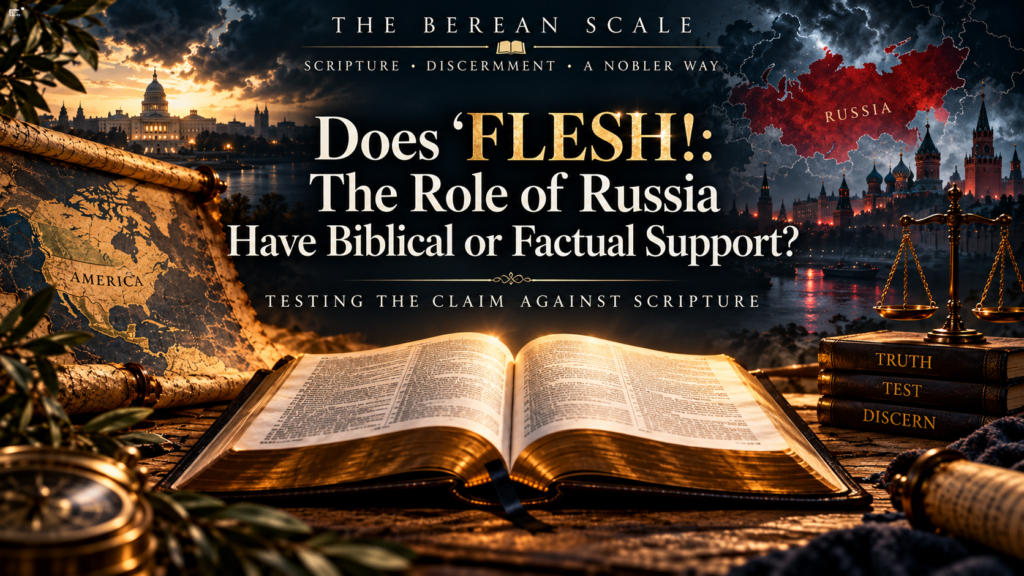
In “FLESH!”: The Role of Russia — June 27, 2019, Celestial, writing at The Master’s Voice Prophecy Blog, presents claimed visions concerning a future judgment involving Russia, China, Ukraine, other nations, and the United States. The source is not simply warning that nations may be proud, war is cruel, or Yahweh judges injustice. It attributes a detailed geopolitical forecast and an apparently irreversible decree of judgment to Yahweh.
Its concrete claims matter. The source describes an alleged private international meeting about labor needs, says America was selected as a source of human labor, assigns Russia the strategic directing role and China the tactical role, and foresees a brutal combined attack in which Americans are sold or taken away into slavery. It also portrays Russia’s leader as a hidden, exceptionally capable strategist driven by old grievances and extensive private planning. Symbolic scenes involving a bear, Cain and Abel, cowboys and Indians, a dinner party, exclusion, and revenge reinforce that interpretation.
The article supplies no fulfillment date, military sequence, stated repentance condition, or public definition by which the alleged secret meeting could be identified. Therefore, elapsed time alone does not disprove its future predictions. But neither may broad world tensions, Russia-China cooperation, or later warfare elsewhere be treated as fulfillment of a more specific forecast. The claims must be tested separately: by Scripture where Scripture is cited, and by evidence where the source makes factual or predictive assertions.
What the source claims—and what kind of claims they are
A vivid vision is not one indivisible claim. Some assertions concern biblical interpretation; others concern history, future events, or an individual’s inner life. Keeping those categories distinct prevents a general truth from becoming evidence for every attached prediction.
| Source claim | What can be tested | Present assessment |
|---|---|---|
| America treated Russia unfairly and has received an unrecoverable divine sentence. | Historical rivalry is testable; the divine causal decree is not established by history alone. | Historical premise partly supported in a limited sense; divine conclusion unsupported by the cited texts. |
| Isaiah 13:18 describes future Russian cruelty toward Americans. | The passage’s named target and attackers. | Contradicted as direct biblical identification. |
| Russia, China, Ukraine, and others met secretly to obtain American slave labor. | A concrete meeting and its alleged outcome. | Uncorroborated; the future outcome remains pending and unverified. |
| Russia will direct China in a combined conquest of America. | Existing cooperation differs from the claimed hierarchy, target, attack, and captivity. | Pending and unverified. |
| Russia’s leader privately nurses rage and manages many concealed plans. | Public conduct and statements can be checked; private thoughts cannot. | Not objectively testable as stated. |
The source’s reference to “the leader of Russia” likely concerns the contemporary Russian president, but it does not expressly name him. More importantly, public speeches may reveal publicly stated grievances or strategic arguments; they cannot verify alleged meditation habits, map collections, inward obsession, hidden rage, or dozens of simultaneous secret schemes. Later events that seem compatible with a description do not provide access to a person’s mind.
Isaiah 13 names Babylon and the Medes
The strongest scriptural test concerns Isaiah 13:18. Its immediate context must control its application. Isaiah 13:1 introduces the unit as a massaʾ, an oracle or pronouncement, “concerning Babylon.” The term does not signal a concealed code for a later unnamed country. Isaiah 13 belongs to the sequence of oracles concerning nations in Isaiah 13–23, and its own wording repeatedly identifies its subject.
The chapter depicts Yahweh mustering forces from a distant land for battle (Isaiah 13:2–5), announces the day of Yahweh and Babylon’s terror and collapse (vv. 6–16), and then names the attacking people: “Behold, I am stirring up the Medes against them” (v. 17). The Hebrew Madai means Media or the Medes; it does not linguistically mean Russia. Verse 19 again identifies the object of judgment as Babylon, “the glory of kingdoms, the splendor and pride of the Chaldeans.” Isaiah 14:3–23 continues the Babylon-focused setting, including relief from Babylonian oppression and a taunt against Babylon’s king.
Isaiah 13:18 is severe. The attackers’ bows strike young men; they do not pity the fruit of the womb, and their eyes do not spare children. The verb commonly rendered “spare” describes withholding pity or compassion in the immediate poetic depiction. The cruelty should not be minimized. Yet the passage identifies the violent force as the Medes and the judged kingdom as Babylon. Jeremiah supplies a close parallel: his oracles against Babylon likewise connect its downfall with the Medes (Jeremiah 50:1–3, 9–10; 51:11, 27–29).
That does not resolve every scholarly question about Isaiah 13’s date, literary formation, historical horizon, or expansive day-of-Yahweh language. Some interpreters reasonably see Babylon as a recurring pattern of proud and oppressive power. But a typological pattern is not a modern identification. Isaiah 13 does not name the United States, Russia, China, Ukraine, Vladimir Putin, a North American invasion, or an American labor-slavery system.
Thus, if Isaiah 13:18 is offered as direct proof that Russians will show no mercy in a future American captivity, the claim conflicts with the chapter’s explicit participants. If it is offered only as an analogy about the horrors of divine judgment through war, it may be a symbolic application—but it is no longer a biblical prediction of Russia’s conduct toward America. Similar images of children, weapons, devastation, or cruelty cannot transfer the oracle’s named actors to modern nations merely by resemblance. Readers considering related claims about Isaiah and captivity may also consult this review of whether Isaiah 20 predicts American enslavement by Russia and China.
1 Thessalonians 3 does not forecast modern geopolitics
The source’s opening citation also requires correction. Its wording about having told believers in advance that “we were to suffer affliction” corresponds substantially to 1 Thessalonians 3:4, not 1 Thessalonians 3:7. Verse 7 says Paul was encouraged through the Thessalonians’ faith amid his own distress and affliction. This is a checkable citation error, not a minor point if the quotation is used to frame a claimed revelation.
In 1 Thessalonians 3:1–8, Paul explains why he sent Timothy: to strengthen the Thessalonian believers amid pressure, to ensure that temptation had not unsettled them, and to receive news of their continuing faith. The Greek thlipsis refers broadly to affliction, distress, or pressure. The passage is pastoral and missionary. It says nothing about Russia, China, America, invasion, slavery, secret diplomacy, or a future arrangement among nations.
The limited thematic use is fair: disciples of Messiah should not be surprised by suffering. But that general truth cannot serve as exegetical proof for the source’s Russia-China-America forecast. Scripture does teach that Yahweh judges nations, opposes pride, condemns injustice, and may use nations in historical judgment. Those truths establish a category; they do not identify America as Babylon, Russia as Yahweh’s appointed instrument, or China as Russia’s tactical partner. That additional modern mapping needs additional warrant.
The source’s historical charge also needs this distinction. Cold War rivalry, arms competition, sanctions, distrust, and conflicts over Ukraine are real features of U.S.-Russian relations. Those facts support the narrow claim that serious rivalry existed. They do not demonstrate that America uniquely or decisively mistreated Russia, that Russia’s future retaliation is righteous, or that Yahweh decreed “blows from which there is no recovery.” The moral verdict and divine-causal conclusion go beyond the publicly demonstrable history and beyond the cited passages.
What public evidence does and does not show
Russia and China do have substantial, publicly documented diplomatic, economic, strategic, and defense cooperation. Recent U.S. defense reporting describes expanded defense engagement and Chinese dual-use support relevant to Russia’s war production. This gives limited factual support to the general proposition that Russia and China can coordinate in important settings. It also makes future cooperation geopolitically conceivable.
But cooperation is not fulfillment. It does not establish that Russia commands China, that both have agreed to conquer the United States, that they held the alleged meeting with Ukraine and unnamed nations, or that a labor-slavery system has been planned. A strategic partnership is not the same thing as the source’s claimed division of roles: Russia as mastermind, China as tactical executor, America as defeated target, and Americans as the workforce obtained by attack.
Russia’s full-scale invasion of Ukraine in February 2022 is externally verifiable and morally grave. Yet it does not correspond to the claimed Russia-China-Ukraine discussion about securing American labor. Nor is it a Russia-China attack on the United States. Renaming a different event as fulfillment would make the prophecy less specific after the fact than the source made it beforehand.
No public evidence reviewed here documents a secret meeting in which Russia, China, Ukraine, and other nations selected the United States as a slave-labor source. Since the source calls the meeting secret, the absence of public documentation cannot decisively prove that no such meeting occurred. It does mean the assertion is uncorroborated and cannot presently be independently verified. The resulting forecast—a combined Russia-China attack defeating America and selling or removing Americans into labor slavery—has not occurred in the stated concrete form on the dossier’s assessment date of September 24, 2026. Because the article gave no deadline, it remains pending and unverified rather than automatically false.
Public Russian rhetoric can provide limited background for claims of historical grievance or criticism of Western policy. It cannot establish private temperament, interior motives, or a divinely disclosed hidden plan. This is precisely where responsible review must stop: outward actions and public words may be documented; inward mental states alleged through vision are not confirmed merely because they are plausible descriptions of a political leader.
The strongest available defense
A fair defense would say that the source reports extra-biblical revelation and uses Isaiah 13 illustratively rather than claiming that Isaiah alone predicts the scenario. Scripture does not command believers to despise prophecies. First Thessalonians 5:19–22 instead calls them to test everything and hold fast what is good. And an undated future prediction is not automatically false because it has not occurred by a particular date.
A defender might also appeal to the broad day-of-Yahweh language in Isaiah 13 and to Babylon’s use elsewhere as a pattern of arrogant, oppressive power. That can support a theological application: Yahweh judges pride and unjust power. It cannot, without a further argument, establish that modern America is Babylon or that Russia and China are the Medes. It certainly does not supply the source’s detailed claims of a labor meeting, national command structure, mass captivity, or military outcome.
Jeremiah 18:7–10 provides another possible defense. Yahweh describes how announced judgment or blessing may respond to a nation’s change of conduct. A warning may therefore be conditional even when its condition is not elaborated at length. Yet the source itself does not plainly frame this scenario as a conditional warning. Its language about a stage set, assigned roles, and blows without recovery makes an unstated repentance condition difficult to introduce later as a way of removing its concrete predictions.
Likewise, symbols can be symbolic. The bear, dinner party, and Cain-and-Abel imagery need not be literal scenes. But symbolism cannot erase every testable detail when the source itself identifies Russia, China, Ukraine, America, labor demand, attack, slavery, and distinct strategic roles. The defense preserves the possibility that the claimed revelation is future, partly symbolic, or conditional. It does not make its specific claims verified or make Isaiah 13 a direct forecast of them.
How believers should test claimed revelation
Deuteronomy gives related but distinct tests. Deuteronomy 13:1–5 teaches that even a sign or prediction does not validate a messenger who leads people away from loyalty to Yahweh. Its central concern is covenant faithfulness, not geopolitical accuracy alone. An apparently accurate prediction is not sufficient proof of divine authorization.
Deuteronomy 18:20–22 addresses presumptuous speech in Yahweh’s name and identifies non-occurrence as a negative test for a predictive word. That warning is serious. Yet it should not be misused: an undated prediction cannot be declared false simply because it has not happened by an arbitrary deadline. If a stated concrete outcome fails within a time frame later supplied by the claimant, that passage bears directly on the claim.
Jeremiah 23:9–32 and Ezekiel 13:1–23 warn against speaking visions from one’s own mind or following one’s own spirit without Yahweh’s authorization. They require sobriety toward anyone who says, in effect, “Yahweh showed me.” They do not, by themselves, prove that this individual source has already been disproved. Matthew 7:15–23 adds the need to consider fruit and genuine obedience rather than relying on impressive words uttered in the Lord’s name.
First John 4:1–6 commands believers to test spirits because many false prophets have gone out into the world. Its immediate doctrinal focus is confession concerning Yeshua Messiah; it is not a decoding key for nation-specific forecasts. First Thessalonians 5:21 uses dokimazō, “test” or “examine,” calling for assessment rather than contempt or credulity. Fearful imagery, general compatibility with tensions among nations, and the possibility of war are not substitutes for textual warrant and verifiable correspondence. For a fuller explanation of these distinct tests, see How Scripture Tests Prophetic Claims.
Berean verdict
What Scripture explicitly establishes: Isaiah 13 is an oracle concerning Babylon; it names the Medes as the force stirred against Babylon and depicts their ruthlessness. First Thessalonians 3 concerns Paul’s care for the Thessalonians amid affliction. Yahweh judges nations, and believers must test claimed prophecy.
What remains inferred or debated: Russia-China cooperation makes some future coordination conceivable, and Isaiah’s Babylon language may be applied typologically to later proud powers. Neither point identifies America, Russia, or China in Isaiah 13 or verifies the source’s scenario.
What is unsupported or unproven: that America’s treatment of Russia caused an irreversible divine decree; that Isaiah 13:18 predicts Russian cruelty toward Americans; that the alleged secret labor meeting occurred; and that Russia will direct China in an attack resulting in American slavery. The central forecast remains pending and unverified, while claims about a leader’s private inner life are not objectively testable.
The biblical warnings about pride, judgment, warfare, and discernment should be received. The use of Isaiah 13 and 1 Thessalonians 3 as proof of this specific modern forecast should not. This study forms part of The Berean Scale’s ongoing review of The Master’s Voice Prophecy Blog and its claimed revelations; readers can also examine the broader Master’s Voice Prophecy Blog review hub and the companion review of “FLESH!: The Role of China”.
Discussion
Join the Discussion
Test the claim with Scripture. Address the text and the argument, not the person. Comments may be held for moderation.
Keep it Berean: cite the text when possible, make the argument clearly, and keep disagreement respectful.