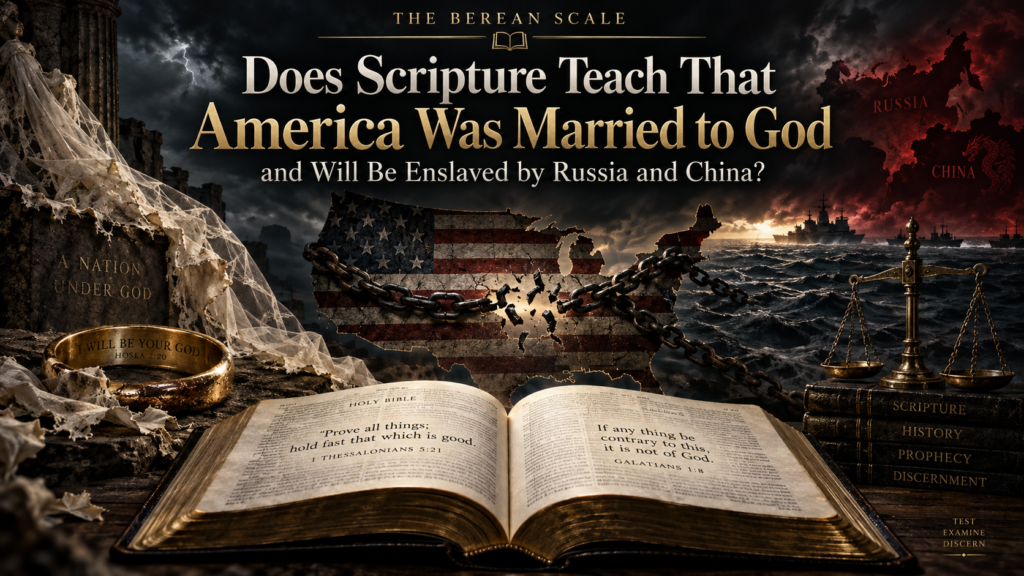
Celestial’s June 7, 2019 post at The Master’s Voice Prophecy Blog, “The Slavery Chronicles: America in Chains, Pt 2,” presents itself as a reported vision. It should therefore be examined as a claimed revelation, not treated as an established event or as a conclusion every reader must draw from Scripture. The post says that America was once married or betrothed to the Lord Yeshua, but became unfaithful and will be judged through war, invasion, captivity, slavery, and family separation at the hands of Russia and China.
The central question is narrow: does Scripture identify the United States as Yeshua’s former covenant bride, and does it predict this particular Russian-Chinese conquest and deportation scenario? The post rightly raises concerns Scripture itself raises. Yahweh judges evil, nations are morally accountable, and repentance is always a fitting biblical call. Yet a true call to repent does not automatically establish every national identification or future prediction attached to it.
Scripture requires neither contempt nor credulity toward prophetic claims. Deuteronomy 13:1–5 and 18:20–22, 1 Thessalonians 5:19–22, and 1 John 4:1 require testing. This review therefore asks what the cited passages actually say in context, what may be applied by analogy, and what remains a private-revelation assertion requiring factual confirmation. The page is identified as published June 7, 2019; it also displays October 22, 2020. Nothing supplied establishes either date as the date the vision was allegedly received.
What the post specifically claims
Before evaluating the interpretation, the claims should be stated fairly. Celestial writes that “America used to be married to the Lord Jesus Christ.” The post presents America as a once-favored woman, clothed and adorned by God, who later became unfaithful and was rejected. Its biblical associations include Joseph’s distinctive garment in Genesis 37:3, the clothed and covenanted woman in Ezekiel 16:1–19, Judah’s captivity under Babylon, the “double” repayment of Jeremiah 16:18, and Revelation 18:6.
The reported future scenario is correspondingly specific. Russia and China are said to wage war against and invade the United States. Americans are said to be captured, transported by ship to those nations, and compelled into slavery. Families are said to be divided by sex and age; women and girls are said to face particular danger; many captives are said never to return but to die abroad.
These should not be softened into vague predictions of national difficulty. General hostility between powers, cyberattacks, economic pressure, human trafficking crimes, immigration controversies, or unrelated wars would not fulfill a prediction of joint territorial invasion, mass seizure of Americans, overseas deportation, sex-and-age separation, and forced labor. Three distinct matters must be tested: whether America has the claimed covenant identity, whether the cited texts forecast the scenario, and whether the concrete prediction has occurred.
Ezekiel 16 names Jerusalem, not America
Ezekiel 16 is the controlling text because the post uses it to explain America’s supposed marriage, favor, clothing, and rejection. The chapter’s opening is not ambiguous. Yahweh tells Ezekiel to make Jerusalem know her abominations (Ezekiel 16:1–2), and verse 3 continues to address Jerusalem directly. The Hebrew name Yerushalayim is a proper place-name, not a flexible label that the passage assigns to later wealthy or influential nations.
Verses 4–19 develop an extended allegory. The woman is portrayed as abandoned at birth, preserved by Yahweh, brought to maturity, covered, washed, clothed, adorned, fed, and made renowned. At verse 8 Yahweh swears an oath and enters a berit, a covenant, with her; she becomes his. Then she trusts in her beauty, uses gifts Yahweh supplied for idolatrous worship, and acts unfaithfully. The language is forceful because Ezekiel is exposing Jerusalem’s idolatry and disloyalty within its covenant history.
The covenant term matters, but its context matters just as much. Deuteronomy 5:1–3 and 29:1, 10–15 identify Israel as the people addressed in Yahweh’s covenant at Horeb and Moab. Ezekiel’s marriage imagery grows out of that identifiable relationship. The continuation of Ezekiel 16 does not shift to an unnamed future nation; it continues its indictment and judgment of Jerusalem, compares her conduct with Samaria and Sodom, and speaks of remembered covenant mercy (Ezekiel 16:20–63). Ezekiel 23 follows a similar pattern, explicitly personifying Samaria and Jerusalem as two women.
The chapter’s sexual language must also be handled responsibly. The Hebrew verb family associated with zanah can describe prostitution and is regularly used in the prophets as a metaphor for idolatry and covenant betrayal. In Ezekiel 16, the imagery communicates Jerusalem’s spiritual infidelity. It does not authorize readers to turn the chapter’s humiliating judgment rhetoric into a literal forecast that American women and girls will suffer the violence described in the post.
Ezekiel 16 can certainly be applied as a warning. Any people may be warned against pride, idolatry, injustice, false alliances, and misuse of gifts. But application is not identification. The chapter directly addresses Jerusalem, and none of the cited passages supplies a further biblical statement identifying America as the woman in Ezekiel 16. The transfer from Jerusalem to the United States is therefore a theological analogy joined to the reported vision, not the chapter’s explicit teaching.
Bride imagery and the limits of American covenant language
The Bible does use marriage imagery for Yahweh’s relationship with his covenant people. Isaiah 54:5–8, Jeremiah 3:1–14, and Hosea 1–3 speak in that way concerning Israel and Judah. The New Testament also presents Yeshua as bridegroom. Ephesians 5:25–32, 2 Corinthians 11:2, Revelation 19:6–9, and Revelation 21:2, 9–10 use bridal language for Messiah’s redeemed people and for the New Jerusalem. In Revelation, the Greek nymphē, “bride,” belongs to that corporate and eschatological setting.
Those two bodies of imagery are related, but they are not interchangeable with a modern Gentile nation-state. No cited text says that the United States entered a marriage covenant with Yeshua and later ceased to be his bride. A nation may contain believers, churches, faithful communities, and people who genuinely covenant before God; it does not follow that its whole civil order is Messiah’s bride.
Genesis 37:3–4 does not bridge that gap. Joseph’s distinctive garment marks Jacob’s special love for Joseph and provokes his brothers’ jealousy. The passage contains no marriage covenant, no oracle concerning national apostasy, and no rule that a garment, flag colors, or apparent national favor proves divine betrothal. Connecting Joseph’s garment to a lost American “robe” is imaginative symbolism, not an exegetical conclusion from Genesis.
There is a serious historical case for saying that America has received substantial Christian influence. Colonial covenant thought, churches, revivals, biblical rhetoric, public prayer, and appeals to providence are real parts of its history. Some communities made explicit religious commitments. But that history does not equal a biblical declaration that Yahweh covenanted with the United States as he did with Israel. The federal constitutional order also established religious liberty, prohibited a federal religious test, and barred congressional establishment of religion. That framework does not deny America’s Christian influence; it cautions against treating the entire civil nation as one universally professing covenant body.
America is morally accountable to Yahweh, as are all nations. Yet “America used to be married to the Lord Jesus Christ” is not an explicit scriptural teaching. It is a private-revelation claim resting on a transfer of biblical imagery beyond the passages that originally use it.
Captivity, Babylon, and Revelation 18
The post does appeal to real biblical judgments. Leviticus 26:14–39 and Deuteronomy 28:15–68 warn covenant Israel of defeat, scattering, and exile for persistent disobedience. Second Kings 24–25 and Jeremiah 52 record Babylon’s conquest of Judah and Jerusalem and the deportation of many Judeans. Captivity was not imaginary; it was a grievous historical judgment within the named covenant relationship between Yahweh and Israel.
That fact does not establish a universal predictive formula. Scripture does not say that every sinful later nation must be invaded, shipped overseas, and enslaved by named powers. Jeremiah 16:14–18 concerns Israel and Judah, the land Yahweh gave their fathers, its defilement, approaching judgment, and eventual restoration. Its reference to repayment belongs to that oracle; it does not identify America.
Revelation 18:6 must likewise be read with Revelation 17–18 rather than isolated. The command to repay Babylon double uses the Greek verb diploō, meaning to double or repay doubly. It establishes severe recompense for Babylon in John’s vision. But Revelation 17:18 describes the woman as “the great city,” and the text never names America, the United States, Russia, or China.
Interpreters have long disagreed about Babylon. A major historical reading associates it principally with Rome in John’s world. Others argue for Jerusalem, a transhistorical anti-God system, or a future end-time expression of such power. The debate deserves its full weight. Even so, moral resemblance is not direct identification. America can be compared to Babylon where arrogance, idolatry, unjust wealth, violence, or false security are present; that does not prove that Revelation 18:6 predicts a double repayment specifically against America.
The strongest case for a special American role
The strongest opposing reading should not be dismissed. Some Christians contend that colonial covenants, widespread biblical ideals, revival history, national blessings, and public appeals to providence give America a covenant-like responsibility before God. Scripture does judge nations, and greater light can bring greater accountability. Biblical histories can also warn later societies without becoming wooden one-to-one forecasts.
Likewise, futurist readings of Revelation may allow Babylon to have a future dimension beyond first-century Rome. Russia and China possess substantial military, cyber, economic, and coercive capabilities, and strategic cooperation between them makes vigilance reasonable. A future attack on America is not logically impossible merely because it has not happened.
Yet possibility does not establish prophecy. Christian influence in a country’s history does not create the explicit covenant premise needed to replace Jerusalem with America in Ezekiel 16. Nor do national blessings demonstrate that the nation is Messiah’s bride. Even if Babylon has a future embodiment, Revelation does not name America as Babylon or Russia and China as its conquerors. The most this opposing reading can support is a conditional moral warning and a call to prayerful vigilance. It cannot establish Celestial’s detailed identification and captivity scenario as Yahweh’s revealed word.
The factual test of the Russia-China captivity prediction
The factual claim must be assessed by its stated particulars. It entails joint Russian-Chinese war against the United States, invasion and territorial capture, mass detention, transoceanic transportation of Americans, coerced labor, family division by sex and age, widespread sexual violence, and death in foreign captivity. A headline about geopolitical rivalry is not equivalent to that combined scenario.
The supplied audit record reports that, as of September 23, 2026, no independently verified event matched these particulars. It reports no joint Russian-Chinese invasion and occupation of the United States, no nationwide capture and overseas deportation of Americans into slavery, and no corresponding mass family-separation event. Serious threats involving missiles, cyber operations, coercion, regional conflict, and strategic competition do not verify the prophecy’s asserted fulfillment.
No deadline is supplied for the prediction. Its non-fulfillment by the audit date therefore does not, by itself, prove that no future event could ever occur. But an open-ended prediction cannot be declared fulfilled by retrofitting vague tensions, isolated crimes, unrelated wars, or ordinary political disputes to words that describe a far more definite event. The invasion, shipping, slavery, family separation, violence, and permanent non-return claims remain unverified private-revelation predictions. They are not conclusions stated by Genesis 37, Ezekiel 16, Jeremiah 16, or Revelation 18.
Berean verdict
Scripture explicitly teaches that Yahweh covenanted with Israel, that Ezekiel 16 addresses Jerusalem, that the prophets use marital imagery for Israel and Judah, that Babylon deported Judeans, that Messiah’s bride imagery concerns his redeemed people and the New Jerusalem, and that Revelation announces Babylon’s judgment. It reasonably permits moral warnings to modern nations, including America, against idolatry, injustice, violence, pride, and false security.
What it does not explicitly establish is America as Yeshua’s former covenant bride, America as the woman of Ezekiel 16, or Revelation 18:6 as a direct prediction of double repayment against the United States. Babylon’s identity in Revelation and America’s possible providential responsibility remain debated; neither debate names Russia and China as America’s captors. The reported invasion, deportation, slavery, family division, sexual violence, and mass death scenario remains unverified.
The post’s call to repentance is a biblical exhortation. Its transfer of Jerusalem’s covenant-marriage imagery to America fails as a textual claim, and its geopolitical particulars should not be preached as established prophecy. This study is part of The Berean Scale’s ongoing review of The Master’s Voice Prophecy Blog and its claimed revelations. Readers can also examine the companion review, Does Scripture Identify America as Babylon the Great?, and the methodological guide, How Scripture Tests Prophetic Claims: A Berean Framework for Discernment.

Discussion
2 Comments
Test the claim with Scripture. Address the text and the argument, not the person. Comments may be held for moderation.
Keep it Berean: cite the text when possible, make the argument clearly, and keep disagreement respectful.