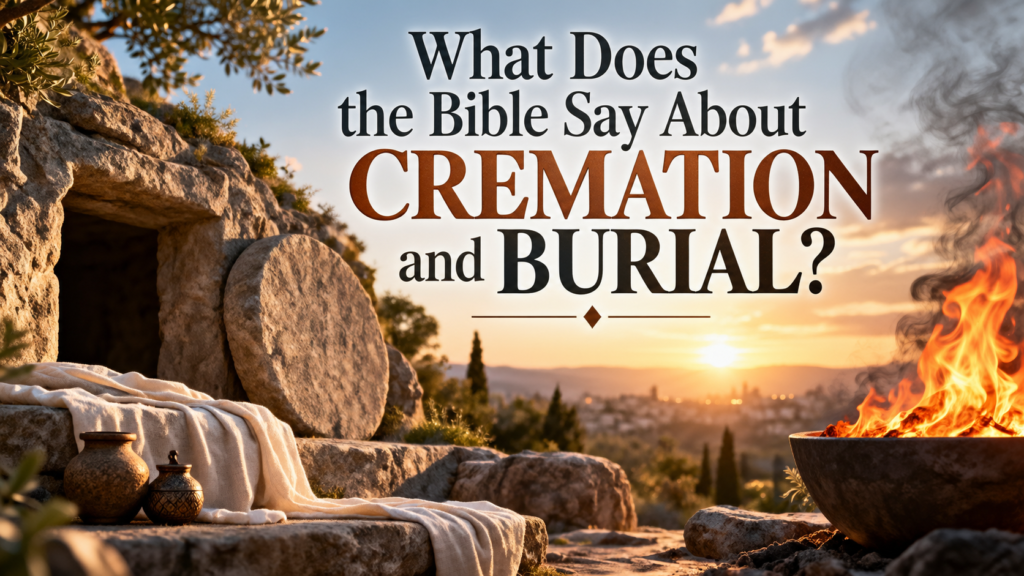
Burial is the Bible’s normal and positively portrayed way of caring for the dead. Yet the passages examined here do not explicitly command burial for every believer or expressly forbid cremation. Scripture gives a serious basis for preferring burial, but it does not permit us to turn a repeated biblical practice into a universal prohibition without further textual warrant.
The distinction matters because modern cremation is not identical in every detail with every biblical reference to burning human remains. In 1 Samuel 31, Saul and his sons’ bodies are burned after a battlefield recovery, and their bones are then buried. In Amos 2, Yahweh condemns Moab for burning an enemy king’s bones “to lime,” in a setting of hostile international violence. Neither text is a general funeral instruction.
This is also not a question of a loved one’s salvation or resurrection. The Bible does not present resurrection hope as a reward for preserving a corpse in a particular condition. The proper method is to let each passage speak in its own setting, distinguish direct teaching from theological inference, and then assess what conclusion the combined evidence can bear.
Burial is the dominant and honored biblical pattern
Genesis 23 presents burial as an intentional, dignified response to death. After Sarah dies, Abraham mourns for her and purchases Ephron’s field and the cave of Machpelah as a legally secure burial property. He then buries Sarah there. The chapter gives considerable attention to the transaction, underscoring that Sarah was not discarded or forgotten. Her burial is connected with grief, family memory, and Abraham’s settled attachment to the land Yahweh had promised.
The patriarchal story continues this family-tomb pattern. Jacob directs his sons to bury him with his ancestors, and they carry out that request (Genesis 49:29–33; 50:12–13). These accounts establish that burial held deep importance within this covenant family. They do not, however, issue legislation for every later family, nation, or believer. A narrated custom, even an honorable and repeated one, is not automatically a universal command.
Yeshua’s burial is an especially weighty example. Joseph of Arimathea receives permission to take the body, while Nicodemus brings myrrh and aloes. Together they wrap Yeshua’s body with linen cloths and spices and lay him in a new tomb, following Jewish burial custom (John 19:38–42). John’s account makes clear that Yeshua truly died and was carefully buried before his resurrection. Lazarus’s burial cloths in John 11:43–44 corroborate the Jewish setting described by John, but neither passage commands every disciple to reproduce every feature of first-century Jewish burial.
Deuteronomy 21:22–23 is the closest biblical legal instruction concerning burial. It requires that a person executed and displayed on a tree not remain there overnight, but be buried that day, lest the land be defiled. Its direct scope is therefore an executed person publicly exposed after death. The principle that the dead must not be left in degrading public display is significant; extending this law into a universal ban on cremation requires an additional argument.
Burial, then, is not a minor or accidental biblical custom. It is the dominant positive pattern, repeatedly associated with honor, mourning, family memory, and proper care. But the texts considered so far establish a pattern, not an explicit requirement that burial is the only permitted disposition for every body.
Saul and his sons: burning followed by burial
First Samuel 31:11–13 requires particular care because it resists simple slogans. After the Philistines defeat Israel, they publicly dishonor Saul’s body and the bodies of his sons at Beth-shan. Men of Jabesh-gilead then travel through the night, recover the bodies from the wall, bring them back to Jabesh, burn them there, bury their bones under a tree, and fast for seven days.
The recovery itself is plainly an act of courage and loyalty. Saul had earlier delivered Jabesh-gilead from Nahash the Ammonite (1 Samuel 11:1–11). In the aftermath of his defeat, the men of that city risk themselves to rescue him and his sons from Philistine disgrace. The narrator presents their retrieval, burial of the bones, and mourning as a grave response to a national tragedy. Yet it does not pause to explain or separately evaluate the burning.
The Hebrew verb saraph means “burn,” while the following reference to atsamot, “bones,” says that bones were subsequently buried. Those terms report the sequence, but they do not identify a modern technical cremation process or explain its practical reason. Interpreters have proposed mutilation, decomposition, sanitation, prevention of further desecration, or an emergency honor rite. Each proposal may be possible; none is stated by the passage itself.
The parallel account in 1 Chronicles 10:11–12 tells of the men of Jabesh recovering Saul and his sons and burying their bones, without mentioning the burning. That omission should not automatically be treated as criticism of Samuel’s report. Later, David gathers Saul’s and Jonathan’s bones and gives them burial in the tomb of Saul’s father (2 Samuel 21:12–14). The continuing importance of burial is unmistakable.
The limited conclusion is important. This exceptional battlefield account prevents the claim that Scripture explicitly condemns every postmortem burning. At the same time, it does not establish cremation as the normal biblical model. The bodies had suffered enemy abuse, the narrative gives no general rule, and the men of Jabesh ultimately buried the bones.
Amos condemns hostile desecration, not an ordinary funeral
Amos 2:1 belongs to Amos 1:3–2:3, a series of judgment oracles against nations surrounding Israel. Yahweh’s charge against Moab is that it burned the bones of the king of Edom laśśîd, commonly rendered “to lime” or “into lime.” Some translations say “to ashes,” but the wording commonly understood as “to lime” points beyond a generic report that a corpse was burned. The verse does not say what use, if any, was made of the lime, and it should not be made to say more.
Its setting differs sharply from a household’s reverent disposition of its dead. The victim is an enemy king; the object is already skeletal remains; and the action appears in a prophetic indictment of violent transgression between nations. The context therefore strongly supports reading the act as postmortem hostility, desecration, or vengeance rather than an ordinary funeral rite.
Second Kings 23:16–20 offers a closer biblical parallel in purpose. Josiah removes bones from graves and burns them on an altar in order to defile it. That is not a burial practice but an act of judgment against an idolatrous cult. Such passages help explain why bone-burning may carry an especially dishonoring force in Amos.
Precisely what Amos emphasizes remains debated. The offense may include burning itself, violation of a grave, reduction of royal bones to lime, contempt for a defeated enemy, or the totality of an unnamed atrocity. Amos does not identify the historical event, and readers should not confidently equate it with a conflict in 2 Kings 3. What the passage certainly does establish is that human remains can be treated in ways Yahweh judges as wicked. What it does not establish is that every later cremation is morally equivalent to Moab’s assault on an enemy king’s remains.
Fire, bodily dignity, and resurrection hope
Those who are troubled by cremation are not inventing their concern. Scripture sometimes associates burning with severe judgment, execution, or defilement. Leviticus 20:14 and 21:9 prescribe burning in specified legal cases. Joshua 7 records judgment on Achan and all that belonged to him. Josiah’s burning of bones on an altar is deliberately defiling. These texts give understandable symbolic weight to fire, particularly when it is used to punish or dishonor.
But fire does not have only one meaning in Scripture, and narrow penal or cultic laws do not directly regulate every later treatment of the dead. First Samuel 31, whatever the precise reason for the burning, is not a story of Yahweh sentencing Saul’s body to destruction. It is a story of loyal Israelites recovering him from enemy humiliation. The association between fire and judgment therefore supplies a reason for caution and for a burial preference; it does not by itself prove that cremation is always sinful.
Royal “burnings” should also be handled cautiously. Second Chronicles 16:14; 21:19; and Jeremiah 34:5 mention burnings in connection with royal deaths. Many interpreters understand these as burnings of spices or funerary fires rather than cremation of the king’s body. They cannot be used as certain proof either for or against cremation.
The central resurrection text is 1 Corinthians 15:35–49, continued through verses 50–57. Paul addresses questions about how the dead are raised and what kind of body they receive. He does not discuss burial, cremation, embalming, ashes, or the preservation of bodily material. His answer compares death and resurrection to sowing seed: what is sown dies, and God gives it a body as he chooses. The analogy affirms relation and continuity, but above all it emphasizes God’s creative gift and profound transformation.
Paul says that what is sown perishable, dishonorable, and weak is raised imperishable, glorious, and powerful. He contrasts a sōma psychikon, a natural or animate body, with a sōma pneumatikon, a spiritual body. “Spiritual body” does not mean a bodyless or merely immaterial existence. Paul uses sōma, “body,” in both expressions. The contrast is between mortal Adamic life and resurrection life characterized by the Spirit, not between a physical body and no body at all.
The strongest conclusion is that resurrection rests on Yahweh’s power to raise and transform the dead. It is therefore a reasonable theological inference, not a direct sentence about cremation, that decay, drowning, destruction in war, lost remains, and cremation do not put a person beyond Yahweh’s power. Christian hope rests in the risen Messiah and the God who raises the dead, not in an asserted minimum quantity of preserved bodily material. The embodied character of that hope remains important; the risen Yeshua is central to it, as discussed in this study of Thomas’s confession in John 20:28.
The strongest case for burial as the Christian norm
The burial-preference reading deserves to be heard at its strongest. Its case is not simply that ancient people buried their dead. Burial is pervasive across Scripture, visibly honors the body, provides a setting for mourning and family memory, and is exemplified in the burial of Yeshua. For Christians, burial may function as an enacted confession that the body matters to God and that death will not have the final word.
Yeshua’s burial followed by bodily resurrection gives that symbolism particular force. A church may reasonably judge that burial best expresses confidence in future resurrection and avoids the troubling associations that fire sometimes carries in judgment texts. On this basis, Christians have substantial biblical grounds to prefer and commend burial as the ordinary and often wisest practice. Churches may also establish burial-preference disciplines as pastoral or theological judgments.
Yet this cumulative case has textual limits. Genesis 23 and John 19 do not say every believer must be buried. Deuteronomy 21 addresses a defined circumstance. Amos condemns an atrocity, not a reverent funeral. And 1 Samuel 31 never calls the burning of Saul’s body sinful. Later Christian traditions may deepen the preference for burial, but tradition and church discipline should be named honestly rather than presented as an explicit biblical prohibition.
The strongest case for conditional permissibility
The alternative case is narrower than “cremation is the biblical ideal.” It observes that no cited passage says all cremation is sinful or commands burial for every believer. A universal ban needs more than the fact that burial is common. First Samuel records burning followed by bone burial without narrator condemnation; Amos concerns hostile violence against an enemy king’s bones; and 1 Corinthians grounds resurrection in Yahweh’s action rather than stated preservation requirements.
On that reading, cremation may be judged permissible when it is not chosen to express contempt for the body, denial of bodily resurrection, idolatrous ritual, deliberate desecration, or disregard for lawful and loving family responsibilities. This framework takes bodily dignity seriously while refusing to declare sin where the relevant texts do not give a universal prohibition.
Its limitations are equally important. Silence does not establish that every motive or practice associated with cremation is wise. Saul’s case is exceptional. And conditional permissibility must not dismiss biblical burial as meaningless, superstitious, or disposable custom. Burial’s repeated prominence gives Christians sound reason to value it even if it is not shown to be the sole faithful option.
Berean verdict
What Scripture explicitly establishes: burial is repeatedly portrayed as honorable; Abraham buries Sarah, and Yeshua receives careful Jewish burial. Saul and his sons’ bodies are burned and their bones buried. Amos condemns Moab for burning an Edomite king’s bones to lime. Paul teaches that God raises the dead into imperishable, glorious, powerful embodied life.
What reasonably follows: burial may be commended as a meaningful expression of bodily dignity, mourning, and resurrection hope. First Corinthians 15 does not make resurrection contingent on an intact or preserved corpse. Cremation should never be used to express contempt, idolatry, or denial of resurrection.
What remains debated: whether burial’s biblical pattern creates an exclusive Christian obligation, whether fire’s negative associations make cremation inherently wrong, and what the burning in 1 Samuel 31 signifies in detail.
Burial is the clearest positive biblical pattern and remains a weighty Christian choice. Nevertheless, these texts do not explicitly forbid cremation or require burial for every believer. Christians may conscientiously prefer burial, but they should be cautious about declaring a reverent cremation sinful on these texts alone. Grieving families should honor the dead truthfully and reverently, respect conscience and lawful responsibilities, and rest their hope in Yahweh, who raises the dead through the risen Messiah.
Discussion
Join the Discussion
Test the claim with Scripture. Address the text and the argument, not the person. Comments may be held for moderation.
Keep it Berean: cite the text when possible, make the argument clearly, and keep disagreement respectful.