Short answer: Scripture does not identify Black Americans collectively as the descendants of Jacob or as a particular tribe of Israel. Some biblical curses contain real parallels with the history of slavery and dispersion, but those parallels do not establish genealogy. Scripture also does not rule out Israelite ancestry for particular Black individuals or families; that would require evidence beyond racial identity alone.
The question is narrow but important: does Scripture itself identify Black people, Black Americans, or another modern racial population as the exclusive true Israelites? A responsible answer must refuse two opposite errors. It must not minimize the transatlantic slave trade—its forced voyages, family separation, chattel slavery, and continuing social consequences were grave historical evils. But neither may shared suffering be treated as automatic proof of descent from one particular ancient people.
Several categories must remain distinct. Israelite ancestry concerns descent from Jacob. Tribal affiliation concerns a particular branch of Jacob’s family. Jewish or Judean identity has ethnic, geographic, religious, and historical dimensions depending on the period. Covenant membership concerns relationship to Yahweh and his people. Faith in Messiah concerns salvation and allegiance to Yeshua. Modern nationality and modern racial identity are later social categories. Scripture sometimes connects these matters, but it does not simply equate them.
The proper method is therefore textual before speculative: establish whom Scripture calls Israel, read Deuteronomy 28 in its covenant setting, and then test proposed modern applications. A resemblance between an ancient curse and a later tragedy can raise a serious question. It cannot, by itself, establish the genealogical conclusion that a modern population descends from Jacob.
How Scripture identifies Israel
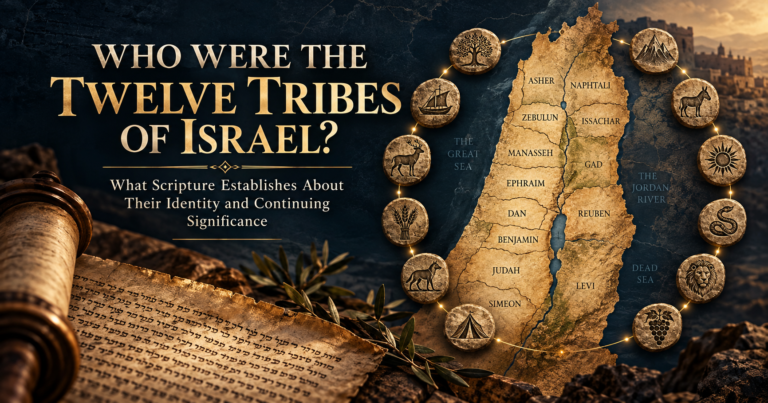
In Scripture’s foundational account, Israel is first a person: Jacob, whose name Yahweh changes to Israel. Genesis 35:22–26 names his twelve sons. Genesis 46:8–27 lists the household that went to Egypt. Genesis 49:1–28 addresses Jacob’s sons as the fathers of Israel’s tribes. The basic framework is ancestry, household, and tribe.
Numbers 1:1–47 makes the pattern even plainer. Israel is counted “by their clans, by their fathers’ houses,” with tribes and named leaders. First Chronicles 1–9 likewise devotes extensive space to genealogies, tribal lines, towns, and families. These records do not prove that every Israelite in every age could document a complete pedigree. They do establish what an Israelite or tribal claim ordinarily meant in the biblical world: a kinship claim connected to Jacob’s descendants, not an identification based on a later skin-color category.
Hebrew terms reinforce the point without solving modern claims by themselves. Yisra’el may refer to Jacob, his descendants, the united people, or sometimes the northern kingdom, depending on context. Shevet commonly means tribe in tribal settings; mishpachah refers to family or clan; and zera‘ means offspring or descendants. All are relational and genealogical categories. None is a biblical equivalent of “Black,” “white,” African American, or another modern race.
This does not mean ancestry is the only biblical concern. Foreigners could join Israel’s covenant life, and Scripture repeatedly requires justice and welcome for the resident alien. Yet covenant incorporation does not erase the distinction between descent, tribal location, covenant participation, and later racial labels. A collective claim to be “the true Israelites” in a genealogical sense therefore needs a credible connection to Jacob’s descendants. A later experience of curses cannot create the genealogy that the claim seeks to prove. For the tribal framework itself, see Who Were the Twelve Tribes of Israel?
What Deuteronomy 28 actually says
Deuteronomy 28 belongs to Moses’ covenant instruction to Israel. Verses 1–14 set blessings before Israel if it listens to Yahweh’s voice and carefully keeps his commandments. Verse 15 introduces the opposite outcome for disobedience. The curses are thus not presented as a neutral prediction about whichever later people experience oppression. They are covenant sanctions addressed to Israel.
The chapter’s judgments are broad and cumulative: sickness, crop failure, drought, defeat, foreign exploitation, loss of children and livestock, siege, famine, removal from the land, scattering, fear, and despair (Deuteronomy 28:15–67). Verses 49–57 describe a foreign nation from afar, whose language Israel does not understand, besieging fortified towns until hunger becomes horrific. The account includes the terrible image of parents consuming their own children under siege. This is not incidental background; it is part of the curse sequence that must frame any appeal to verse 68.
Deuteronomy 28:63–68 then speaks of removal from the land and scattering among all peoples. It says Israel will find no ease among those nations and will live with trembling heart, failing eyes, and despair. Finally, it says Yahweh will bring Israel back to Egypt in ships, by a route concerning which he had said they would not see it again; there they would offer themselves to enemies as male and female slaves, but no one would buy them.
The terms place limits on interpretation. Mitsrayim ordinarily means Egypt. ’Oniyyot means ships or vessels. The text does not name America, the Atlantic Ocean, Europeans, West Africa, Black Americans, or the transatlantic slave trade. Nor does it give a physical description of Israelites, establish a racial category, or say that a future people may prove tribal descent by undergoing slavery after sea travel.
The surrounding Torah confirms the covenant pattern. Deuteronomy 4:25–31 and Leviticus 26:14–45 warn of dispersion but also call Israel to seek Yahweh in distress. Deuteronomy 30:1–10 follows the curses with return, restoration, and heart transformation when the people return to him. Deuteronomy 28 is therefore not a free-floating ethnic fingerprint; it is part of a covenant sequence of judgment, repentance, mercy, and restoration. A fuller reading is available in Deuteronomy 28: What Do the Blessings, Curses, and Exile Actually Mean?.
The ancient exile context controls the first reading
The strongest contextual reading begins with the people to whom Deuteronomy was addressed and with the later biblical narratives that interpret Israel’s disasters. Second Kings 17:6–23 describes Assyria’s defeat of the northern kingdom, deportation of Israelites, and resettlement of other peoples in Samaria. The passage explicitly explains the catastrophe as judgment for Israel’s persistent covenant unfaithfulness. Its themes of foreign conquest, removal, and dispersion closely fit Deuteronomy’s warning.
Second Kings 25:1–21 describes Babylon’s siege of Jerusalem, severe famine, the breach of the city, the burning of the temple and houses, and deportation from Judah. These events are especially relevant to Deuteronomy 28:52–57. A siege that reduces a city to starvation is not an abstract prediction awaiting a modern fulfillment; Scripture itself later records such covenant judgment against Judah.
This does not require the claim that every phrase in Deuteronomy 28 was exhausted in one Assyrian campaign or one Babylonian invasion. The chapter’s warnings are extensive, and interpreters debate how individual details relate to particular events. But Assyrian and Babylonian crises are the most immediate canonical contexts for its language. They must be considered before a reader transfers the chapter to a modern event thousands of years later.
Nor does exile mean that Yahweh’s covenant purpose was permanently erased. Deuteronomy 30 anticipates a dispersed people being gathered when they return to Yahweh. Leviticus 26 ends its warning with Yahweh remembering his covenant with Jacob, Isaac, and Abraham. The ancient historical-covenantal reading does not deny that later oppression may resemble biblical curse language. It insists that resemblance must be read after, not instead of, the text’s covenant addressee and its own historical setting.
The strongest Black Hebrew Israelite argument
Black Hebrew Israelite is a broad label, not a single doctrine or organization. Communities identified by that label differ over Torah observance, Yeshua’s identity, Gentile inclusion, salvation, modern Jews, and race. It is neither accurate nor useful to assign every adherent the most extreme views held by any group. The question here is whether the central identification argument is supported.
The strongest form of that argument is cumulative. Many teachers argue that Deuteronomy 28 describes Black American history through ships, enslavement, foreign rule, dispersion, loss of identity, fear, poverty, and enduring oppression. The transatlantic slave trade did indeed involve forced maritime transport, commercial sale of human beings, violent family rupture, dispossession, and generations of racialized bondage and discrimination in the Americas. Those parallels should not be denied.
The argument often adds that scattered Israelites lost records of tribal identity, were renamed by oppressors, and can now be recognized through the curse pattern. Some versions connect restoration texts in Isaiah, Jeremiah, Hosea, Joel, and Amos to the same conclusion. Some also appeal to Revelation 2:9 and 3:9 against modern Jewish claims, and to modern Twelve Tribes charts assigning Black Americans and other diaspora populations to Judah, Benjamin, Levi, Ephraim, or other tribes.
The conclusion sought is substantial: Black Americans, sometimes together with other populations, are said to be covenant Israel in a unique ancestral sense, while modern Jews are often treated as false claimants. The central question is therefore not whether Atlantic slavery was real or whether some biblical language resembles it. The question is whether those similarities establish collective descent from Jacob and, in some versions, descent from particular tribes. That genealogical step requires evidence beyond resemblance.
Why ships, slavery, and scattering do not prove tribal descent
Deuteronomy 28:68 must be tested as a whole. It contains Egypt, ships, sale to enemies as male and female slaves, and the statement that no one will buy. The Atlantic comparison highlights ships and slavery, and those are genuine points of historical similarity. But a proposed fulfillment must also account for the destination named in the verse and for the final no-buyer clause rather than selecting only its most familiar terms.
Some interpreters take Egypt literally, which is the ordinary sense of Mitsrayim. Others contend that Egypt may evoke a figurative condition of bondage or reversal, allowing a destination other than geographic Egypt. That proposal should not be dismissed merely by assertion, since Scripture can use Exodus imagery beyond one historical setting. Yet even if a reader judges a figurative resonance possible here, Deuteronomy 28:68 does not say that America is Egypt. That identification is an additional inference requiring its own evidence.
The statement that Israel would offer itself for sale but find no buyer is also difficult to align simply with the successful commercial slave markets invoked in the Atlantic comparison. Some explain the phrase as no one being willing to purchase such degraded captives; others take it as no one able or willing to redeem them. Neither proposal straightforwardly describes a specific later slave economy in which millions were bought and sold. This difficulty does not settle every question about the verse, but it prevents an effortless equation between the text and the transatlantic trade.
More broadly, conquest, deportation, siege, famine, enslavement, scattering, and trauma have occurred in many settings. The more general a proposed set of marks becomes, the less it can uniquely identify one people. A curse pattern may resemble multiple histories of oppression without functioning as a racial or genealogical diagnostic.
The documented Atlantic trade establishes that diverse African peoples and their descendants endured forced transport and slavery. It does not establish a historical chain from Jacob’s tribes to West or West-Central African populations and then to Black Americans as a whole. Black American identity includes people and families with varied African, American, European, Caribbean, and other ancestries; it cannot itself be equivalent to one ancient clan, tribe, or household.
The strongest opposing reading is therefore straightforward: Deuteronomy 28 is principally a covenant warning to ancient Israel, substantially illuminated by exile and diaspora, and it cannot identify a modern racial population without independent evidence of Jacob-derived ancestry. Rejecting this argument does not prove that no Black individual, family, or community could have Israelite ancestry. It means that Deuteronomy 28 does not establish that ancestry for Black Americans collectively.
Exile did not erase every Israelite identity claim
Scripture supports severe disruption of Israelite life, deportations, lost homes, and—in some cases—incomplete genealogical records. It does not explicitly teach that all Israelites permanently lost every form of collective identity. Before the northern kingdom’s final fall, Hezekiah invited Ephraim, Manasseh, Zebulun, and other northern areas to keep Passover in Jerusalem (2 Chronicles 30:1–11, 25–27). Some mocked the invitation, but some humbled themselves and came. The text does not treat northern Israelites as an unknowable racial mystery.
After the Babylonian exile, Ezra 1–2 and Nehemiah 7 preserve registers of returning families, towns, priests, Levites, and lay people. Some priestly families could not establish their genealogies and were excluded from priestly privileges until the matter could be resolved. That is important evidence of real disruption. But it is also evidence against a total-erasure claim: the community retained substantial family and communal identification and regarded verifiable genealogy as meaningful.
Other texts continue this pattern. Esther 2:5–7 identifies Mordecai as a Jew from a Benjaminite family in the Persian realm. Luke 2:36–38 identifies Anna with the tribe of Asher. Acts 2:5–11 portrays Jews from many diaspora regions gathered in Jerusalem. In Acts 26:6–7, Paul speaks of “our twelve tribes” in connection with Israel’s hope. James 1:1 addresses “the twelve tribes in the Dispersion,” whether one understands that phrase as literal diaspora-Israel language, a Christian-covenant designation, or a combination of both.
Romans 9–11 requires equal care. Romans 9:3–5 calls Paul’s kinsmen according to the flesh Israelites and names their covenant privileges. Romans 9:6–13 argues that Yahweh’s saving promise and election are not reducible to physical descent alone. Romans 11:1 identifies Paul as an Israelite from Benjamin, and 11:1–2 denies that God has rejected his people. Gentile inclusion through faith and Yahweh’s sovereign mercy do not establish a biological replacement of ethnic Israel by a modern racial population. Conversely, these texts do not guarantee that every modern person claiming Jewish continuity can document a particular tribe.
Restoration texts, complexion texts, and Revelation
Isaiah 11:11–12, Isaiah 42:22, Jeremiah 16:13–15, Jeremiah 30–31, Hosea 1–2, Joel 3:1–8, and Amos 9:9–15 all speak meaningfully about Israel or Judah’s judgment, scattering, preservation, and restoration. Interpreters differ about the relation of these texts to returns from exile, future regathering, Messiah-centered fulfillment, and the nations. But none explicitly identifies Black Americans as the exclusive restored people.
Amos 9 says Yahweh will sift the house of Israel among nations while preserving it under judgment; it does not provide a racial method for locating a modern diaspora. Joel 3 condemns nations for scattering Yahweh’s people, dividing his land, and selling Judeans and Jerusalemites. Its stated referents are Judeans and Jerusalemites, not a modern racial category. Jeremiah 30–31 speaks of Jacob, Israel, Judah, land, covenant, and Davidic hope; a specific modern nation or race mapping requires an argument not supplied in the chapters themselves.
Scripture also does not identify Israelites by skin color. In Song of Songs 1:5–6, the woman’s dark appearance is poetic and connected to sun exposure through vineyard labor. Jeremiah 14:2 belongs to a drought lament, not an ethnic census. Lamentations 4:7–8 contrasts former appearance with a darkened appearance under famine and siege; the change is an effect of catastrophe. These texts cannot bear a claim about inherited racial identity.
Daniel 7:9 and Revelation 1:14–15 are visionary depictions. The Ancient of Days’ white hair and Yeshua’s fiery eyes and metal-like feet communicate glory, authority, purity, and judgment within apocalyptic imagery. They do not provide a modern racial portrait of all Israelites or of the Messiah. One should not answer racial proof-texting with unsupported certainty about the exact complexion of every ancient Israelite; Scripture does not offer a modern anthropological taxonomy.
Revelation 2:9 and 3:9 need especially careful treatment. These messages address assemblies in Smyrna and Philadelphia facing particular first-century opponents. The Greek Ioudaios can carry Jewish or Judean dimensions according to context. The identity of the group called a “synagogue of Satan” remains disputed: proposed readings include local non-Messianic Jewish opponents, rival Jewish or Yeshua-following groups, and other local conflicts. The phrase is severe polemic in a concrete setting. It is not a universal verdict on all Jews in later centuries, and it does not transfer Israelite ancestry to Black Americans or any other modern group.
Revelation 7 likewise supplies no modern tribal chart. Verses 1–8 name tribes in the vision of the sealed 144,000; interpreters debate whether the list is literal, symbolic, or both. Verses 9–17 immediately portray an innumerable multitude from every nation, tribe, people, and language before the throne. Across the principal readings, the chapter does not assign present ethnicities or nationalities to Reuben, Judah, Benjamin, Ephraim, or the other tribes.
Modern charts, history, and genetics
Modern Twelve Tribes charts go beyond Scripture. The Bible contains tribal lists, but no chart assigning contemporary racial groups, nations, or diaspora communities to those tribes. It also gives no method for deriving such assignments from complexion, colonial history, language, economic status, or a people’s experience of suffering. Different charts often make different assignments, which underlines the lack of a biblical control.
History should be treated with the same discipline. The transatlantic slave trade was a vast, well-documented forced migration involving numerous African embarkation regions and numerous destinations in the Americas. That historical record strongly supports the reality and scale of maritime slavery. It does not document a migration of Israelite tribes into the Atlantic system, nor does it establish that the diverse descendants of enslaved Africans are collectively one or more tribes of Jacob.
Population genetics has a limited role. It can sometimes illuminate broad affinity, admixture, migration, or a particular documented family question. It ordinarily cannot demonstrate descent from a named biblical tribe. Broad population continuity, individual pedigree, covenant identity, and tribal proof are distinct claims. Genetic evidence should neither be treated as a substitute for Scripture nor forced to answer questions for which the available ancient samples and historical records are inadequate.
The same caution applies in every direction. Scripture does not rule out Israelite ancestry for particular persons of African descent, just as it does not certify every individual modern Jewish claim to a particular tribe. Such questions require case-specific historical and genealogical evidence. A method that turns broad resemblance into certainty should be tested by the same standards used for other identity and prophecy claims; see How Scripture Tests Prophetic Claims: A Berean Framework for Discernment.
Berean verdict: what the text establishes
What Scripture explicitly establishes: Israel is Jacob-derived and organized through families, fathers’ houses, and tribes. Deuteronomy 28 warns covenant Israel that disobedience will bring invasion, siege, famine, removal from the land, scattering, fear, and a return-to-Egypt-in-ships slavery statement. Scripture also depicts continuing Jewish, Israelite, tribal, and diaspora identity after the Assyrian and Babylonian catastrophes.
What Scripture reasonably permits: individual families or communities, including persons of African descent, may possibly have some Israelite ancestry; exile could obscure particular genealogies; and restoration texts may have dimensions about which faithful interpreters continue to differ.
What remains debated: whether Egypt in Deuteronomy 28:68 carries only its geographical meaning or also a bondage resonance; how fully particular ancient events correspond to every curse detail; and how Revelation 7’s tribal imagery functions. Those debates do not produce a modern racial identification.
What goes beyond the evidence: that ships and slavery prove Black Americans collectively are Israelites; that Blackness identifies a tribe of Jacob; that America is explicitly Egypt; that modern Twelve Tribes charts are biblically authorized; or that Revelation’s synagogue language proves all modern Jews are impostors.
Berean judgment: Scripture does not identify Black Americans collectively as the exclusive descendants of biblical Israel, nor does it provide a racial fingerprint by which a modern population can be assigned to Jacob’s tribes. Deuteronomy 28 establishes covenant judgment against Israel; it does not provide a method for proving modern genealogy through slavery, ships, oppression, or skin color. This does not rule out Israelite ancestry for particular individuals or families of African descent. Such ancestry would require independent historical or genealogical evidence. Scripture therefore gives us warrant to reject certainty where the evidence does not establish it—and to stop where the text stops.
Discussion
Join the Discussion
Test the claim with Scripture. Address the text and the argument, not the person. Comments may be held for moderation.
Keep it Berean: cite the text when possible, make the argument clearly, and keep disagreement respectful.