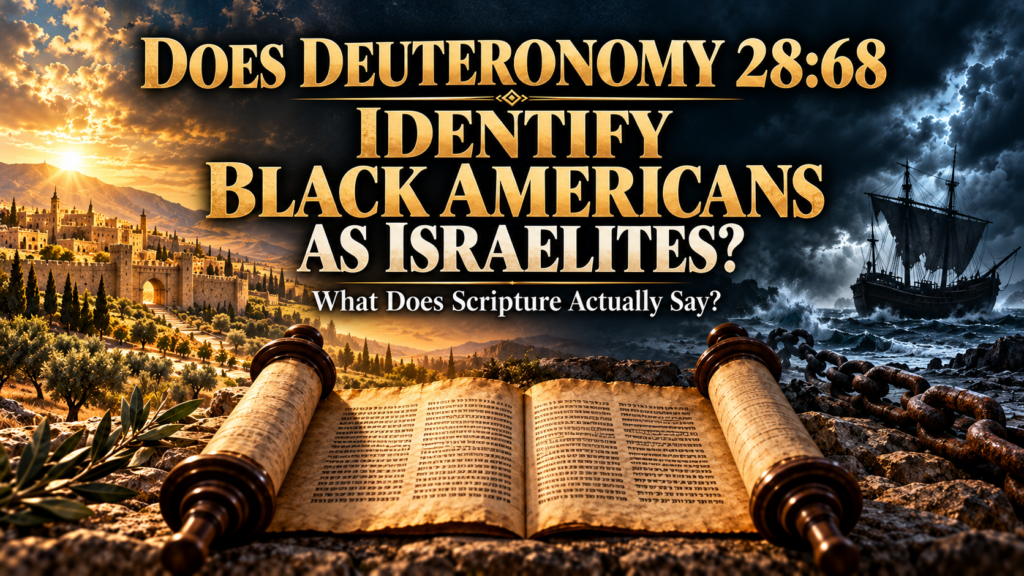
The transatlantic slave trade was an enormous and particular evil: millions of African men, women, and children were violently displaced, transported across the ocean, sold, exploited, and separated from family and homeland. That evil does not depend on whether Deuteronomy 28:68 predicted it. The narrower question is textual: does this verse directly foretell the Atlantic slave trade, and does it therefore identify Black Americans collectively as biblical Israel?
Those are not the same as asking whether particular people or families of African descent may have Israelite ancestry. A possibility of ancestry in some lines differs from a claim about the collective genealogy of a modern racial population. For the wider covenant setting of the chapter, see Deuteronomy 28: What Do the Blessings, Curses, and Exile Actually Mean? This study stays with the final verse of the curse section and the arguments built from it.
The covenant setting: Moses addresses Israel
Deuteronomy places Moses on the plains of Moab, speaking to Israel before entry into the land (Deuteronomy 1:1–5). Chapters 27–30 form a covenant unit. Chapter 27 identifies Israel as Yahweh’s covenant people and pronounces curses on covenant violations. Deuteronomy 28 sets blessings for obedience beside curses for disobedience. Chapter 29 explains national devastation as the consequence of forsaking Yahweh’s covenant, and chapter 30 anticipates mercy and restoration when the scattered people return to Yahweh.
The governing condition appears at Deuteronomy 28:15: the curses come if Israel does not obey Yahweh’s voice and carefully do his commandments and statutes. The immediate addressees, therefore, are not an unnamed future ethnic group whose identity must be decoded from calamity. They are the covenant people Moses addresses.
This does not prevent later readers from seeing patterns, applications, or partial historical correspondences. But it establishes the order of interpretation. Verse 68 first threatens Israel with covenant judgment. To apply it directly to a modern people requires an additional argument showing why that people should be identified with the original addressees. The argument cannot assume the conclusion by treating the later people as Israel before the text has established it.
The movement of Deuteronomy 28:15–68
The curse section is cumulative. It moves through bodily affliction and agricultural loss, military defeat, loss of children and property, oppression, service to enemies, siege, famine, uprooting from the land, scattering, and inward terror. Israel may be defeated before enemies and become an object of horror among the kingdoms (v. 25). Sons and daughters may be given to another people while Israel suffers continual oppression and robbery (vv. 32–33). Those who would not serve Yahweh in abundance will serve enemies in hunger, thirst, nakedness, and want; an iron yoke is placed on the neck (vv. 47–48).
The passage then depicts an enemy nation, siege within Israel’s towns, and devastating famine (vv. 49–57). Yahweh uproots the disobedient people from the land and scatters them “among all peoples” (vv. 63–64). There they experience instability, dread, despair, and the wish that day or night would quickly change (vv. 65–67). Verse 68 is the final intensification of this covenant judgment, not a detached code for identifying a later population.
The same covenant pattern appears elsewhere. Leviticus 26 warns of terror, defeat, desolation, and scattering, while holding out mercy upon confession. Deuteronomy 4:25–31 likewise joins dispersion among the peoples with the promise that those who seek Yahweh may find him. Deuteronomy 30:1–10 follows the curses with promised restoration after Israel returns to Yahweh. These contexts do not make the judgment light; they show that the chapter concerns covenant discipline, exile, and restoration—not a freestanding ethnic test based on suffering.
A close reading of Deuteronomy 28:68
The ESV renders the verse:
“And the LORD will bring you back in ships to Egypt, a journey that I promised that you should never make again; and there you shall offer yourselves for sale to your enemies as male and female slaves, but there will be no buyer.”
The divine name appears as LORD in this translation; the speaker is Yahweh. The verse contains four major elements: return to Egypt, transport by ships, reduction to male and female slave status before enemies, and the final statement that no buyer exists.
Egypt. The Hebrew Mitsrayim is the ordinary proper name for Egypt. It does not lexically mean “bondage.” Yet Egypt is the place from which Yahweh delivered Israel, so the name carries powerful exodus associations in this setting. The threat is dreadful precisely because Yahweh may reverse Israel’s foundational deliverance.
Return. The verb vehesivkha means that Yahweh will bring back or cause to return. The singular “you” is Deuteronomy’s customary corporate address to Israel, not a prediction concerning one future person.
Ships. Ba’oniyyot means “by ships” or “in ships.” It specifies transport by sea. It does not name an ocean, route, vessel type, captor ethnicity, date, Africa, Europe, or the Americas. The ships are significant, but they are not self-interpreting.
Sale and slavery. The form vehitmakartem can be rendered “you will sell yourselves,” as in the ESV’s “offer yourselves for sale,” or idiomatically “you will be sold.” English versions differ because the form is grammatically complex. Either way, the result is not voluntary consent to oppression. The curse portrays utter humiliation: the people are reduced to being available to enemies as la’avadim velishfachot, male and female slaves.
No buyer. Ve’en qoneh literally says, “and there is no buyer.” The verse does not explain why. Many interpreters understand it as an added humiliation: captives are so numerous, so broken, or so unwanted that even their sale cannot be completed. That is plausible, but it remains an explanation rather than an explicit statement. The clause does not directly mean that no one can escape, that slavery will later be abolished, or that the captives possess no human worth.
Egypt and ships: an exodus reversal
The strongest contextual reading takes Egypt as actual Egypt with theological force. Deuteronomy 17:16 forbids Israel’s king from causing the people to return to Egypt for horses, adding that Yahweh had said they must never return that way again. Deuteronomy 28:68 deliberately turns that prohibition into a curse. The people delivered from Egypt may be brought back there under judgment.
That does not make Egypt a merely flat geographical detail. Exodus deliverance is central to Israel’s identity, and a return to Egypt signifies a catastrophic undoing. Hosea also uses return-to-Egypt language as judgment imagery; in related contexts, Hosea can speak of Assyria in the same horizon of punishment (Hosea 8:13; 9:3; 11:5). Those passages show that Egypt-return language may have typological force rooted in the exodus. They do not redefine Mitsrayim to mean every place of oppression, nor do they identify America as Egypt.
Jeremiah 42–44 provides an important historical comparison. After Babylon destroyed Jerusalem, part of Judah’s remnant went to Egypt despite prophetic warning, and Jeremiah announced judgment there. This confirms that an actual movement of Judeans to Egypt belonged to Israel’s later covenant history. It does not, however, report the complete ships-and-no-buyer scenario of Deuteronomy 28:68.
The same care is needed with ships. The Atlantic slave trade undeniably used ships for forced human transport, and that is a real parallel. But ships were also integral to ancient Mediterranean commerce, warfare, deportation, captive movement, and slave trading. Maritime slave systems existed long before the Atlantic world. Therefore, “by ships” can make an Atlantic comparison emotionally and historically meaningful, but it cannot uniquely identify the Atlantic trade.
Testing the transatlantic reading fairly
The strongest Black Hebrew Israelite reading begins from genuine parallels. Descendants of enslaved Africans endured forced displacement by ship, foreign domination, enslavement, dispossession, family rupture, diaspora, and deep intergenerational trauma. Several of these realities resemble themes in Deuteronomy 28. That resemblance should not be dismissed because of the movement with which an argument is associated.
Still, each claim must be tested by what the verse actually says.
- “Ships” means transatlantic slave ships. Explicitly, the text says ships. It does not say Atlantic ships, West African ports, European traders, American plantations, or an early-modern date. The proposed connection is an analogy followed by a further identification; it is not the verse’s stated referent.
- “Egypt” means bondage rather than Egypt. Egypt naturally evokes Israel’s bondage, but the word names Egypt. A reader may apply Egypt typologically to later captivity, especially because of the exodus-reversal motif. Yet that application adds a premise the text does not state: that Egypt here should be substituted with the Americas or generalized bondage.
- Africans were sold as slaves exactly as predicted. The broad parallel is tragically real. But the verse names Egypt as destination, addresses covenant Israel, and ends with “no buyer.” Enslaved Africans were bought and sold on a vast and horrific scale. That historical fact creates a substantial difficulty for claims of exact fulfillment, not a minor detail that can be omitted.
- “No buyer” means captives were worthless, abandoned, or unable to gain freedom. None of these explanations appears in the clause itself. Its word is “buyer,” not redeemer, liberator, or rescuer. The verse gives a scene of failed sale or unpurchased enslavement; it does not define the social or economic reason.
- Therefore, Black Americans collectively are Israelites. This conclusion requires several additional premises: that Egypt means America or a generic captivity; that the warning awaited a remote, exclusive fulfillment; that the original Israelite addressees are genealogically identical with a modern racial population; and that shared calamity proves descent. Verse 68 supplies none of those premises.
Historical suffering may warrant serious inquiry, lament, and solidarity. It does not by itself establish genealogy. Collective identification needs independent historical and genealogical evidence, and where relevant carefully interpreted genetic evidence. A verse describing covenant judgment cannot bear that burden alone.
Ancient judgments and the 70 CE proposal
Israel and Judah’s ancient history provides the first historical horizon for Deuteronomy’s warnings. Second Kings 17 interprets the Assyrian removal of the northern kingdom through Israel’s persistent unfaithfulness. Second Kings 25 and 2 Chronicles 36 describe Babylon’s destruction of Jerusalem and Judah’s deportation. Lamentations depicts the resulting dispossession, servitude, grief, and humiliation. These texts demonstrate that conquest, exile, loss of land, and scattering were not merely remote possibilities; they occurred within Israel and Judah’s covenant history.
They do not prove that every feature of Deuteronomy 28:68 was exhausted in a single event. Nor should readers claim more than the evidence permits about 70 CE. Josephus reports in Jewish War 6.418 that, after Jerusalem’s fall, Titus sent captives over seventeen years old to Egyptian mines, sent many others to provincial spectacles, and sold those under seventeen as slaves. This is significant evidence of Roman forced labor, enslavement, and an Egyptian destination for some Judean captives.
But Josephus does not say in that report that captives traveled to Egypt by ship. He does not say that the same people were sold in Egypt, and he does not say no buyer could be found. The account supports a possible partial correspondence within a recurring covenant-judgment pattern. It does not document a point-for-point fulfillment of Deuteronomy 28:68.
Berean verdict
What the text explicitly establishes: Deuteronomy 28:68 threatens covenant Israel with Yahweh bringing it back to Egypt by ships, reducing men and women to slave status before enemies, and ending with the humiliation that there is no buyer. It names Egypt, ships, slaves, and no buyer. It does not name Black Americans, Africans, Europeans, the Atlantic Ocean, America, skin color, or a modern date.
What can reasonably be inferred: the verse deliberately reverses the exodus and portrays the extremity of covenant judgment. Its language may legitimately resonate with later histories of slavery, forced displacement, and diaspora. Egypt may also carry typological significance beyond bare geography.
What remains debated or unsupported: the precise ancient scenario behind transport by ships, a symbolic extension of Egypt to a later place of bondage, and a partial Roman-era correspondence are debated matters. None establishes a direct prophecy of the transatlantic slave trade. Deuteronomy 28:68 also does not establish that Black Americans, as a collective, are Israelites.
Rejecting that proposed fulfillment does not diminish the evil of slavery or the obligation to pursue truth, lament, justice, and careful historical inquiry. Readers examining the broader identity claim may continue with Are Black Americans Israelites? What Does Scripture Actually Say? Scripture should be allowed to name what it names—and should not be made to settle a genealogical claim it does not itself state.
Discussion
Join the Discussion
Test the claim with Scripture. Address the text and the argument, not the person. Comments may be held for moderation.
Keep it Berean: cite the text when possible, make the argument clearly, and keep disagreement respectful.