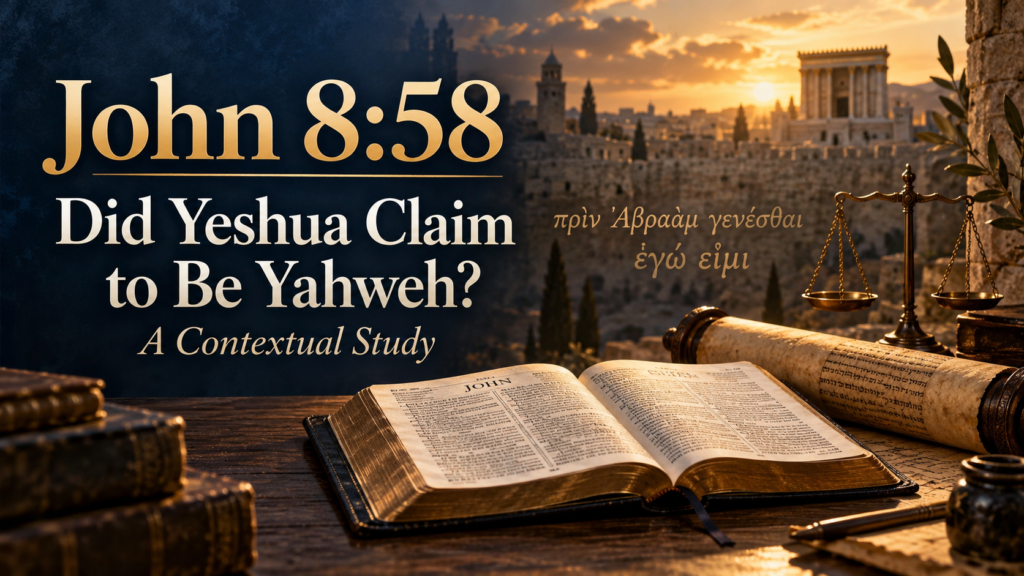
The Short Answer
No. John 8:58 does not, by itself, establish that Yeshua claimed to be Yahweh.
Yeshua (Jesus) was making a massive claim about His identity and His place in Yahweh’s messianic purpose. He was placing Himself above Abraham in a striking way. But John 8:58 does not, by itself, establish that He was claiming to be the One True God. Let’s weigh the text on the scale and see what it actually says.
Read the Story First
Before we jump to the Old Testament, we have to read what is happening in John chapter 8.
People were arguing with Yeshua. They asked Him, “Are you greater than our father Abraham?” They also asked, “Who do you think you are?”
Notice how Yeshua answers. He points straight to His Father. He says: “It is My Father who glorifies Me, of whom you say, ‘He is our God.’” (John 8:54).
Look closely at that. Yeshua distinguishes Himself from the Father, whom His opponents call their God. He does not say, “I am the God you worship.”
What Does “I Am” Mean in Greek?
In John 8:58, Yeshua says, “Before Abraham came to be, I am.” In the Greek language, the words for “I am” are egō eimi.
Many people are taught that these Greek words are a secret code for God. But they are not.
In the very next chapter (John 9:9), a blind beggar is asked if he is the man who used to sit by the road. The beggar answers with the exact same Greek words: egō eimi. He just meant, “I am the man.”
The blind beggar was not claiming to be God. He was just speaking normal Greek. So, the words “I am” do not automatically mean “I am Yahweh.”
Did Yeshua Quote the Burning Bush?
People often say Yeshua was quoting the burning bush in Exodus 3:14 when God told Moses “I AM WHO I AM.”
But let’s test that claim. In the ancient Greek translation of the Old Testament, Exodus 3:14 reads egō eimi ho ōn, meaning “I am the One who is.” Yahweh then tells Moses to say, “The One who is” (ho ōn) has sent him.
Yeshua does not say ho ōn in John 8:58. He says egō eimi. So He was not quoting Exodus 3:14 word-for-word.
The Sender and the Sent
Yeshua uses language that strongly echoes Yahweh’s declarations in Isaiah. For example, Isaiah 43:10 uses egō eimi when Yahweh says, “that you may know and believe… that I am He.” John uses very similar language in places like John 8:24 and John 8:28. That makes Yeshua’s words far more serious than ordinary speech—but an echo of Yahweh’s language is not automatically the same thing as claiming to be Yahweh.
The Gospel of John clearly shows us the difference between them: Yahweh sends, and Yeshua is sent.
Yeshua says He only speaks the words His Father taught Him. He does not come on His own. In John 17:3, Yeshua calls the Father “the only true God” and identifies Himself as the Messiah whom the Father sent. We cannot use one verse to erase the rest of the book.
Why Did They Try to Stone Him?
People often argue, “But they tried to stone Him for blasphemy! They must have known He was claiming to be God!”
John 8:59 says they picked up stones, but that verse never states the exact charge against Him.
Yeshua had just placed Himself in an extraordinary position over Abraham, saying that Abraham rejoiced to see His day. Their reaction shows they understood Yeshua’s statement as intolerable. But John does not tell us the exact charge in verse 59, so their reaction cannot settle the meaning of the statement for us.
Existing Before Abraham Does Not Automatically Mean Yahweh
Yeshua says, “Before Abraham came to be, I am.”
Yeshua is placing Himself before Abraham in a striking way, and many understand this as a claim to personal preexistence. That is a huge deal. But we still have to keep the claims separate.
Even if Yeshua is claiming personal existence before Abraham, preexistence and identity with Yahweh are still two different claims. One does not automatically prove the other.
The Berean Verdict
We must weigh everything on the scale.
John 8:58 presents Yeshua as greater than Abraham and may point to personal existence before Abraham. It also uses language that strongly echoes Yahweh’s declarations in Isaiah. But the verse never says, “I am Yahweh,” it is not a direct quotation of Exodus 3:14, and John 8:59 does not state the exact charge behind the attempted stoning.
So we should not force John 8:58 to say more than it says. Yahweh is the One True God, and Yeshua is His Messiah, Son, and King.
We don’t read Scripture to defend an inherited system. We put the claim on the scale. We test the words. We read the context. And we stop where the text stops. ⚖️
Discussion
3 Comments
Test the claim with Scripture. Address the text and the argument, not the person. Comments may be held for moderation.
Keep it Berean: cite the text when possible, make the argument clearly, and keep disagreement respectful.