Why John 8:58 Matters
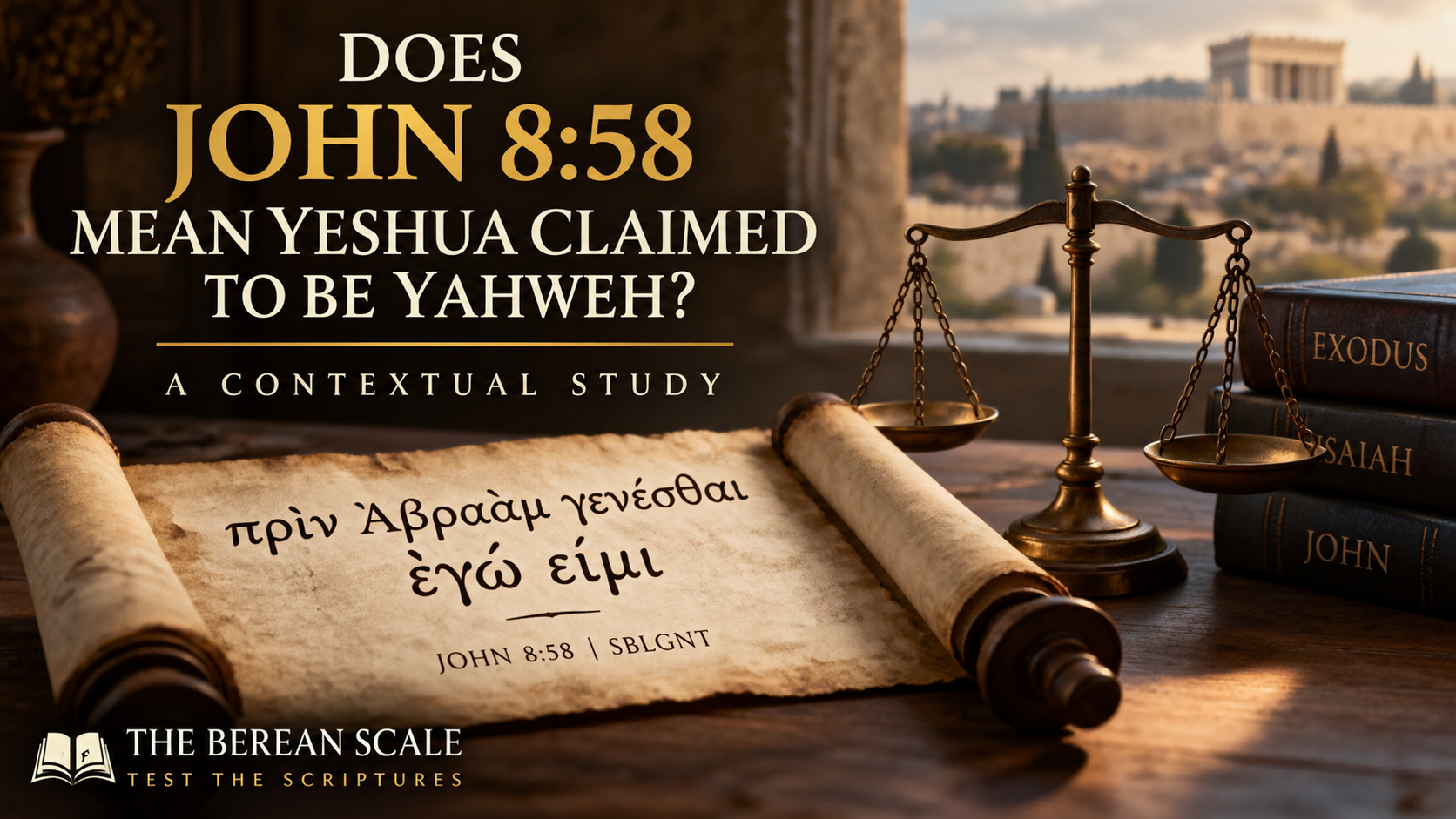
Few statements attributed to Yeshua have carried as much theological weight as John 8:58:
“Truly, truly, I say to you, before Abraham came to be, I am.”
In Greek:
πρὶν Ἀβραὰμ γενέσθαι ἐγώ εἰμι — SBLGNT prin Abraam genesthai egō eimi [1]
For centuries, this verse has occupied a central place in debates over the identity of Yeshua. Many Christian interpreters understand the statement as one of the clearest declarations of Yeshua’s divine identity. The argument is familiar: Yahweh identifies Himself at the burning bush with “I AM” in Exodus 3:14; Yeshua declares egō eimi—“I am”—in John 8:58; his opponents immediately attempt to stone him. Read together, these features are often taken to mean that Yeshua deliberately identified himself with Yahweh.
That interpretation deserves serious examination. But a Berean investigation cannot begin by assuming either its truth or its falsehood.
The question is not: “Which theological tradition have we inherited?” Nor is it: “Which conclusion do we want John to reach?” The question is: What does the text actually establish?
That requires more than isolating two Greek words.
More Than “I Am”
The expression ἐγώ εἰμι (egō eimi) unquestionably appears in John 8:58. But those same words can function as ordinary Greek. In John 9:9, the formerly blind man uses egō eimi to identify himself: “I am he.”
At the same time, the Septuagint—the ancient Greek translation of the Hebrew Scriptures—also uses egō eimi in Yahweh’s solemn self-declarations, particularly in Isaiah.
So neither extreme will do. It is inadequate to argue: “Egō eimi automatically means Yahweh.” But it is equally inadequate to argue: “Egō eimi is ordinary Greek, therefore the expression cannot carry scriptural or theological significance.”
Context determines meaning. And John’s context is unusually rich.
The Questions We Must Actually Ask
Before reaching a conclusion, several separate issues must be weighed:
- Does John 8:58 actually quote Exodus 3:14, or is the linguistic connection less direct than commonly assumed?
- Does John instead draw upon Yahweh’s “I am he” declarations in Isaiah, where the Greek parallels are considerably stronger?
- Why does Yeshua contrast Abraham’s coming to be (genesthai) with his own present-tense egō eimi?
- Does that construction indicate personal preexistence, existence extending from the past, foreordination within Yahweh’s purpose, or something still greater?
- What does Yeshua mean when he says, “Abraham rejoiced to see My day”?
- Why do his opponents pick up stones?
And perhaps most importantly: If John deliberately places language associated with Yahweh on the lips of Yeshua, what theological conclusion does John expect the reader to draw from it?
Does shared language require shared identity? Or can the Gospel’s persistent themes of sending, authorization, name-bearing, revelation, and divine agency account for some or all of that language while preserving the distinction John repeatedly makes between the Father and the Son?
Those questions cannot be answered responsibly by a slogan. They require exegesis.
Two Truths Must Be Allowed to Stand
John’s Gospel presents an extraordinarily exalted Messiah. Yeshua speaks of heavenly origin. He speaks of glory before the foundation of the world. Abraham rejoices to see his day. He performs works given to him by the Father. He bears the Father’s name and speaks the Father’s words. He uses language that appears to echo Yahweh’s declarations in Isaiah.
A serious reading cannot minimize those claims.
Yet the same Gospel repeatedly presents Yeshua as the one sent by the Father, taught by the Father, authorized by the Father, and glorified by the Father. And Yeshua addresses the Father as “the only true God” while identifying himself as “Yeshua Messiah whom You have sent.”
A serious reading cannot minimize those statements either. The task is therefore not to make one set of texts disappear beneath another. It is to allow all of John’s testimony to remain on the table at once.
The Berean Method
This study will therefore proceed from the text outward rather than from later theological systems backward. We will examine:
- The immediate argument of John 8.
- The Greek grammar of genesthai and egō eimi.
- John’s other uses of egō eimi.
- The Hebrew and Greek of Exodus 3:14.
- The much stronger Isaiah LXX parallels.
- Abraham’s relationship to Yeshua’s “day.”
- Preexistence and foreordination.
- The attempted stoning.
- The distinction between exaltation, agency, preexistence, and identity.
The conclusion will not depend upon denying Yeshua’s extraordinary status. Nor will it depend upon making John say less than he says.
The standard is simpler: Establish what the text establishes. Distinguish what can reasonably be inferred. Refuse to turn an inference into an explicit statement of Scripture.
John 8:58 deserves that level of care. So before declaring that these five Greek words settle the identity of Yeshua once and for all, we will do what the Bereans did. We will examine the Scriptures. We will test the claim.
And we will put John 8:58 on the Scale. ⚖️📖
Read John 8:56–59 in Context
Before isolating the grammar of verse 58 or searching for scriptural echoes in Exodus or Isaiah, the most fundamental Berean discipline must be applied: read the surrounding text.
John 8:58 does not drop out of the sky. It is the climax of a highly charged, escalating confrontation between Yeshua and his Judean interlocutors. To understand what Yeshua’s statement means, we must first identify the exact question He is answering.
The Escalation: Life and Death
The immediate context begins with a fierce exchange of accusations. In verse 48, the Judeans accuse Yeshua of being a Samaritan and having a demon. Yeshua denies the charge, stating that He honors His Father and does not seek His own glory (vv. 49–50).
Then, Yeshua makes an astonishing claim regarding His own authority:
“Truly, truly, I say to you, if anyone keeps My word he will never see death.” (John 8:51)
In the ears of His opponents, this is an impossible, arrogant assertion. It forces the conversation directly to the patriarchs, because the patriarchs, despite their righteousness, died.
The Central Question: “Are You Greater?”
The Judeans immediately seize on the historical reality of Abraham’s death to expose what they perceive as Yeshua’s delusion:
“Now we know that You have a demon. Abraham died, and the prophets also; and You say, ‘If anyone keeps My word, he will never taste of death.’ Surely You are not greater than our father Abraham, who died? The prophets died too; whom do You make Yourself out to be?” (John 8:52–53)
This is the hinge of the entire chapter. The Judeans ask two distinct but related questions that govern everything Yeshua says next:
- Are You greater than our father Abraham?
- Whom do You make Yourself out to be?
If we divorce John 8:58 from these two questions, we will invariably misinterpret it.
The Source of Authority
Before answering the question about Abraham directly, Yeshua clarifies exactly where His authority originates. This is a vital theological boundary that Yeshua sets Himself:
“If I glorify Myself, My glory is nothing; it is My Father who glorifies Me, of whom you say, ‘He is our God’; and you have not come to know Him, but I know Him.” (John 8:54–55)
Yeshua explicitly distinguishes himself from the Father who glorifies him. He does not present his glory here as self-generated or independent; he attributes that glorification to his Father.
The Climax: Abraham’s Joy
Having established that His glory comes from the Father, Yeshua finally answers the question concerning His relationship to Abraham:
“Your father Abraham rejoiced to see My day, and he saw it and was glad.” (John 8:56)
Yeshua answers the question, “Are you greater than our father Abraham?” with an emphatic yes. Abraham did not look down on Yeshua; Abraham looked forward to Yeshua. The patriarch’s own joy was tethered to the future messianic fulfillment that Yeshua now embodies.
The Judeans respond by interpreting the statement in chronological terms:
“You are not yet fifty years old, and have You seen Abraham?” (John 8:57)
This sets the stage for the final statement. They are asking how a Galilean rabbi standing in the temple in the first century can claim an intimate, superior connection to a patriarch who lived millennia earlier.
The Answer in Verse 58
When Yeshua replies, “Before Abraham came to be, egō eimi” (v. 58), He is delivering the ultimate answer to the question asked in verse 53: Whom do You make Yourself out to be?
He is not shifting the subject to a completely unrelated philosophical discussion about Exodus 3. He is concluding the argument about Abraham. He is asserting a relationship to Abraham that places His identity and mission above the patriarchal claim on which His opponents rely. Verse 58 then raises the further question of whether that priority is chronological, covenantal, personal, or some combination of these.
“Before Abraham Came to Be, I Am”
John 8:58 reads:
πρὶν Ἀβραὰμ γενέσθαι ἐγώ εἰμι — SBLGNT prin Abraam genesthai egō eimi “Before Abraham came to be, I am.”
The wording is deliberately arresting. Abraham is described with γενέσθαι (genesthai), the aorist infinitive of ginomai—“to become,” “come to be,” or “come into existence.” Yeshua then speaks of himself using ἐγώ εἰμι (egō eimi), the present form of “I am.”
At first glance, the contrast appears sharp: Abraham came to be. Yeshua is.
Many interpreters therefore argue that John contrasts Abraham’s temporal beginning with Yeshua’s timeless existence. On that reading, Yeshua deliberately avoids saying ἐγώ ἦν (egō ēn), “I was,” because his existence transcends ordinary temporal categories.
That interpretation deserves to be taken seriously. But it is not the only grammatical possibility.
The Extension-from-Past Present
Koine Greek can use a present-tense verb for a state or action that began in the past and continues into the speaker’s present. English normally expresses this with a perfect construction such as “I have been.”
John itself provides a clear example in John 14:9:
τοσοῦτον χρόνον μεθ’ ὑμῶν εἰμι — SBLGNT Literally: “So much time with you I am.”
Natural English renders the sense: “Have I been so long with you…?”
No one supposes that the present eimi in John 14:9 denotes timeless existence. The temporal expression reaches backward and presents Yeshua’s being-with-the-disciples as a continuing state. Grammarians such as Kenneth McKay have argued that John 8:58 can naturally communicate something similar: “I have been in existence since before Abraham was born.” [2]
Other grammarians dispute whether that category should control John 8:58, so it must be presented as a serious grammatical interpretation rather than an indisputable rule. [3] That distinction is important. If egō eimi functions this way in John 8:58, the verse unquestionably places Yeshua’s existence—or identity—before Abraham. But continued existence from before Abraham is not grammatically identical to timeless, beginningless existence. The latter is a theological conclusion requiring additional evidence.
Does Egō Eimi by Itself Mean “I Am Yahweh”?
No. The expression itself is ordinary Greek.
Only one chapter later, the formerly blind man uses the exact same phrase:
ἐκεῖνος ἔλεγεν ὅτι ἐγώ εἰμι — SBLGNT “He kept saying, ‘I am [he].’” (John 9:9)
Nobody understands the healed man to be claiming to be Yahweh. He is simply saying, “I am the man.” Therefore, the bare words egō eimi cannot function as a lexical equation where ἐγώ εἰμι = “I am Yahweh.”
John 8:58 may carry greater theological significance because of its particular context, temporal construction, and possible scriptural echoes, but that significance must be demonstrated from those factors—not merely asserted from the two Greek words.
What About “I Am He”?
Earlier in the same chapter, Yeshua uses absolute egō eimi statements:
- “Unless you believe that egō eimi…” (John 8:24)
- “Then you will know that egō eimi…” (John 8:28)
English translations frequently supply “He” because Greek can leave the predicate implicit. This makes a messianic reading highly relevant (“I am the Messiah”). However, we cannot state categorically that John 8:58 must therefore mean, “Before Abraham came to be, I am [the Messiah].”
The temporal construction in verse 58 puts unusual emphasis on Yeshua’s relationship to Abraham’s existence, so an existential sense—“I have existed”—remains grammatically serious.
The stronger Berean argument is this: Even if John 8:58 asserts personal preexistence before Abraham, that fact alone does not establish that Yeshua is Yahweh.
Foreordination and the Legal Charge
While 1 Peter 1:20 declares that Yeshua was “foreknown before the foundation of the world,” establishing the Messiah’s central place in Yahweh’s pretemporal purpose, that foreknowledge does not automatically tell us whether Peter envisioned conscious personal existence at that point. It is dangerous to outrun the text by assuming every statement about pre-Abrahamic existence must only mean existence in Yahweh’s plan.
Similarly, we must read the climax of the confrontation with absolute precision.
ἦραν οὖν λίθους ἵνα βάλωσιν ἐπ’ αὐτόν — SBLGNT “Therefore they picked up stones to throw at Him…” (John 8:59)
Their attempt to stone Yeshua shows that they regarded the statement as intolerable, but John 8:59 itself does not specify precisely which element of the claim they understood as blasphemous. To say exactly what the text gives us, and stop where the text stops, is the essence of biblical discernment.
Conclusion
The grammatical contrast in John 8:58 is profound: Abraham “came to be,” while Yeshua declares egō eimi. The construction can reasonably be understood as expressing existence extending from before Abraham into Yeshua’s present, although interpreters dispute whether John intends something still stronger.
What the grammar does not establish by itself is that Yeshua possesses the uncreated, timeless ontology of Yahweh. Nor do the bare words egō eimi constitute Yahweh’s divine name. Those larger claims must be tested against John’s scriptural background and the wider biblical witness.
Does John Echo Yahweh’s “I Am He” Declarations in Isaiah?
The strongest argument that John’s egō eimi sayings carry divine significance does not come from the mere lexical meaning of the words “I am.” As John 9:9 proves, those words can function ordinarily.
The stronger case comes from John’s apparent reuse of Yahweh’s self-declaration language in Isaiah.
In the Hebrew prophets, Yahweh repeatedly declares, אֲנִי הוּא (ani hu — “I am he”). The Greek Septuagint (LXX) often renders this with ἐγώ εἰμι (egō eimi). The most important example is Isaiah 43:10:
“Before Me there was no God formed, and there will be none after Me… that you may know and believe and understand that I am (hina gnōte kai pisteusēte kai synēte hoti egō eimi).”
Here, absolute egō eimi language unquestionably functions as Yahweh’s self-declaration. The same Greek words that are ordinary in John 9:9 are heavily allusive in Isaiah.
When we place Isaiah 43:10 next to Yeshua’s statements in John, the lexical parallels become very difficult to dismiss:
- John 8:24: “Unless you believe that egō eimi…” (ean gar mē pisteusēte hoti egō eimi).
- John 8:28: “Then you will know that egō eimi…” (tote gnōsesthe hoti egō eimi).
- John 13:19: “From now on I am telling you before it happens, so that when it happens you may believe that egō eimi.” (hina pisteusēte… hoti egō eimi).
The sequence in John 13:19 (hina pisteusēte… hoti egō eimi) is strikingly close to Isaiah 43:10. [6] We should state the evidence directly: John’s absolute egō eimi sayings likely participate in the language of Isaiah’s Yahweh declarations. That literary relationship should not be minimized.
But an allusion is not yet an interpretation. What does John intend by placing Yahweh’s scriptural language on the lips of Yahweh’s Messiah?
The Divine Identity vs. The Agency Motif
Many readers argue that by placing this language on Yeshua’s lips, John is incorporating Yeshua directly into Yahweh’s unique, uncreated divine identity. [10] Because the literary parallels are genuine, this argument deserves serious weight.
But there is another question that must be asked: Does a speaker using language belonging to Yahweh necessarily mean the speaker is numerically identical with Yahweh?
This is where the wider Johannine context becomes indispensable. In the very same chapter where Yeshua uses egō eimi, he repeatedly and emphatically distinguishes himself from the One who sent him:
- “He who sent Me is true.” (John 8:26)
- “I speak these things as the Father taught Me.” (John 8:28)
- “He who sent Me is with Me.” (John 8:29)
- “I came forth and have come from God, for I have not even come on My own initiative, but He sent Me.” (John 8:42)
Whatever egō eimi means in John 8, John does not collapse Yahweh who sends into Yeshua who is sent. The distinction remains explicit.
Bearing the Name
John repeatedly portrays Yeshua as acting within the biblical and Jewish agency motif—a scriptural pattern in which an authorized representative bears the full authority of the sender. [8]
- “I have come in My Father’s name.” (John 5:43)
- “The works that I do in My Father’s name, these testify of Me.” (John 10:25)
- “I have manifested Your name to the men whom You gave Me.” (John 17:6)
Within the biblical-agency reading, this pattern helps explain how Yeshua can bear, manifest, speak, and act in the authority of the Father while remaining distinguished from the One who commissioned him.
Even Isaiah itself provides this category. Isaiah does not merely reveal Yahweh’s identity; it introduces Yahweh’s chosen agent. Isaiah 42:1 itself provides this distinction: Yahweh chooses, upholds, and empowers His servant, upon whom He places His Spirit.
The Constraint of John 17:3
Eventually, any interpretation of John 8:58 must interact with Yeshua’s own definitive statement in John 17:3:
“This is eternal life, that they may know You, the only true God, and Yeshua Messiah whom You have sent.”
John presents the Father as “the only true God” and Yeshua as the Messiah He sent. Whatever interpretation we adopt for John 8:58 must be capable of living alongside John 17:3 without forcing one passage to erase the other. This rules out careless reasoning that assumes egō eimi automatically makes Yeshua the same referent as the Father.
Weighing the Evidence
At this stage, the evidence establishes three things:
- The phrase egō eimi alone is not Yahweh’s proper name (demonstrated by John 9:9).
- John nevertheless appears to deliberately evoke Yahweh’s egō eimi declarations from Isaiah.
- The theological significance of that appropriation must be interpreted alongside John’s equally explicit distinction between the Father who sends and Yeshua who is sent.
Does John 8:58 Quote Exodus 3:14?
The most common apologetic argument for John 8:58 is that Yeshua is quoting the divine name directly from the burning bush in Exodus 3:14. It is often presented as a closed case: Yahweh said “I AM,” and Yeshua said “I am,” therefore Yeshua is identifying Himself as Yahweh.
But when we put the actual texts on the scale—comparing the Hebrew, the Greek Septuagint (LXX), and John’s Gospel—the grammatical connection is considerably less direct than is usually assumed.
The Hebrew: Ehyeh Asher Ehyeh
In Exodus 3:14, Yahweh reveals Himself to Moses with the phrase:
אֶהְיֶה אֲשֶׁר אֶהְיֶה ehyeh asher ehyeh
The Hebrew imperfect ehyeh can express present or future-oriented existence depending on context. [4] “I AM WHO I AM” and “I WILL BE WHAT I WILL BE” both attempt to represent the Hebrew, while Exodus 3:12—where the same form appears in “I will be with you”—shows why the future nuance cannot simply be dismissed.
The Septuagint: Egō Eimi Ho Ōn
When Jewish scholars translated the Hebrew Scriptures into Greek centuries before Yeshua, they had to decide how to render ehyeh asher ehyeh. The LXX translates it as:
ἐγώ εἰμι ὁ ὤν egō eimi ho ōn
Literally, this means “I am the One who is.”
Crucially, the text immediately follows this with Yahweh’s instruction to Moses regarding what to call Him to the Israelites:
“Thus you shall say to the sons of Israel, ‘The One who is (ho ōn) has sent me to you.’”
In the LXX rendering of verse 14, the expression singled out and repeated as Yahweh’s self-designation is ho ōn (“the One Who Is”), not the bare expression egō eimi. [5]
The Missing Designation in John 8:58
This brings us back to Yeshua’s statement:
πρὶν Ἀβραὰμ γενέσθαι ἐγώ εἰμι prin Abraam genesthai egō eimi
Yeshua says egō eimi. He does not say egō eimi ho ōn. He does not instruct the Judeans that ho ōn is standing before them.
The Verdict on the Exodus Connection
John 8:58 is not a verbatim quotation of Exodus 3:14 in either Hebrew or Greek. An allusion to Exodus remains possible, especially within John’s wider theological use of scriptural language, but it cannot be established merely because both passages contain the Greek words egō eimi.
As established in the previous section, the “I am he” declarations in Isaiah offer a much stronger and more direct literary parallel to John’s Gospel. Relying on an imprecise grammatical connection to Exodus 3:14 forces the text to say more than it actually says.
Abraham Saw “My Day”: What Did Yeshua Mean?
John 8:58 does not appear in isolation. Yeshua’s statement comes as the climax of an argument about Abraham. Immediately before it, Yeshua declares:
“Abraham your father rejoiced to see My day, and he saw it and was glad.” (John 8:56)
The response is revealing:
“You are not yet fifty years old, and have You seen Abraham?” (John 8:57)
Then comes verse 58: “Before Abraham came to be, egō eimi.”
Whatever verse 58 means, therefore, it must answer the question raised by verse 57. The discussion concerns Yeshua’s relationship to Abraham and to the fulfillment of the promises given to him. [7]
What is “My day”?
The expression “My day” naturally points toward the messianic fulfillment associated with Yeshua. Scripture repeatedly connects Abraham with a future promise extending far beyond Abraham himself. Yahweh told Abraham: “In you all the families of the earth will be blessed.”
The promise was forward-looking. Abraham lived within a covenant whose ultimate fulfillment extended beyond his own lifetime. This makes Yeshua’s statement extraordinary: Abraham rejoiced to see My day. Yeshua places himself at the center of the fulfillment Abraham anticipated.
The question is how Abraham “saw” it.
Did Abraham Literally See Yeshua?
John does not explain precisely what event Yeshua has in mind. Possible backgrounds have been proposed: Abraham’s encounter with the promises, the covenant visions of Genesis, the offering of Isaac in Genesis 22, prophetic revelation concerning the future Messiah, or Abraham’s broader perception of Yahweh’s promised future.
The text itself does not identify one specific Genesis episode, and that should restrain us.
What John clearly states is that Abraham somehow perceived and rejoiced in the coming messianic fulfillment represented by Yeshua’s “day.” This resembles a broader biblical pattern in which the patriarchs embraced promises whose fulfillment remained future. Hebrews 11:13 describes the faithful patriarchs as having “seen them and welcomed them from a distance.” The language need not mean ordinary physical sight. Biblical authors can speak of seeing a promised reality through faith, revelation, or prophetic anticipation.
Yeshua is Greater Than Abraham
The argument of John 8 becomes increasingly forceful. Yeshua’s opponents appeal to Abraham: “Abraham is our father” (John 8:39). Yeshua responds that genuine children of Abraham would do Abraham’s works.
Then he goes farther. Abraham did not merely precede Yeshua as an honored patriarch. Abraham looked forward to Yeshua’s day. The direction of expectation therefore runs from Abraham toward the Messiah, rather than the Messiah deriving his significance from Abraham.
Yeshua’s authority does not depend upon Abraham. Rather, the Abrahamic promise itself reaches toward what Yahweh accomplishes through Yeshua. That makes verse 58 the culmination of the argument. He places his own identity and mission prior to and above the patriarchal claim on which his opponents rely.
What This Does—and Does Not—Prove
John 8:56 unquestionably gives Yeshua an extraordinary place in salvation history. But the statement, “Abraham rejoiced to see My day,” does not by itself answer whether Yeshua personally existed alongside Abraham, existed before Abraham, or existed at that stage within Yahweh’s foreordained purpose.
Verse 58 brings that question into sharper focus.
Preexistence, Foreordination, or Both?
Once John 8:58 is read in context, a major question becomes unavoidable: Is Yeshua claiming literal personal existence before Abraham, existence in Yahweh’s foreordained purpose, or some combination of the two concepts?
This question cannot be settled by theological preference. The evidence must be weighed.
Foreordination is Unquestionably Biblical
Scripture frequently speaks about realities established in Yahweh’s purpose before their historical manifestation. Yeshua himself is described this way. First Peter 1:20 says Messiah was “foreknown before the foundation of the world, but has appeared in these last times.”
The distinction is important: foreknown beforehand, then manifested afterward. This unquestionably demonstrates that Yeshua and his messianic mission occupied a place in Yahweh’s purpose before his historical appearance. Likewise, Scripture can describe promised realities as though they are already secure because Yahweh has decreed them. This is deeply compatible with biblical covenantal thought.
But foreordination alone does not settle John 8:58.
Personal Preexistence Must Also Be Taken Seriously
John contains statements that go beyond John 8:58 and therefore must be considered before reaching a conclusion. For example, Yeshua says:
“I have come down from heaven.” (John 6:38)
And in John 17:5:
“Glorify Me together with Yourself, Father, with the glory which I had with You before the world was.”
John 17:24 likewise speaks of the Father loving Yeshua “before the foundation of the world.”
Those texts create a serious exegetical burden for any interpretation that reduces Johannine preexistence language entirely to existence within Yahweh’s plan. They may ultimately be interpreted within categories of foreordination, personified divine purpose, actual personal preexistence, or another Johannine framework—but they cannot simply be ignored. A Berean reading must let those texts speak too.
Preexistence is Not the Same Proposition as Being Yahweh
Here a distinction becomes essential. Suppose, for the sake of argument, that John 8:58 teaches literal personal preexistence. What follows?
It would establish: Yeshua existed before Abraham. It would not automatically establish: Yeshua is the one God, Yahweh.
Those are separate propositions. A being can precede Abraham without being the eternal Creator. Therefore, this argument is logically invalid: Yeshua existed before Abraham → therefore Yeshua is Yahweh. Additional premises would still be required.
The same distinction applies to John 17:5. Even if one concludes that Yeshua personally possessed glory alongside the Father before creation, the text still presents Yeshua possessing glory, and the Father with whom he possessed it. Preexistence may establish an extraordinarily elevated Christology without erasing the relational distinction between Yahweh and His Son.
John’s Gospel Requires Both Exaltation and Distinction
This tension runs throughout John. Yeshua speaks of coming from above. He speaks of glory before the world’s foundation. He uses language that echoes Yahweh’s words in Isaiah. He performs works associated with divine authority.
Yet the same Gospel repeatedly identifies the Father as the One who sent him, taught him, gave him authority, gave him works, gave him words, gave him disciples, gave him glory, and commanded him what to say.
That pattern cannot be incidental. John’s Yeshua is astonishingly exalted. But exaltation and identity are not automatically synonymous. The question is therefore not, “Is John’s Christology high?” Clearly, it is. The question is: What kind of high Christology does John actually present?
Does John identify Yeshua as Yahweh Himself? Does he present Yeshua as Yahweh’s uniquely preexistent Son who perfectly bears His Father’s authority? Does he employ agency, Wisdom, Word, Messiah, Son of Man, and other biblical categories together? Those questions must be determined from John’s complete witness rather than from one grammatical construction.
Where the Evidence Currently Stands
At this point in the investigation we can safely say:
- Foreordination is explicitly biblical.
- Personal preexistence is a serious interpretation of John and cannot simply be dismissed.
- Neither foreordination nor personal preexistence, by themselves, establish that Yeshua is Yahweh.
Why Did They Pick Up Stones?
A common argument concerning John 8:58 runs like this: The Judeans immediately picked up stones after Yeshua said egō eimi. Blasphemy was punished by stoning. Therefore, they understood Yeshua to be claiming that He was Yahweh.
The reaction is unquestionably severe. But does John actually tell us that this was their interpretation?
What John 8:59 Actually Says
John records the immediate aftermath of Yeshua’s statement:
ἦραν οὖν λίθους ἵνα βάλωσιν ἐπ’ αὐτόν — SBLGNT ēran oun lithous hina balōsin ep’ auton “Therefore they picked up stones so that they might throw them at Him.”
Yeshua then hides himself and leaves the temple. That is the entirety of the explanation.
John 8:59 does not say, “because He claimed to be Yahweh.” It does not explicitly name blasphemy. It does not provide a formal legal charge. It records the attempted stoning and leaves the reader to interpret that reaction from the surrounding narrative.
That distinction is critical. The opponents’ reaction is evidence that they regarded Yeshua’s statement as intolerable. But a hostile reaction cannot, by itself, tell us precisely which theological proposition they believed Yeshua had asserted.
Stoning Does Not Identify a Single Offense
The Torah certainly prescribes stoning in connection with blasphemy. Leviticus 24:16 commands death by stoning for the one who blasphemes Yahweh’s Name.
But blasphemy was not the only Torah offense associated with stoning. For example, Deuteronomy prescribes stoning in cases involving idolatry and attempting to lead Israel away after other gods. Therefore, this inference is too strong: Stones → blasphemy → claiming to be Yahweh.
The first step does not automatically establish the second, much less the third. The means of attempted punishment alone cannot identify the exact alleged offense.
What About the Rabbinic Definition of Blasphemy?
The later Mishnah provides an interesting comparison. Mishnah Sanhedrin 7:5 describes the capital offense of blasphemy in specifically verbal terms involving cursing God while uttering the divine Name. [9]
This should make us cautious about treating every offensive theological statement as though first-century Jewish law automatically classified it identically. However, this evidence must also be handled carefully. The Mishnah reached its final redacted form around 200 CE, well after the events narrated by John. Although it contains earlier tannaitic traditions, it cannot simply be projected backward as though Sanhedrin 7:5 were a court transcript from Yeshua’s lifetime.
The most defensible conclusion is this: Neither Torah law nor later rabbinic evidence permits us to infer the precise accusation in John 8:59 merely from the fact that stones were picked up. John himself does not state the charge there.
John 10 Gives Us Something John 8 Does Not
This is where comparing John’s other narratives becomes extremely important. In John 10, Yeshua says, “I and the Father are one” (John 10:30). The Judeans again pick up stones. But this time Yeshua asks why. And this time, they actually state their accusation:
“For a good work we do not stone You, but for blasphemy, and because You, being a man, make Yourself out to be God.” (John 10:33)
The Greek explicitly contains peri blasphēmias (“for blasphemy”) and poieis seauton theon (“make yourself God”). Unlike John 8:59, John 10:33 gives us the opponents’ interpretation explicitly.
That accusation must be taken seriously. But we must also ask the next Berean question: Does John present their accusation as the final interpretation of Yeshua’s claim—or does Yeshua answer and clarify it?
He answers it.
Yeshua’s Response: Psalm 82
Yeshua replies by appealing to Scripture: “Has it not been written in your Law, ‘I said, you are gods’?” (John 10:34, citing Psalm 82:6).
He then argues that if Scripture could employ such language for those to whom Yahweh’s word came, why do they say of the one whom the Father sanctified and sent into the world: “You are blaspheming,” because I said, “I am the Son of God”? (John 10:36).
That response deserves extraordinary attention. The accusation in verse 33 is, “You make yourself God.” Yeshua’s own formulation in verse 36 is, “I said, ‘I am the Son of God.’”
We should not simply quote the opponents’ accusation and stop reading. The narrative continues. Yeshua answers the charge using Scripture and describes himself precisely as:
- The one sanctified by the Father.
- The one sent by the Father.
- The Son of God.
“I and the Father Are One”
Nor should we evade John 10:30. Yeshua’s claim is enormous:
ἐγὼ καὶ ὁ πατὴρ ἕν ἐσμεν — SBLGNT egō kai ho patēr hen esmen “I and the Father are one.”
The word translated “one” is ἕν (hen), which is neuter singular. The verse therefore expresses profound unity between Father and Son. But the grammar does not say, “I am the Father.” There remain two grammatical subjects (I and the Father) followed by a plural verb (ἐσμεν — “we are”).
Whatever the unity consists of, relational distinction remains embedded in the sentence itself. The immediate context concerns Yeshua’s protection of the sheep entrusted to him and the Father’s superior authority behind that security. Once again, John’s presentation contains both extraordinary unity and real distinction.
John 5 Shows the Same Pattern
John 5 supplies another critical comparison. John reports that Yeshua’s opponents sought to kill him because he was not only accused of violating the Sabbath but was “calling God His own Father, making Himself equal with God” (John 5:18).
That is a serious statement and should not be minimized. Yet Yeshua’s response begins: “The Son can do nothing from Himself, unless it is something He sees the Father doing” (John 5:19). John then develops a remarkable theology in which the Father gives the Son works, authority, judgment, life-giving authority, and honor.
We encounter the same Johannine tension: unprecedented exaltation of the Son without the disappearance of the Father as the source, and the Son as the recipient and commissioned agent. That makes it dangerous to turn the opponents’ accusation into John’s entire Christological conclusion without reading Yeshua’s answer.
Were the Opponents Always Reliable Interpreters?
Throughout John’s Gospel, Yeshua’s opponents repeatedly misunderstand his words:
- He speaks of destroying “this temple,” and they understand the physical temple.
- He speaks of birth from above, and Nicodemus initially thinks of physical rebirth.
- He speaks of living water, and the woman at the well thinks of physical thirst.
- He speaks of Lazarus sleeping, and the disciples understand ordinary sleep.
John regularly builds theological conversations around misunderstanding followed by clarification. Therefore, “His opponents understood Him this way” cannot automatically mean “Therefore that interpretation is correct.” Sometimes their understanding is partially correct; sometimes John deliberately records misunderstanding so that Yeshua can clarify the matter. The interpretation must come from the entire discourse.
Put the Reaction on the Scale
The stoning attempt establishes something important: John 8:58 is no trivial statement. Yeshua has made an extraordinary claim concerning his identity and relationship to Abraham.
But this argument goes too far: They picked up stones → therefore Yeshua must have claimed to be Yahweh. The conclusion does not logically follow from the reaction alone.
A more disciplined conclusion is this: The attempted stoning confirms the perceived severity of Yeshua’s claim, but John 8:59 does not tell us precisely what his opponents thought the claim meant. Therefore, the reaction cannot substitute for exegesis of the statement itself.
Does John Identify Yeshua as Yahweh—or as Yahweh’s Messiah and Agent?
We have now examined the major components of John 8:58 separately. It is time to place them on the scale together. Several conclusions have emerged:
- The grammar: Egō eimi is not intrinsically a divine name. Yet John 8:58 employs the expression in a striking temporal construction that places Yeshua in an extraordinary relationship to Abraham.
- Exodus 3:14: John 8:58 is not a verbatim quotation of the Hebrew ehyeh asher ehyeh or the LXX expression egō eimi ho ōn. An Exodus allusion remains possible, but the shared words egō eimi do not establish it by themselves.
- Isaiah: The parallels between Isaiah’s Yahweh declarations and John’s absolute egō eimi sayings are considerably stronger. John appears deliberately to employ scriptural language associated with Yahweh.
- Abraham: Yeshua places himself at the center of the messianic fulfillment toward which Abraham looked.
- Preexistence and foreordination: John contains genuine language of both pretemporal purpose and extraordinary preexistence. How those categories relate requires interpretation, but neither category alone logically establishes that Yeshua is Yahweh.
- The stoning: John 8:59 demonstrates that Yeshua’s statement was regarded as intolerable, but the verse itself does not identify the precise accusation.
Taken together, these observations produce an extraordinarily high Christology. The remaining question is what kind.
The Divine-Identity Reading
One major interpretation holds that John deliberately incorporates Yeshua into Yahweh’s unique divine identity. [10]
The argument is cumulative rather than lexical. On this reading, Yeshua’s use of Isaianic egō eimi language, his preexistence, his possession of precreation glory, his unity with the Father, his exercise of divine prerogatives, and other Johannine passages collectively point beyond merely delegated messianic authority. John 8:58 would therefore form one piece of a larger Johannine portrait.
That interpretation deserves to be represented seriously. But it must also account for another body of evidence that John emphasizes just as repeatedly.
Yeshua says:
“If I glorify Myself, My glory is nothing; it is My Father who glorifies Me, of whom you say, ‘He is our God.’” (John 8:54)
He also says:
“This is eternal life, that they may know You, the only true God, and Yeshua Messiah whom You have sent.” (John 17:3)
Throughout the Gospel, Yeshua is the one who is sent, taught, authorized, given works, given words, given judgment, and given glory by the Father. Whatever conclusions are drawn from John’s highest Christological statements must therefore preserve this persistent relational distinction.
The Biblical Agency Reading
A second interpretive framework emphasizes the biblical pattern of authorized representation. Throughout the Tanakh, Yahweh commissions servants who speak His words and exercise authority derived from Him. John’s Gospel intensifies this pattern around Yeshua.
Yeshua says:
“I do nothing from Myself, but I speak these things as the Father taught Me.” (John 8:28)
He comes “in My Father’s name” (John 5:43) and manifests the Father’s name (John 17:6). Throughout John, receiving Yeshua is inseparable from receiving the One who sent him.
Within the biblical-agency reading, this pattern helps explain how Yeshua can bear, manifest, speak, and act in the authority of the Father while remaining distinguished from the One who commissioned him.
Even Isaiah itself provides this category. Isaiah does not merely reveal Yahweh’s identity; it introduces Yahweh’s chosen agent. Isaiah 42:1 itself provides this distinction: Yahweh chooses, upholds, and empowers His servant, upon whom He places His Spirit.
But Agency Cannot Simply Be Assumed
The agency reading must be held to the same evidentiary standard. It is not sufficient simply to say: “Yeshua is Yahweh’s agent, therefore every divine-sounding statement is only agency.”
John’s language concerning preexistence, glory, heavenly origin, and the Word is too substantial for that shortcut. Biblical agency may explain important features of John’s Christology, but the concept must be demonstrated text by text rather than used as a universal escape hatch. That is particularly true of John 17:5 and other passages that appear to describe Yeshua’s relationship with the Father before the world existed. A Berean reading must resist oversimplification in both directions.
Exaltation and Identity Are Different Questions
This distinction is central. John unquestionably presents Yeshua as supremely exalted. He is Messiah. He is Son of God. He is Son of Man. He is the one sent from the Father. Abraham rejoiced to see his day. He bears the Father’s name and authority. He speaks the Father’s words. He receives judgment and life-giving authority. And John’s Gospel contains serious evidence that may indicate personal preexistence before Abraham and even before creation.
But the proposition: Yeshua possesses extraordinary preexistence and divine authority is not logically identical to: Yeshua is Yahweh, the one God.
That second proposition requires its own demonstration. John 8:58 cannot bear the entire weight of that conclusion merely because it contains egō eimi.
What John 8:58 Actually Establishes
At minimum, John 8:58 establishes an extraordinary priority of Yeshua over Abraham. Whether understood in terms of personal preexistence, foreordination, or a combination of Johannine categories, Yeshua’s identity and mission cannot be derived merely from Abrahamic descent.
Abraham looks toward his day. Yeshua does not derive his ultimate significance from Abraham. Rather, Abraham’s covenantal story reaches forward toward what Yahweh accomplishes through Yeshua.
The verse therefore presents an immense messianic claim. But the investigation has also demonstrated that several common shortcuts fail:
- Egō eimi does not lexically mean “I am Yahweh.”
- John 8:58 is not a verbatim quotation of Exodus 3:14.
- The attempted stoning does not independently identify the precise theological charge.
- And personal preexistence, even if established, is not logically identical to being Yahweh.
The Johannine Tension Must Remain Intact
Perhaps the greatest danger is trying to solve John’s Christology by deleting one side of his presentation. John will not permit us to reduce Yeshua to an ordinary human teacher. But neither will John permit us to erase the Father-Son distinction.
The Father sends. The Son is sent. The Father gives. The Son receives. The Father commands. The Son obeys.
Yet the Son also bears an authority, glory, and revelatory significance unlike any ordinary messenger. The proper question, therefore, is not merely: “How high is John’s Christology?” It is: “How does John define the relationship between Yahweh, the Father, and Yeshua, His uniquely exalted Son?”
John 8:58 contributes significantly to that question. It does not settle it by itself.
Put It on the Scale: What Does John 8:58 Actually Prove?
When we bring a doctrinal claim to the text, we must weigh exactly what the scripture provides—no more, and no less. John 8:58 is undeniably one of the most magnificent, exalted, and fiercely debated declarations in the New Testament. But when we place it on the Berean Scale, what does the evidence actually permit us to conclude?
What the Verse Certainly Establishes
- Yeshua’s Absolute Preeminence: The verse definitively answers the Judeans’ question, “Are you greater than our father Abraham?” Yeshua outranks the patriarchs entirely. His authority is not derived from Abraham; rather, Abraham’s existence was always pointing toward the messianic reality Yeshua fulfills.
- A Staggering Messianic Claim: Yeshua possesses a status that transcends ordinary chronological boundaries. His “day” is the focal point of Yahweh’s covenantal promises, placing him at the very center of salvation history.
- A Deliberate Contrast: By contrasting Abraham’s coming into existence (genesthai) with his own being (egō eimi), Yeshua makes a claim to identity that his opponents recognize immediately as an intolerable usurpation of patriarchal authority, prompting a lethal reaction.
What the Verse Plausibly Establishes
- An Echo of Yahweh’s Isaiah Declarations: Given John’s usage of similar language elsewhere (John 8:24, 8:28, 13:19), it is highly probable that Yeshua is deliberately invoking the absolute “I am he” language of Isaiah. He is deliberately employing language associated with Yahweh’s self-declarations and speaking with the unmitigated authority of his Father.
- Personal Preexistence or Profound Foreordination: The grammar and Johannine context allow for the serious possibility that Yeshua is claiming conscious, personal existence before Abraham. Alternatively, he is claiming an established, supreme identity in the pretemporal purpose of Yahweh. Both categories carry immense scriptural weight.
What the Verse Does Not Establish By Itself
- It is not a verbatim quote of Exodus 3:14. The Greek words egō eimi alone do not constitute the divine self-designation given at the burning bush (ho ōn).
- It does not lexically translate to “I am Yahweh.” As John 9:9 proves, the phrase itself functions perfectly well as standard Greek for “I am he.”
- The stoning does not prove the specific charge. The opponents’ violent reaction confirms they heard an offensive claim to supreme authority, but it does not serve as a flawless, infallible transcript proving they believed Yeshua was claiming identity with Yahweh.
- Preexistence is not identical to being the Creator. Even if John 8:58 demands literal, pre-creation existence, that fact alone does not erase John 17:3, nor does it dissolve the perpetual biblical distinction between Yahweh who sends and the Son who is sent.
The Verdict: John 8:58 presents Yeshua as the preeminent Messiah whose identity and mission stand above Abraham and at the center of Yahweh’s covenantal purpose. The verse may contribute to a broader argument for divine identity, but it does not by itself establish that Yeshua is Yahweh. Its grammar, scriptural echoes, and immediate context must be weighed alongside John’s persistent distinction between the Father who sends and the Son who is sent. The evidence therefore permits the confession of Yahweh as the one true God and Yeshua as His uniquely exalted Messiah, Son, and King without requiring John 8:58 itself to bear more theological weight than the text supplies.
Textual Note: Greek New Testament quotations follow the SBLGNT unless otherwise noted. Septuagint quotations are checked against Rahlfs-Hanhart, and Hebrew text against BHS. Unless otherwise identified, English Scripture quotations are taken from the NASB® New American Standard Bible®, Copyright © 1960, 1971, 1977, 1995 by The Lockman Foundation. Used by permission. All rights reserved. www.Lockman.org. Translations of Greek or Hebrew prepared specifically for this study are the author’s rendering.
Endnotes
- Greek New Testament text. Greek New Testament quotations may be taken from Michael W. Holmes, ed., The Greek New Testament: SBL Edition (Atlanta: Society of Biblical Literature; Bellingham, WA: Logos Bible Software, 2010), hereafter SBLGNT. SBL identifies it as a critically edited Greek New Testament and permits electronic quotation with attribution.
- Extension-from-past present. Kenneth L. McKay classifies John 8:58 under an “extension from past” use of the present and renders its sense along the lines of continued existence from before Abraham into the speaker’s present. See Kenneth L. McKay, A New Syntax of the Verb in New Testament Greek: An Aspectual Approach, Studies in Biblical Greek 5 (New York: Peter Lang, 1994), 41–42; idem, “‘I Am’ in John’s Gospel,” The Expository Times 107, no. 10 (1996): 302–303.
- The grammatical debate. The extension-from-past interpretation should not be presented as universally accepted. For a standard discussion of the Greek present tense and the unusual construction in John 8:58, see Daniel B. Wallace, Greek Grammar Beyond the Basics: An Exegetical Syntax of the New Testament (Grand Rapids: Zondervan, 1996). Wallace’s grammar is a major exegetical syntax of the NT and discusses why the form should not simply be treated as an ordinary historical present.
- Hebrew ehyeh. אֶהְיֶה (ʾehyeh) in Exodus 3:14 is Qal imperfect, first-person common singular, from הָיָה (hayah, “to be/become”). The NET Bible’s textual note specifically acknowledges both the familiar “I am” rendering and the argument for the future-oriented “I will be,” while Exodus 3:12 supplies the same verbal form in a context commonly rendered “I will be with you.” See also Biblia Hebraica Stuttgartensia, ed. Karl Elliger and Wilhelm Rudolph, 5th ed. (Stuttgart: Deutsche Bibelgesellschaft, 1997).
- Exodus 3:14 in the Septuagint. The LXX reads ἐγώ εἰμι ὁ ὤν (egō eimi ho ōn) and then ὁ ὢν ἀπέσταλκέν με πρὸς ὑμᾶς—making ho ōn the expression repeated in the instruction to Moses. See Alfred Rahlfs and Robert Hanhart, eds., Septuaginta, editio altera (Stuttgart: Deutsche Bibelgesellschaft, 2006), Exod 3:14.
- Isaiah 43:10 and John’s “I am” sayings. Isaiah 43:10 LXX contains ἵνα γνῶτε καὶ πιστεύσητε καὶ συνῆτε ὅτι ἐγώ εἰμι, making the verbal similarities with John 8:24, 8:28, and 13:19 substantial. Mary Coloe discusses the Isaianic background of John 8:24 and 8:28 within her study of John 8 and Abraham. See Mary Coloe, “Like Father, Like Son: The Role of Abraham in Tabernacles—John 8:31–59,” Pacifica 12, no. 1 (1999): 1–11.
- Abraham and the narrative setting of John 8. For a scholarly treatment specifically devoted to Abraham’s function in John 8:31–59 and its relationship to Yeshua’s identity, see Coloe, “Like Father, Like Son,” 1–11. Coloe treats Abraham as an important witness within the Gospel’s argument concerning Yeshua’s identity and relationship to Israel’s God.
- Biblical/Jewish agency. The agency framework has genuine scholarly precedent, but it should be identified as an interpretive model rather than simply asserted as settled historical fact. Jacobus Kok compares John’s sending motif with Jewish institutions of agency and describes Yeshua as the empowered representative of the sender; his study also emphasizes the recurring sender-agent distinction. See Jacobus Kok, “The Plenipotentiary Idea as Leitmotiv in John’s Gospel,” In die Skriflig 49, no. 2 (2015), https://doi.org/10.4102/ids.v49i2.1923.
- Mishnah Sanhedrin 7:5. Mishnah Sanhedrin 7:5 states that the blasphemer is not liable unless the divine name is uttered in the curse. The Mishnah was compiled in approximately 200 CE under Judah ha-Nasi and therefore should be used as comparative rabbinic evidence rather than simply projected backward as a verbatim record of legal procedure in Yeshua’s lifetime. See Mishnah Sanhedrin 7:5; Robert Goldenberg, The Origins of Judaism: From Canaan to the Rise of Islam (Cambridge: Cambridge University Press, 2007), chap. 9, “The Rabbis and Their Torah.”
- The divine-identity reading. For a strong articulation of this interpretation, see D. A. Carson, “‘I Am’ Sayings,” in Evangelical Dictionary of Theology, 2nd ed., ed. Walter A. Elwell (Grand Rapids: Baker, 2001), 585. Carson interprets John 8:58 and 13:19 against the background of Yahweh’s “I am” declarations, especially Isaiah 43:10–11. See also Richard Bauckham, Jesus and the God of Israel: God Crucified and Other Studies on the New Testament’s Christology of Divine Identity (Grand Rapids: Eerdmans, 2008).
Selected Bibliography & Sources
- Bauckham, Richard. Jesus and the God of Israel: God Crucified and Other Studies on the New Testament’s Christology of Divine Identity. Grand Rapids: Eerdmans, 2008.
- Carson, D. A. “‘I Am’ Sayings.” In Evangelical Dictionary of Theology, 2nd ed., edited by Walter A. Elwell, 585. Grand Rapids: Baker, 2001.
- Coloe, Mary. “Like Father, Like Son: The Role of Abraham in Tabernacles—John 8:31–59.” Pacifica 12, no. 1 (1999): 1–11.
- Elliger, Karl, and Wilhelm Rudolph, eds. Biblia Hebraica Stuttgartensia. 5th ed. Stuttgart: Deutsche Bibelgesellschaft, 1997.
- Goldenberg, Robert. The Origins of Judaism: From Canaan to the Rise of Islam. Cambridge: Cambridge University Press, 2007.
- Holmes, Michael W., ed. The Greek New Testament: SBL Edition. Atlanta: Society of Biblical Literature; Bellingham, WA: Logos Bible Software, 2010.
- Kok, Jacobus. “The Plenipotentiary Idea as Leitmotiv in John’s Gospel.” In die Skriflig 49, no. 2 (2015). https://doi.org/10.4102/ids.v49i2.1923.
- McKay, Kenneth L. A New Syntax of the Verb in New Testament Greek: An Aspectual Approach. Studies in Biblical Greek 5. New York: Peter Lang, 1994.
- McKay, Kenneth L. “‘I Am’ in John’s Gospel.” The Expository Times 107, no. 10 (1996): 302–303.
- Rahlfs, Alfred, and Robert Hanhart, eds. Septuaginta. Editio altera. Stuttgart: Deutsche Bibelgesellschaft, 2006.
- Wallace, Daniel B. Greek Grammar Beyond the Basics: An Exegetical Syntax of the New Testament. Grand Rapids: Zondervan, 1996.