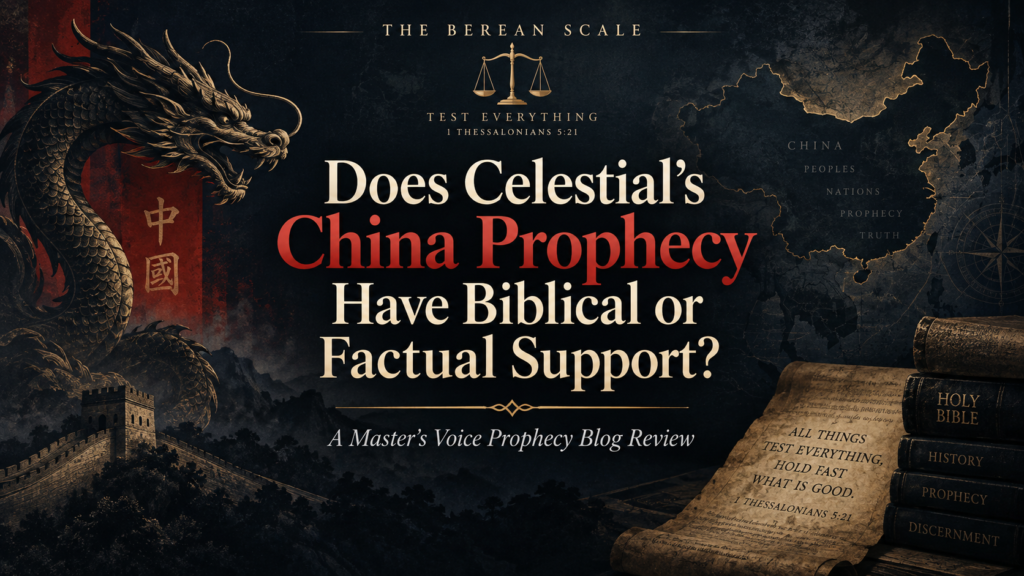
Celestial’s June 16, 2019 post, “WORLD POLITICS: China” on The Master’s Voice Prophecy Blog, presents China’s ascent as a matter shown in a vision. It calls China the “Golden Dragon,” Japan the “Red Dragon,” and describes a smaller “Blue Dragon” whose national identity the writer says she does not know. It also foresees China-Japan talks, worldwide resources flowing toward China, agreements that become constraining demands, exceptional technology and weapons, and an extraordinary rise in geopolitical power.
Those claims are not all of one kind. Some are symbolic identifications; some describe conditions already visible in 2019; some are broad forecasts; and some sound like distinctive technological predictions. A fair audit must not treat a continuing trend as a fulfilled prediction merely because it was described in a prophecy post. Nor should it declare an open or undefined claim false simply because public verification has not appeared.
The biblical standard is neither contempt nor credulity. First Thessalonians 5:19–22 tells believers not to despise prophecies, but to test everything and hold fast to what is good. Deuteronomy 18:20–22 makes truthfulness relevant when someone speaks in Yahweh’s name, while Deuteronomy 13:1–5 warns that even an apparent sign is not self-authenticating if it conflicts with faithfulness to Yahweh. This review assesses the stated claims, not Celestial’s motives, sincerity, or personal experience.
What was already public before June 16, 2019?
The baseline matters greatly. China was already a global manufacturing power, a leading consumer of industrial commodities, a major importer of energy and food, an overseas lender and investor, and a rapidly modernizing military power. These were not hidden developments. China’s Belt and Road Initiative had been operating since 2013. “Made in China 2025,” military-civil fusion, artificial-intelligence investment, electronics manufacturing, virtual-reality policy, satellite navigation, naval expansion, and missile modernization were all matters of public reporting before this post appeared.
The resource imagery has substantial overlap with known facts, but that overlap is largely retrospective description rather than new foreknowledge. Official 2019 reporting recorded Chinese imports of roughly 1.07 billion metric tons of iron ore, 506 million tons of crude oil, 96.56 million tons of natural gas, and 88.51 million tons of soybeans. China’s energy-import dependence was likewise well documented by the U.S. Energy Information Administration. It also imported uranium. Thus, a picture of metals, fuel, food, and uranium moving toward China fit an already-established industrial reality.
This does not make the post factually wrong. China’s need for resources has continued to be consequential. But an accurate description of a visible condition does not, by itself, demonstrate information unavailable in 2019. The same caution applies to broad statements that China would “rise,” become technologically important, or develop stronger weapons. Without dates, measurable thresholds, defined markets, or stated outcomes, such language has limited power to distinguish revelation from a reasonable projection of public trends.
Do biblical dragons identify modern China, Japan, or a Blue Dragon nation?
Scripture must govern biblical symbolism. Revelation 12:3 depicts a great fiery-red dragon, but Revelation itself interprets the central figure: Revelation 12:9 identifies the dragon as “the ancient serpent,” the Devil, and Satan. Revelation 20:2 repeats that identification. The Greek word drakōn refers to a dragon or serpent-like monster; pyrrhos describes the dragon’s fiery-red appearance. Neither term establishes a color code for modern nations, flags, or East Asian cultural symbols.
This makes the designation “Red Dragon (Japan)” especially serious if it is intended as a Revelation-based identification. Revelation’s stated referent is Satan, not Japan. It would be unfair, however, to assume that Celestial meant to say Japan itself is Satan. The imagery could be private symbolism rather than an attempted exposition of Revelation. On that narrower reading, the designation is not a direct assertion about Japan’s spiritual identity. Yet Scripture still provides no affirmative warrant for treating red, gold, and blue dragons as a divinely supplied geopolitical map.
Revelation also maintains distinctions that modern applications can blur. In Revelation 13:1–4, the dragon gives authority to the beast; the dragon and beast are not simply interchangeable labels for the same political entity. Revelation 16:12–14 mentions kings from the east and unclean spirits associated with the dragon, but it names neither China nor Japan, much less an unnamed smaller country. Connecting that passage to three present-day dragon nations is an inference, not an explicit interpretation.
Daniel 7 does not fill the gap. Daniel’s beasts are interpreted within that vision as kings or kingdoms (Daniel 7:17–27), so Scripture can use animal imagery for political powers. But Daniel supplies neither dragons nor a gold-red-blue scheme, and it provides no textual route from its ancient vision to China, Japan, and an unidentified modern “Little Brother.” China’s longstanding cultural association with dragons, and Japan’s use of dragon motifs, may explain why the imagery seems plausible. Cultural symbolism, however, is not canonical prophecy.
Therefore, China as the Golden Dragon, Japan as the Red Dragon, and a modern Blue Dragon nation are unsupported as biblical identifications. The Japan label is incompatible with Revelation’s own meaning if it is offered as a straightforward reuse of Revelation’s red dragon.
Resources, agreements, and talks with Japan
The post’s resource claim is best classified as already observable before publication, with later continuation of the same pattern. China’s demand for metals, energy, agricultural goods, and nuclear fuel was immense before June 2019 and remains economically important. More unusual visual details in the post, including soil and bubble-wrapped eggs, do not become strong evidence without advance criteria and an unusually close, independently verifiable later correspondence.
The warning about agreements and partnerships becoming restrictive has more factual substance, but it needs qualification. Chinese overseas loans and infrastructure projects have generated credible concerns about opaque contracts, debt burdens, project viability, collateral arrangements, leverage, and renegotiation. The World Bank’s 2019 Belt and Road assessment recognized potential transport and trade gains while also warning of debt-sustainability, transparency, environmental, social, and corruption risks. Later AidData research has also documented hidden-debt concerns in portions of China’s overseas lending.
That evidence supports a limited judgment: the claim is already observable before publication and partially matched afterward. It does not establish that every Chinese agreement is a deliberate trap or that China alone causes a borrowing country’s distress. Recipient governments make choices; project economics, domestic governance, commodity shocks, private creditors, multilateral lenders, and debt restructuring all matter. The post’s picture of China universally “smothering” nations therefore goes beyond what the evidence can demonstrate as a uniform policy.
China and Japan have indeed continued diplomatic, security, maritime, economic, and foreign-minister contacts. Japan’s Foreign Ministry records such consultations and wider regional meetings. Yet this is a weak prophetic test. The two states are neighboring major economies with deep trade ties, maritime disputes, longstanding diplomatic relations, and major regional-security interests. The post supplied no date, venue, topic, outcome, or distinctive event. Later talks were foreseeable ordinary diplomacy, not a clearly discriminating fulfillment.
The Blue Dragon remains still weaker as evidence. Celestial expressly said she did not know what nation it represented. No country-level criteria, role, deadline, or later interpretation identifies it. Selecting a smaller nation after later events would invite confirmation bias. At present this claim is not yet verified and too undefined to test reliably.
Technology and weapons: where the test should be strictest
China’s technological and military development is real. It has extensive electronics manufacturing, large technology firms, advanced research programs, BeiDou navigation capabilities, and continued investment in artificial intelligence, quantum technologies, biotechnology, cyber capabilities, electronic warfare, space systems, missiles, naval forces, autonomy, and undersea operations. Later defense assessments describe substantial continuing modernization, even while noting bottlenecks and limits rather than uncontested Chinese dominance in every field.
But the generic portion was already visible in 2019. China had publicly declared industrial-upgrading ambitions, maintained a major electronics sector, issued virtual-reality industry guidance, and pursued a military capable of challenging U.S. advantages in the Indo-Pacific. Accordingly, the claims that China would become a major technology producer, make advanced weapons, and gain geopolitical weight are best classed as plausible trend extrapolation and partially matched by later events. They are not clearly matched as unique predictions because terms such as “take over,” “dominate the sky,” and “beyond what you would believe possible” have no stated benchmark.
The distinctive claims deserve a higher evidentiary standard. Chinese firms produce displays and participate in virtual-reality hardware and supply chains. That does not verify a uniquely Chinese display or goggles system so realistic that users cannot distinguish virtuality from reality, nor does it establish a defined product category “coveted by the nations” for that reason. Exports, popularity, or investment in VR are not close substitutes for the wording of the claim. “Coveted” has no product list, market measure, comparative threshold, or time frame, making it too vague for comprehensive confirmation.
The same restraint is necessary with the military language. Public evidence supports Chinese work on sonar, stealth, underwater systems, camouflage materials, detection, navigation, and advanced munitions. It does not closely corroborate a discrete Chinese system called “silent sonar,” an operational diver suit that renders a diver unseen, or an identifiable “flaming gun” or battlefield ignition device. Nearby technologies cannot be substituted for the original words merely to produce a fulfillment.
A fair objection is that military capabilities can be classified. That is true: lack of public evidence does not prove that a classified system cannot exist. Yet a public prophecy cannot receive public confirmation from undefined and inaccessible claims. Unless the terms can be tied to identifiable, independently assessable evidence, these details remain not yet verified or too vague to test. The pattern is notable: the broader a claim becomes, the easier it is to find general resemblance; the more distinctive it becomes, the less close public corroboration appears.
The strongest favorable reading
The strongest case for the post should be stated plainly. China’s strategic influence, manufacturing scale, commodity demand, military capacity, overseas finance, and selected technology sectors have remained globally consequential. China and Japan did continue to meet. Some countries have faced serious debt, transparency, and bargaining problems in relation to Chinese lenders or projects. In that broad sense, later events partially resemble the post’s warnings about economic leverage, technology, military strength, and Chinese geopolitical weight.
On this reading, the post functions as a high-level warning that China’s already-visible ascent would intensify. That reading is more defensible than claiming it precisely foretold hidden events. It also explains why portions of the post may feel persuasive to readers observing later developments.
It cannot, however, establish prophetic validation. Continuation along openly reported strategic, economic, and industrial paths does not show knowledge beyond what could reasonably be known in 2019. The favorable reading must also leave the national dragon map unproven, the Blue Dragon unidentified, the China-Japan talks nonspecific, and the unusual technical claims unverified. Further, Deuteronomy 13 teaches that even a sign that occurs is not enough by itself to authenticate a claimed message; it must be weighed by fidelity to Yahweh’s revealed word.
Claim audit and Berean verdict
| Claim group | Assessment |
|---|---|
| China as Golden Dragon; Japan as Red Dragon | Unsupported biblically; Japan’s label conflicts with Revelation’s referent if presented as Revelation-derived. |
| Blue Dragon nation | Not yet verified and presently too undefined to test. |
| China-Japan talks | Already foreseeable; later contacts occurred but the claim is too vague to function as strong confirmation. |
| Resources and broad Chinese rise | Already observable before publication; later developments provide broad, partial correspondence. |
| Economic pressure through partnerships | Partially matched in some cases; universal trapping imagery is overstated. |
| Technology and military modernization | Plausible trend extrapolation, broadly and partially matched, but not uniquely predictive. |
| Exceptional VR, “silent sonar,” diver cloaking, and flaming-gun claims | Unverified or insufficiently defined for fair public testing. |
Berean verdict: Scripture does not authorize Celestial’s China-Japan-Blue Dragon mapping. Revelation explicitly identifies its dragon as Satan, while Chinese cultural dragon symbolism supplies no biblical basis for assigning China a prophetic dragon role. Subsequent public facts partly resemble broad statements about Chinese resource demand, overseas economic influence, technology development, military modernization, and geopolitical importance. Yet those trends were substantially public before June 16, 2019. They do not provide distinctive confirmation that the post conveyed otherwise unavailable revelation.
The narrower, more discriminating claims remain undefined, unverified, or not closely matched by known public evidence. That does not require declaring every open claim false. It does mean the post has not met the evidentiary burden for treating its national symbols or specific technological predictions as biblically validated prophecy. Readers should retain what is good through the Scripture-first method set out in How Scripture Tests Prophetic Claims: A Berean Framework for Discernment.
This study is part of The Berean Scale’s ongoing independent review of The Master’s Voice Prophecy Blog and its claimed revelations.


Discussion
Join the Discussion
Test the claim with Scripture. Address the text and the argument, not the person. Comments may be held for moderation.
Keep it Berean: cite the text when possible, make the argument clearly, and keep disagreement respectful.