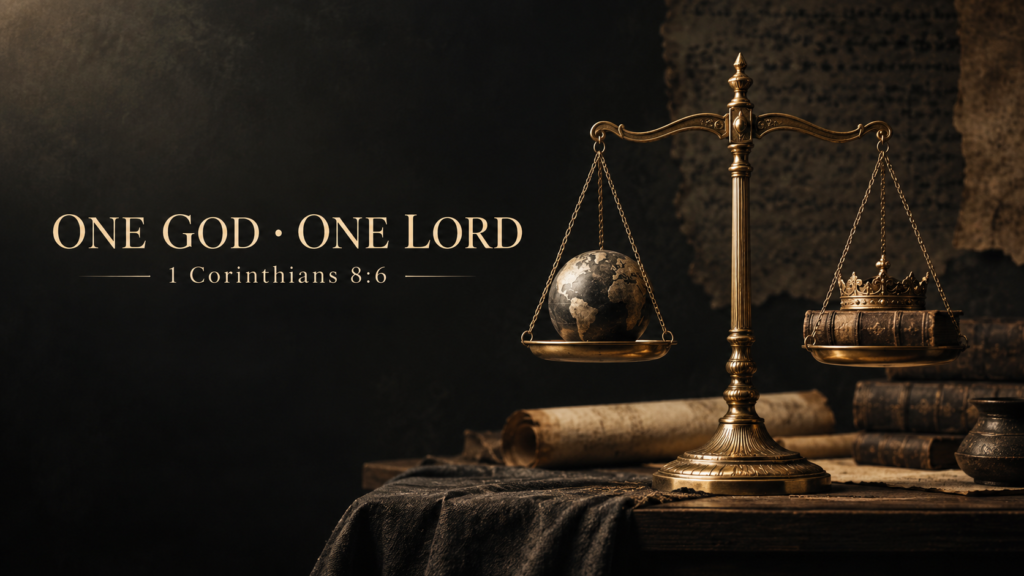
In 1 Corinthians 8:6, Paul answers the question directly: the one God is the Father, and the one Lord is Yeshua Messiah. The verse is grammatically clear on those identifications. It is also the source of a larger debate because Paul says that all things are from the Father and through Yeshua. Does this place Yeshua within Yahweh’s unique divine identity, or does it distinguish the one God from His exalted cosmic agent? The text establishes some matters plainly; the full metaphysical conclusion requires broader theological synthesis.
Paul’s answer belongs to the idol-food argument
First Corinthians 8:6 should not be separated from verses 4–6. Paul is addressing food associated with idols, a problem that continues through chapter 10. He begins by saying that an idol has no real standing as a rival deity and that there is no God except one. Yet he recognizes that the surrounding world has many beings socially and religiously called “gods” and “lords,” whether in heaven or on earth.
Against that plural religious environment, Paul gives the Christian confession: “Yet for us there is one God, the Father, from whom are all things and we for him; and one Lord, Yeshua Messiah, through whom are all things and we through him” (1 Corinthians 8:6, author’s translation). English translations differ slightly in how they supply verbs in the compact final clauses.
The contrast is not between the Father and Yeshua, as though Paul were setting them against each other. It is between the many alleged gods and lords of the pagan world and the exclusive allegiance of believers to the one God and the one Lord. Verse 7 then returns immediately to the practical problem: not every believer has the same conscience concerning idols. Knowledge that an idol is nothing must be governed by love, so that a believer does not wound a brother or sister for whom idol associations remain spiritually dangerous.
Paul’s theology therefore has ethical force. He rejects rival worship and warns against participation that harms conscience or draws believers toward idolatry. At the same time, 1 Corinthians 8 does not treat food itself as intrinsically contaminated, nor does it identify every act of eating food associated with idols as idolatry. Correct theological knowledge must be exercised in love.
The balanced confession: one God and one Lord
The verse has a deliberate balance:
- One God—the Father—from whom are all things, and we for him.
- One Lord—Yeshua Messiah—through whom are all things, and we through him.
The Father and Yeshua are distinct referents. Paul does not identify the Father as Yeshua, and he does not directly write, “Yeshua is the one God.” The phrase “one God” is explicitly explained by “the Father.” The phrase “one Lord” is explicitly explained by “Yeshua Messiah.” Any responsible reading must preserve that distinction.
At the same time, the statement about Yeshua is exceptionally elevated. Paul does not merely call him a respected teacher, a Davidic king, or a human religious master. “All things” are said to be through him, and Paul also says, elliptically, “we through him.” Since Paul repeats all things without an expressed limitation, the natural sense is cosmic rather than merely individual or redemptive. The verse does not explain the mechanism of that mediation, but it gives Yeshua a universal role in relation to all things.
The parallelism coordinates the Father and Yeshua in one monotheistic confession while distinguishing their titles and relations. Coordination is explicit. The precise ontological implications of that coordination are not explicitly defined in this verse.
Greek observations: what the wording does and does not prove
Paul’s wording makes his primary identifications plain. Heis theos ho patēr means “one God, the Father.” The apposition is straightforward: “the Father” identifies the one God in this confession. This should not be weakened into “one God, of whom the Father is one member.” Yet the phrase by itself does not settle every question about whether Paul may use theos differently elsewhere or how he understands the divine identity in its fullness.
The corresponding phrase, heis kyrios Iēsous Christos, means “one Lord, Yeshua Messiah.” Kyrios can refer to God, to a ruler, or to a master. The fact that the Greek Old Testament often uses kyrios to render the divine name Yahweh is important background, but it does not mean that every occurrence of kyrios automatically means Yahweh. Its force here must be judged from the monotheistic context, the one-God/one-Lord pairing, and the cosmic statements that follow.
The Father is described as ex hou ta panta, “from whom are all things.” The preposition ek commonly marks source or origin. Yeshua is described as di’ hou ta panta, “through whom are all things.” Dia with the genitive commonly denotes mediation, agency, or means. Thus, the sentence distinguishes source and mediation: all things are from the Father and through Yeshua.
Neither preposition independently resolves the debate. “Through whom” does not by itself prove that Yeshua is a creature or lesser being. Nor does it by itself prove equality of essence with the Father. Grammar identifies differentiated relations in Paul’s sentence; it does not supply later technical categories such as consubstantiality.
The final phrases are elliptical: kai hēmeis eis auton, “and we [are/exist] for him,” and kai hēmeis di’ autou, “and we [are/exist] through him.” Paul explicitly describes believers as being for the Father and through Yeshua; English translations reasonably supply “exist,” “live,” or “are.” The Father/through-Yeshua pattern remains clear without requiring one English verb as the only possible rendering.
The Old Testament background: a Shema-shaped confession?
Many interpreters see a deliberate echo of the Shema in Deuteronomy 6:4–5: Israel confesses Yahweh as one and is commanded to love Him wholly. The surrounding context warns Israel not to follow other gods, for Yahweh alone is to receive covenant loyalty (Deuteronomy 6:14–15). That setting closely resembles Paul’s concern with alleged gods, lords, and idolatrous associations.
Other Old Testament texts similarly join Yahweh’s uniqueness, fatherhood, and creative work. Deuteronomy 4:35, 39 declares that Yahweh alone is God in heaven and on earth. Malachi 2:10 asks, “Have we not all one Father? Has not one God created us?” Those texts make Paul’s explicit identification of the one God as “the Father” wholly at home within Israel’s Scriptures.
The proposed connection to Deuteronomy 6:4 is strong enough to deserve serious weight. First Corinthians 8:6 comes immediately after a denial of real rival gods, and Paul then pairs “one God” with “one Lord” in a compact confession. Many scholars therefore describe the verse as a Christological reworking of the Shema.
Still, care is necessary. Paul does not formally quote Deuteronomy 6:4 word for word. The Hebrew wording of the Shema has well-known translation questions, and its Greek form also requires attention. It is better to speak of a Shema-shaped echo or reworking than an explicit quotation. Likewise, the Septuagintal use of kyrios for Yahweh provides real divine resonance, but kyrios is not mechanically equivalent to the divine name in every setting.
What Paul explicitly says about the Father and Yeshua
Paul’s stated claims should be kept separate from conclusions drawn from them. He explicitly says that there is one God, the Father. He explicitly says that there is one Lord, Yeshua Messiah. He explicitly says that all things are from the Father and through Yeshua. He also explicitly places believers “for” the Father and “through” Yeshua, though English renderings must supply the implied verb.
These claims establish both distinction and an ordered relation. The verse portrays the Father as the one from whom all things are and as the one toward whom believers are oriented, while Yeshua is the one through whom all things are. This naturally gives rise to source-and-mediation language, but those descriptions go beyond Paul’s exact wording. Yet “from” and “through” do not tell the reader whether this distinction is eternal, ontological, functional, or some combination of these. That question must be answered, if at all, by considering the wider scriptural witness rather than by forcing more into a preposition than it can bear.
Related Pauline texts reinforce the distinction. In 1 Timothy 2:5, Paul says there is “one God” and “one mediator between God and men,” the human Messiah Yeshua. First Corinthians 11:3 says that the head of Messiah is God. In 1 Corinthians 15:24–28, the Son delivers the kingdom to God and is subjected to the One who subjected all things to him, “that God may be all in all.” These passages do not define Messiah as ordinary or merely human; they do show that Paul can speak of God and Messiah as distinct and ordered.
The strongest divine-identity reading
The strongest Trinitarian or divine-identity reading begins with the likely Shema echo. On this view, Paul deliberately takes the monotheistic identifiers “God” and “Lord,” associated in Israel’s confession with Yahweh, and speaks of the Father as the one God and Yeshua as the one Lord. He is not proposing two gods or two competing divine beings. Rather, he includes Yeshua within the unique divine identity while maintaining personal distinction between Father and Son.
The phrase “through whom are all things” is central to this case. In the Old Testament, creation belongs distinctively to Yahweh. If Paul gives Yeshua an unrestricted role in relation to all things, this is more than an honorific title or delegated earthly authority. Colossians 1:15–17 intensifies the same kind of cosmic language: all things are created through and for the Son, and all things hold together in him. Hebrews 1:2–3 likewise says that God made the ages through the Son, though Hebrews must be read within its own literary setting.
Philippians 2:9–11 is often brought into the cumulative case. There every knee bows and every tongue confesses that Yeshua Messiah is Lord, to the glory of God the Father. Because the passage strongly echoes Isaiah 45:23–24, where such universal homage belongs to Yahweh, many conclude that Yeshua receives Yahweh’s own unique honor. Romans 10:9–13 and its use of Joel 2:32 are also frequently offered as supporting evidence, though interpreters dispute whether Paul directly identifies Yeshua with Yahweh there or speaks through agency and representative fulfillment.
This reading has important limits. First Corinthians 8:6 does not use the words Trinity, person, essence, or consubstantial. It does not mention the Holy Spirit. A Nicene conclusion may be a theological synthesis from this verse alongside other texts, but it is not Paul’s technical vocabulary in this passage. For a related examination of divine-identity reasoning without collapsing Father and Son, see Does John 10:30 Mean Yeshua and the Father Are One God?.
The strongest Father-alone and agency reading
The strongest Father-alone reading begins with Paul’s explicit grammar: “one God, the Father.” It observes that Paul repeatedly distinguishes God from the Lord Yeshua Messiah, and it reads “from whom are all things” as language of ultimate source. Yeshua, by contrast, is the one through whom God works. On this reading, Paul teaches monotheism centered on the Father while proclaiming Yeshua as the uniquely exalted Lord and cosmic mediator.
The agency reading appeals to broader biblical and Jewish patterns in which Yahweh works through appointed representatives and through Wisdom-like or Word-like mediation. These parallels may help explain mediated divine action, but they do not by themselves determine Yeshua’s identity in 1 Corinthians 8:6. On this reading, the preposition dia fits real mediation without independently settling the mediator’s ontology.
This reading also faces real pressure from the verse. It must explain why Paul names Yeshua, not merely an abstract divine attribute, as the one Lord within a confession framed against many supposed gods and lords. It must account for the unqualified scope of “all things.” Agency may explain how God works through another; it cannot be used to reduce Yeshua to an ordinary prophet, angel, king, or instrument. Paul’s confession places him in a category far beyond ordinary agency.
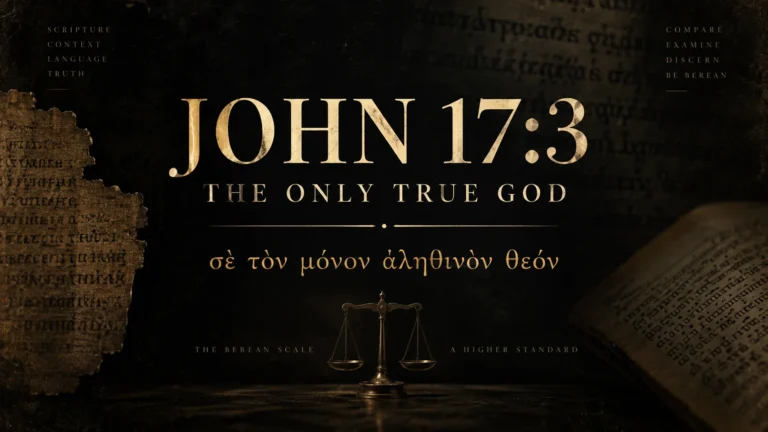
John 17:3 offers a close conceptual parallel, though it belongs to a different author and setting: Yeshua addresses the Father as “the only true God” and identifies himself as the One sent by Him. That distinction deserves its full weight; see John 17:3: Who Is “the Only True God”?. Yet neither John 17 nor 1 Corinthians 8 permits a reader to ignore the other New Testament texts that ascribe cosmic and uniquely exalted roles to Yeshua.
What is explicit, inferred, and debated
- Explicit: The one God is the Father. The one Lord is Yeshua Messiah. All things are from the Father and through Yeshua. Believers are described as being for the Father and through Yeshua, with English translations supplying the implied verb.
- Reasonable inference: Paul defines Christian allegiance over against idols, distinguishes Father and Son, and gives Yeshua a cosmic role that exceeds ordinary messianic or human categories.
- Debated: Whether Paul intentionally reworks the Shema; whether the one-Lord confession includes Yeshua in Yahweh’s unique divine identity; and whether source/mediation language implies an ontological difference.
- Not stated in this verse alone: A technical doctrine of one essence, eternal generation, the Spirit’s place in the divine identity, or a complete metaphysical account of Father and Son.
Berean verdict
The asymmetry of the text should govern the conclusion. The Father’s identity as the one God is grammatically explicit: Paul says, “one God, the Father.” Yeshua’s identity as the one Lord is equally explicit, as is his universal role: all things are through him. The verse therefore neither permits the Father/Son distinction to be erased nor permits Yeshua to be reduced to a merely ordinary agent.
Two shortcuts fail. “Lord always means Yahweh; therefore the debate is over” asks more of the title than the word alone can establish. “Through whom means a lesser creature; therefore the debate is over” asks more of the preposition than it can establish. The surrounding monotheistic confession, the probable Shema resonance, and the unrestricted “all things” give the passage its weight.
Paul’s immediate aim is not a later creedal definition but faithful worship and faithful love. The one God and one Lord define the community’s exclusive allegiance; that allegiance must then shape how believers use knowledge around those whose consciences are vulnerable. For a methodological companion on claims drawn from a single Greek expression, see Does John 8:58 Mean Yeshua Claimed to Be Yahweh?.
Discussion
2 Comments
Test the claim with Scripture. Address the text and the argument, not the person. Comments may be held for moderation.
Keep it Berean: cite the text when possible, make the argument clearly, and keep disagreement respectful.