Thomas’s encounter and confession in context
Thomas was absent when the risen Yeshua first appeared to the disciples (John 20:24). When they told him they had seen the Lord, he refused to believe unless he saw the nail marks, put his finger into them, and placed his hand into Yeshua’s side (vv. 24–25). Eight days later, Yeshua came again while Thomas was present. After greeting them with peace, he answered Thomas’s stated conditions: “Bring your finger here, and see my hands; and bring your hand here, and put it into my side. Do not be unbelieving, but believing” (v. 27).
Thomas then responds: “My Lord and my God!” (v. 28). The immediate question is narrow but significant: whom is Thomas addressing? The following verse matters. Yeshua says that Thomas has believed because he has seen him, then blesses those who will believe without seeing (v. 29). John records neither a rebuke nor a correction of Thomas’s words.
The scene resolves Thomas’s unbelief before directing later readers toward faith without physical sight. Its meaning should therefore begin with the sentence as John narrates it—not with later doctrinal labels, whether accepted or rejected.
Why “my God” is most naturally addressed to Yeshua
John introduces the confession by saying that Thomas “answered and said to him.” The Greek is apekrithē … kai eipen autō; autō is singular, “to him.” The nearest and only stated person to whom Thomas can be responding is Yeshua, who has just spoken directly to him in verse 27. That narrative direction is the central evidence.
Thomas’s words are also a coordinated confession: ho kyrios mou kai ho theos mou, “my Lord and my God.” The possessive mou (“my”) appears with both titles. Kyrios can range in meaning from a respectful “sir” or “lord” to the divine title used for Yahweh in the Greek Scriptures. On its own, therefore, it would not settle the issue. But it is joined here to “my God.” In the natural reading, theos is directly applied to the risen Yeshua.
The two nouns are morphologically nominative rather than formal vocatives. That fact does not prevent direct address: Koine Greek can use an articular nominative in vocative function. Nor does the case form by itself prove a complete doctrine of God. The decisive factor is the surrounding narrative: Thomas speaks to Yeshua in one tightly joined response.
The core wording is also not dependent on a late alteration. A minor article variation associated with Codex Bezae does not remove “my God” or materially alter the interpretive question. At the level of grammar, syntax, and immediate narrative, the best reading is plain: Thomas directly calls Yeshua “my God.”
John holds divine description and Father-Son distinction together
That conclusion must immediately be read beside an earlier statement in the same chapter. The risen Yeshua tells Mary, “I am ascending to my Father and your Father, and to my God and your God” (John 20:17). Thus, Thomas calling Yeshua “my God” does not mean that Yeshua is the Father. John explicitly distinguishes them, even as he presents the Father as the God of both Yeshua and his disciples in different relational senses.
John’s Prologue already prepares readers for this combination of distinction and exalted description. The Word was with God, the Word is described as theos, and the Word became flesh (John 1:1–3, 14). Whatever one concludes about the precise force of John 1:1, the Word is not simply identical with the God he is “with.” Yet John’s language about the Word is far stronger than that of a merely human messenger. For a closer examination of that opening text, see Does John 1:1 Say the Word Is the Father, Divine in Nature, or “a God”?
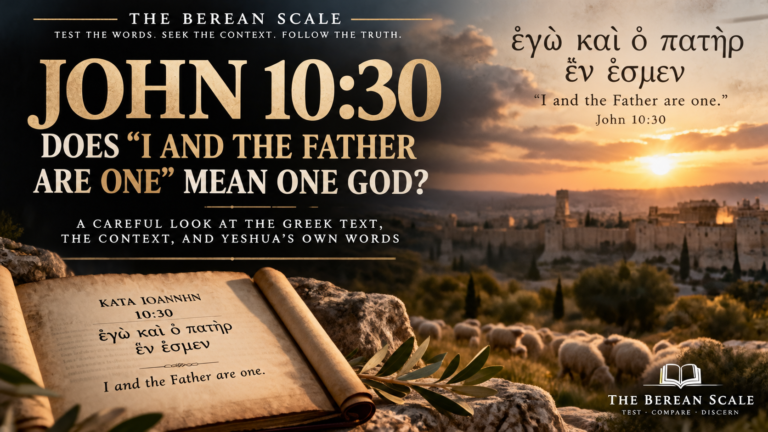
The same pattern continues through the Gospel. The Son does what he sees the Father doing; he gives life and judges, and the Father wills that all honor the Son as they honor the Father (John 5:19–23, 26–30). Yeshua says, “I and the Father are one,” yet also identifies himself as the one whom the Father sanctified and sent (John 10:30–38). He prays to the Father, calls him “the only true God,” identifies himself as the One sent, and speaks of glory shared with the Father before the world existed (John 17:1–5).
These passages do not answer every later theological question by themselves. They do show why John 20:28 cannot responsibly be isolated from either John’s high presentation of Yeshua or his sustained Father-Son relational language. See also John 17:3: Who Is “the Only True God”?
The strongest alternative reading and its difficulties
The strongest alternative proposes that Thomas calls Yeshua “my Lord” but directs “my God” to the Father as an exclamation of astonishment or gratitude. This reading rightly insists that John distinguishes Yeshua from the Father, and it correctly observes that nominative forms can sometimes occur in exclamatory speech. A related two-referent view assigns “my Lord” to Yeshua and “my God” to the Father acting through him.
These readings are not grammatically inconceivable. They are contextually weaker. John says Thomas spoke “to him”; Yeshua has just addressed Thomas; and no narrative signal indicates that Thomas turns from Yeshua to another addressee halfway through one coordinated confession. The text supplies no marker that splits “my Lord” and “my God” between two persons. Such a division is possible only by adding an unmarked shift that John does not narrate.
A divine-agency reading deserves similar care. John certainly portrays Yeshua as the Father’s sent revealer, the one who makes the Father known and does the Father’s works. This protects an essential truth: Yeshua is not the Father. Yet agency language does not remove the actual wording of Thomas’s direct address. The narrative does not say that Thomas addresses the Father through Yeshua, nor does it label “my God” as representative language.
Yeshua’s reply in verse 29 does not explicitly say, “I accept the title God.” Still, it treats Thomas’s response to seeing Yeshua as belief, rather than correcting an inappropriate acclamation. The alternatives preserve Father-Son distinction, but they do so by qualifying the immediate wording more than the text itself requires.
What the verse establishes, supports, and leaves debated
The explicit text is that Thomas speaks to Yeshua and says, “My Lord and my God,” and Yeshua then speaks of Thomas’s belief (John 20:28–29). Also explicit is Yeshua’s statement that the Father is “my God” (v. 17). Both statements must remain in view.
A reasonable inference is that the two titles jointly address Yeshua and that John 20:28 therefore applies divine language directly to him. The placement before John’s purpose statement also reasonably suggests that Thomas’s confession is a climactic model of the faith John seeks to evoke. Yet John 20:30–31 says that these signs were written so readers may believe that Yeshua is the Messiah, the Son of God. That purpose statement frames Thomas’s confession; it does not explicitly explain away “my God” or contradict it.
The debated question is whether this confession entails the later Nicene formulation that the Son is fully divine, of one essence with the Father, and personally distinct from him. A classical Trinitarian reading can coherently draw that synthesis from John 20:28 alongside the Gospel’s wider witness. But the verse itself does not use the later vocabulary of essence, persons, or Trinity. A direct-address, non-conciliar high-Christology reading likewise takes Thomas’s words seriously while seeking to express the conclusion first in John’s own categories.
Hebrews 1:8–9 offers a comparable canonical pattern: the Son is addressed as God, while “God, your God” is also said to have anointed him. That text does not settle John’s meaning, but it shows that high divine designation and distinction from God can stand together. See Does Hebrews 1:8 Say the Father Calls the Son “God”?
Verdict: a direct confession without collapsing Father and Son
Yes. Thomas’s statement most naturally identifies Yeshua as “my God.” Thomas says it to Yeshua, the titles form one unified confession, and Yeshua answers by treating Thomas’s response as belief without correction. Reducing “my God” to a detached exclamation does not best account for the syntax and narrative flow.
But John 20:28 does not say that Yeshua is the Father. John 20:17 and the Gospel as a whole preserve a real distinction between the Father and the Son: the Father sends, the Son is sent; the Son prays to the Father; and Yeshua calls the Father his God.
Therefore, the verse should not be minimized, nor should it be made to bear every element of later Trinitarian doctrine alone. It is among John’s clearest high-Christology statements. Readers should receive Thomas’s confession as John gives it while allowing John’s own categories—Father, Son, sending, glory, honor, revelation, and belief—to govern the larger synthesis.
Discussion
Join the Discussion
Test the claim with Scripture. Address the text and the argument, not the person. Comments may be held for moderation.
Keep it Berean: cite the text when possible, make the argument clearly, and keep disagreement respectful.