This hub examines recurring claims published by The Master’s Voice Prophecy Blog, associated with Celestial, through Scripture and transparent claim-by-claim comparison. It is not a promotional page, a dismissal of all warnings about judgment, or a blanket verdict on every post. A message should not be accepted because it is dramatic, nor rejected merely because it is unusual. But when the source presents messages as words from Yahweh, from the Lord, or from Yeshua, those claims invite serious testing.
The recurring clusters include America’s decline and judgment, the rise of Russia and China, invasion or captivity, nuclear strikes, domestic disorder, and future security or identification systems. These claims do not all have the same evidentiary character. “Yahweh judges wickedness” is a theological assertion that must be interpreted from Scripture in context. “Russia will use pre-emptive nuclear strikes on the United States,” including claims about named cities or disabled weapons, is an externally testable prediction requiring public evidence.
Responsible review begins with document control. Each audit should preserve the original URL, title, date received if given, recording and posting dates, archive capture, transcript or screenshots, exact wording, stated conditions, and later explanations. Different displayed dates can reflect posting, revision, indexing, or a claimed received date; they do not alone prove alteration. This hub supplies the governing method and directs readers to focused audits rather than treating every prophecy as one indistinguishable claim.
The two Deuteronomy tests address different dangers
Deuteronomy 13:1–5 addresses Israel’s covenant loyalty. Its stated scenario is striking: a prophet or dreamer gives a sign or wonder, and the sign or wonder occurs, but then calls Israel to follow other gods. Israel must not listen. The issue is not whether something impressive happened; it is whether the message draws the people from exclusive allegiance to Yahweh. The wider setting in Deuteronomy 4:1–4 and 6:4–15 reinforces that concern. Yahweh alone is to be loved, obeyed, and worshiped.
Therefore Deuteronomy 13 does not establish a failed-prediction test. It assumes that the announced sign occurs. Nor does it teach that a miracle claim, a striking dream, or an apparently accurate forecast validates a messenger. A real or seemingly real sign cannot excuse a message that redirects trust, worship, or obedience away from Yahweh. Applied carefully today, the passage warrants examining whether a ministry’s message preserves exclusive allegiance and obedience to Yahweh rather than drawing people toward another authority, object of worship, or rival source of spiritual allegiance.
Deuteronomy 18:9–22 addresses another danger. Israel was forbidden to seek guidance through divination and related practices because Yahweh would provide His word through His appointed prophet. Verses 20–22 then address one who speaks a word in Yahweh’s name that Yahweh has not commanded, or speaks in the name of other gods. The explicit negative criterion is plain: if the thing spoken in Yahweh’s name does not happen or come about, Yahweh has not spoken that word. Israel was not to fear that prophet.
The Hebrew bezadon in verse 22 describes presumptuous, arrogant, or defiant speaking. It does not give readers access to a claimant’s private motives. It does establish the gravity of unauthorized speech under Yahweh’s name. Deuteronomy 18 is not a license to force a deadline onto an undated future claim; the actual wording, timing, conditions, and claimed outcome must be preserved. Yet where a documented predictive claim has a passed timeframe or a plainly contradicted feature, non-occurrence cannot honestly be rescued by changing its terms after the fact.
The passages should remain distinct. Deuteronomy 13 tests allegiance even when a sign occurs. Deuteronomy 18 gives non-occurrence as a decisive negative criterion for a predictive word spoken in Yahweh’s name. Neither says that political plausibility, repeated warnings, or alarming headlines prove divine revelation. Israel’s covenantal civil penalties also belong to its ancient theocratic setting; they are not instructions for churches or online readers. The enduring seriousness of claiming Yahweh’s authority without His word remains relevant.
Jeremiah and Ezekiel: unauthorized divine speech
Jeremiah 23:9–32 and Ezekiel 13:1–23 add an essential dimension. Both confront people who claimed dreams, visions, and declarations from Yahweh without being sent by Him. Jeremiah rebukes prophets who speak visions from their own minds and use dreams falsely. Ezekiel condemns those who follow their own spirit, see false visions, and say, “Yahweh declares,” when Yahweh has not sent them. Their concern is broader than a missed forecast: unauthorized speech, false reassurance, spiritual harm, and resistance to Yahweh’s truth all matter.
Jeremiah 18:7–10 must also be heard. Yahweh describes a genuine principle of conditional national judgment: when He announces judgment against a nation and that nation turns from evil, He may relent concerning the calamity announced. Biblical warnings can therefore be merciful calls to repentance rather than calendar predictions. Calls to repentance, prayer, holiness, and readiness may be sound biblical exhortations.
But Jeremiah 18 does not automatically insert an unstated condition into every modern declaration. If the original source calls an outcome certain, inevitable, or irreversible, and a repentance condition appears only after difficulties arise, the two wordings must be compared rather than harmonized by assumption. Nor does a valid call to repentance authenticate attached assertions about America, Russia, China, captivity, or nuclear war.
New Testament testing rejects contempt and credulity
Yeshua warns in Matthew 7:15–23 that false prophets are known by their fruit and that verbal claims made in His name do not establish His approval. Fruit should not be reduced to one disputed forecast. Teaching, truthfulness, character, willingness to receive correction, manipulation, financial or social pressure, and pastoral effect all deserve evidence-based consideration. Conversely, this passage should not be used as a shortcut for labeling a claimant false merely because a reviewer dislikes the message.
First Thessalonians 5:19–22 provides the most balanced posture: believers are not to quench the Spirit or despise prophetic utterances, but are to examine everything carefully and hold fast what is good. The verb dokimazō carries the sense of testing or approving after examination. It does not make every alleged prophecy genuine until disproved, and it does not prescribe a complete modern audit protocol. It does forbid both gullibility and reflexive contempt. For a broader treatment, see How Scripture Tests Prophetic Claims: A Berean Framework for Discernment.
First John 4:1–6 likewise commands believers to test spirits because many false prophets have gone out into the world. John’s immediate test concerns confession of Yeshua Messiah come in flesh and conformity to apostolic truth. It is not a generic test of geopolitical forecasting accuracy. Acts 17:11 commends the Bereans for examining the Scriptures daily in response to apostolic preaching; it models receptive scrutiny, not a complete procedure for adjudicating modern dreams. Whether prophecy continues in the same manner today remains debated; that question is considered separately in Do Prophets Exist Today? What Does the Bible Actually Teach?.
How to audit a modern prophecy without retrofitting fulfillment
A sound audit starts with the earliest recoverable wording. Record the named actors, locations, mechanism, scale, timeframe, trigger, and conditions. Then separate the biblical texts cited by the source from the factual assertion being made. Finally, compare the stated claim with independent, publicly verifiable evidence. This sequence prevents a reviewer from either inventing a failure date or retrofitting fulfillment after an event.
| Biblical or interpretive assertion | Externally testable assertion |
|---|---|
| Yahweh judges nations for evil. | Russia and China will conquer the United States and deport Americans for forced labor. |
| Believers should resist deception and remain watchful. | A named catastrophe will bring a specified identification or security system. |
Specificity matters. A warning that America will decline, society will become unstable, or surveillance will grow is difficult to assess without measures or a timeframe. Such developments may be foreseeable and multiply realizable. By contrast, claims involving a Russian nuclear first strike, disabled U.S. weapons, New York or San Francisco, foreign occupation, or overseas deportation are substantially more testable. They must not later be diluted into a general claim that tensions increased or technology changed.
The matching rule is simple: a lesser event is not fulfillment of a larger prediction. China–Russia cooperation, cyber threats, the war in Ukraine, political polarization, biometric systems, and nuclear rhetoric may provide geopolitical context. They do not equal a joint conquest of the United States, attacks on named cities, or a particular end-times sequence. Repetition proves only that the source has repeated a claim; it does not authenticate the claim.
Likewise, an explicitly future claim with no deadline ordinarily remains pending and unverified rather than automatically failed by an audit date. But a prediction tied to a passed date, a stated trigger, or a clearly contradicted detail requires a documented conclusion. Before alleging revision, compare original and later wording. A symbolic, delayed, partial, conditional, or broadened reading materially changes a claim only where the documents show that named actors, locations, mechanisms, scale, or timing have been removed or altered.
Individual audits should use clear labels: supported, partly supported, unsupported by the cited text, contradicted, pending, or not objectively testable. “Did not occur as stated” should be reserved for claims with sufficient documentary and temporal evidence.
Recurring claim clusters and the interpretation problem
The source’s recurring material includes America as Babylon or as a covenant-like spouse; judgment administered through Russia and China; captivity and overseas labor; Russian nuclear strikes and named American cities; Russian supremacy; Ukraine on Russia’s side; and catastrophe producing new identification or Beast-system controls. These are not all equally specific, and no single conclusion should be imposed upon all of them.
The central interpretive issue is straightforward: a biblical text may be true in its original setting while the source’s modern identification remains unproven. Scripture does not explicitly identify the United States as Babylon, Judah, Israel, Egypt, Cush, or the target of Isaiah 20. The mapping must therefore be presented as an inference, not as an explicit biblical fact.
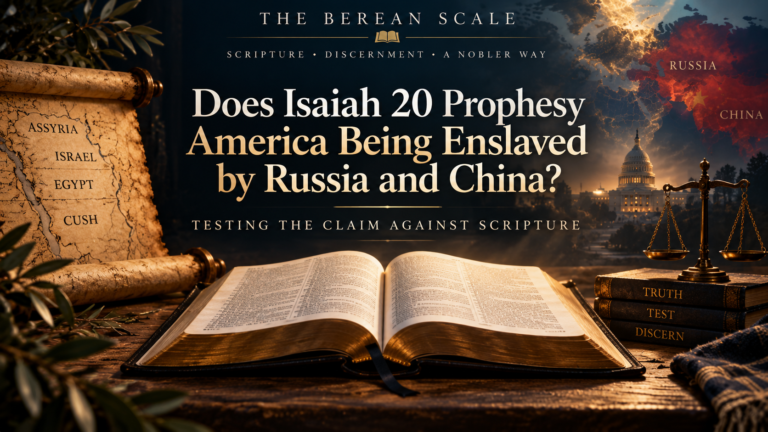
Isaiah 20 illustrates the issue. Its explicit referents are Egypt and Cush in connection with Assyria. America, Russia, China, transatlantic deportation, debt slavery, and an end-times fulfillment are additional interpretive steps. A reader may argue for an analogy, but Isaiah itself does not name those modern entities. The same care applies to Jeremiah and Ezekiel’s covenant judgment oracles and Revelation 17–18’s Babylon imagery. A detailed examination is available in Does Isaiah 20 Prophesy America Being Enslaved by Russia and China? and Does Scripture Identify America as Babylon the Great?.
One factual example requires equal care. A 2019 portrayal of Ukraine as being “on the Russian side” is difficult to treat as confirmed by Russia’s February 2022 full-scale invasion and Ukraine’s resistance. The invasion establishes conflict between Russia and Ukraine, not Ukraine’s willing alignment with Russia. Unless the original message fixed the timeframe or nature of that alignment more precisely, the careful present label is unresolved or pending—not automatic fulfillment and not automatic failure.
The strongest defense—and its limits
The strongest charitable defense is substantial. Biblical prophets did announce coming judgment. Jeremiah 18 shows that warnings may be conditional. A call to repentance can be spiritually serious. Dreams and visions may employ imagery, while apocalyptic texts contain debated symbolism. And an undated future scene cannot be disproved merely because it has not yet happened. Some Christians also reject modern authoritative predictive revelation on closed-canon or cessationist grounds; this hub need not resolve that debate before assessing whether a particular source uses Scripture faithfully and whether its concrete claims occur as stated.
These defenses have limits. Conditionality cannot be presumed only after a certain prediction remains unfulfilled. Symbolism cannot be introduced after the fact merely to remove named nations, cities, mechanisms, or outcomes that the original claim supplied. A long horizon may leave a claim pending, but it also prevents that claim from functioning as present proof of supernatural foreknowledge. Geopolitical plausibility and repeated declarations may show consistency or concern; neither is a biblical test of divine origin.
What Scripture establishes and the present verdict
Scripture explicitly establishes that loyalty to Yahweh remains decisive even where a sign occurs (Deuteronomy 13); that non-occurrence is a decisive negative criterion for a predictive word spoken in Yahweh’s name (Deuteronomy 18); that Jeremiah and Ezekiel condemn unauthorized claims of divine speech; and that the New Testament commands testing without contempt. Readers may reasonably infer that messages framed as words from Yahweh or Yeshua should be examined for doctrine, fruit, biblical interpretation, documentation, and factual correspondence.
Several matters remain debated: how directly Deuteronomy 18 applies to every modern “God told me” claim, whether modern prophecy continues, the precise scope of Matthew 7’s fruit test, and whether Babylon in Revelation can be identified with a modern nation. Those debates do not erase the duty of honest testing.
The measured verdict of this hub is therefore methodological but plain. The source’s modern nation-mappings are unsupported where the biblical text does not make those identifications. Its concrete geopolitical forecasts remain pending and unverified unless they occur in the stated form. They should not be declared fulfilled by partial resemblance, fear-inducing headlines, or altered definitions. Readers should use this page as an index, consult the linked audits for original wording and evidence, and retain only what survives contextual biblical examination and transparent factual comparison.
Discussion
1 Comment
Test the claim with Scripture. Address the text and the argument, not the person. Comments may be held for moderation.
Keep it Berean: cite the text when possible, make the argument clearly, and keep disagreement respectful.