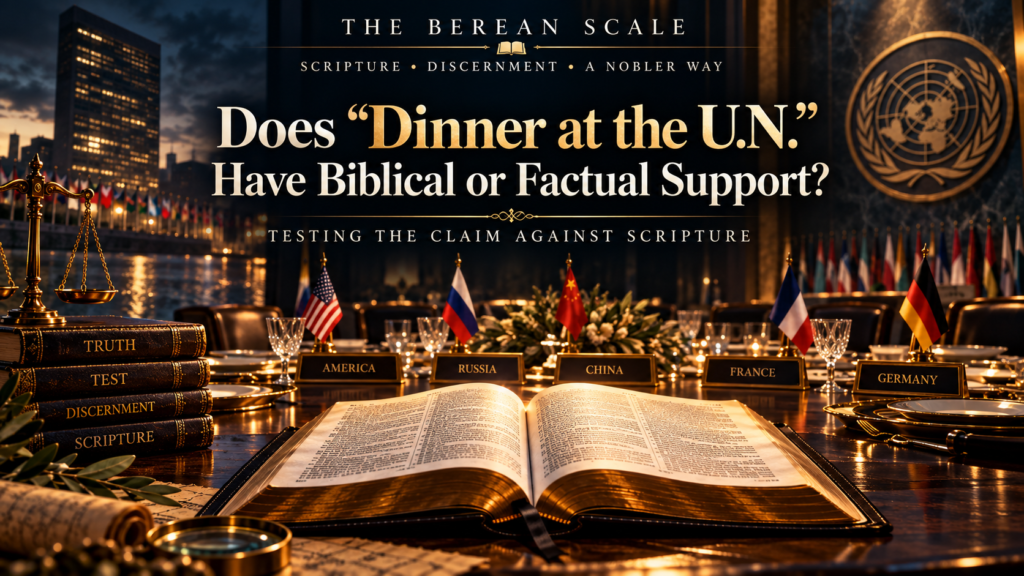
This is an independent review of “Insight: Dinner at The U.N. – June 19, 2019,” published by The Master’s Voice Prophecy Blog and associated with Celestial. The question is not whether Yahweh can govern nations or disclose hidden things. Scripture plainly says that He can. The question is whether Scripture supports this source’s claim that Yahweh revealed Russia and China’s part in America’s downfall, together with France and Germany’s future refusal to help.
The page’s dating should be stated cautiously. Its title names June 19, 2019; its introduction places it among “WORLD POLITICS” visions from June 16; and its URL is dated July 1, 2019. The available page does not explain whether these are separate vision, series, and publication dates or an editorial inconsistency.
The source makes several distinct claims: Yahweh rules political history; the reported dinner scene was a divine vision; Russia and China will cooperate against and “consume” America; America’s overthrow was already underway; domestic conspirators would cause economic decline and terror attacks; France would not help; Germany would not help; and the scene’s symbols reveal those outcomes. These claims should not be treated as one indivisible prediction. The reported imagery and the source’s later interpretation of that imagery are also different things.
Daniel 2:21 teaches Yahweh’s sovereignty, not this modern nation map
Daniel 2:21 belongs to Daniel’s prayer in Daniel 2:20–23. Nebuchadnezzar had demanded that Babylon’s wise men disclose both his concealed dream and its meaning. They could not do so. Daniel sought mercy from the God of heaven, Yahweh revealed the matter in a night vision, and Daniel responded with praise.
In that praise, Daniel says that Yahweh changes “times and seasons,” removes kings and establishes kings, gives wisdom, and reveals hidden things. The Aramaic phrase beʿiddānayyā we-zimnayyā concerns times or periods and appointed seasons; it is not a coded timetable for later geopolitical predictions. Likewise, the statement that Yahweh removes and establishes kings declares His authority over rulers. It does not make every later political vision self-authenticating.
Therefore, the source is right at the level of general doctrine: Yahweh governs historical periods and rulers, and no nation lies outside His providence. Daniel 2 also shows that Yahweh can reveal what human beings cannot know. But Daniel 2:1–30 establishes that Daniel received Nebuchadnezzar’s particular mystery; it does not name America, Russia, China, France, Germany, or the United Nations. Nor does Daniel 2:31–49 give a decoding key by which modern states may be assigned to a later visionary dinner scene. Divine sovereignty is explicit biblical truth; the divine origin and interpretation of this particular vision are additional claims requiring evidence.
How Scripture requires a claimed vision to be tested
Scripture supplies complementary tests rather than one automatic formula. Deuteronomy 13:1–5 teaches that even an apparently confirmed sign must not lead Israel away from Yahweh. Extraordinary experience is therefore not enough by itself. Deuteronomy 18:20–22 warns against speaking presumptuously in Yahweh’s name and treats nonoccurrence as a negative test of a predictive word. Jeremiah 23:16–32 and Ezekiel 13 warn against visions arising from the speaker’s own heart or spirit rather than from Yahweh’s mouth.
Those warnings do not authorize readers to pronounce on Celestial’s motives or spiritual condition. They explain why a claimant who attributes a vision to Yahweh bears a serious burden of warrant. Jeremiah 28 provides a public conflict between prophetic claims and shows that fulfillment matters. Yet biblical prophecy can include warning, symbolism, conditions, and varying time horizons. Readers should not impose an artificial immediate timetable where a text does not give one. At the same time, undefined symbolism cannot be expanded indefinitely so that no outcome could ever disconfirm it.
The New Testament maintains the same balance. Yeshua warns of false prophets and speaks of recognizing them by their fruit (Matthew 7:15–23). First John 4:1–6 commands testing spirits in a Christological and confessional setting; it does not provide a geopolitical code. First Thessalonians 5:19–22 says neither to quench the Spirit nor to despise prophecies, but to test everything and retain what is good. The verb dokimazete means to test or examine. For a fuller explanation of these complementary tests, see How Scripture Tests Prophetic Claims.
Applied here, responsible testing asks: Is the claim faithful to Scripture? What exactly is predicted? Which details were seen and which were inferred? Are factual allegations supported? What observable event would count as fulfillment or failure?
The symbols and the public facts do not establish the forecast
The source reports a U.N.-themed dinner involving labels such as “SITTING DUCK” and “COOKED GOOSE,” eating, drunken speech, silence, empty plates, and “ABSTAIN.” It then assigns political meanings to those details. Scripture does not provide that symbolic lexicon. Neither Daniel 2:21 nor the testing passages identify eating as Russia-China destruction of America, drunkenness as American blindness, empty plates as Franco-German nonparticipation, or “ABSTAIN” as future refusal of aid. Those are the source’s interpretive assignments, not biblical identifications.
The U.N. setting has limited factual correspondence. China, France, Russia, the United Kingdom, and the United States are the five permanent members of the U.N. Security Council, as the United Nations explains. The scene includes four of those five, adds Germany, and omits the United Kingdom. Thus “key U.N. members” is broadly intelligible, but the tableau is not an exact representation of the permanent five. Institutional resemblance does not establish divine origin or symbolic meaning.
| Claim in the source | What can presently be said |
|---|---|
| Russia and China will cooperate against America and “consume” her. | Russia-China strategic cooperation is real public background. It does not demonstrate a jointly revealed purpose to destroy America or permanently remove it from the world scene. |
| France and Germany will abstain from helping America. | France, Germany, and the United States are NATO allies. That does not prove their response to an undefined future crisis, but the source supplies no crisis, requested aid, timing, or measurable act that would constitute abstention. |
| Domestic conspirators are engineering collapse and terror. | These are externally testable allegations, yet the supplied material provides no named actors, evidence, mechanism, dates, or objective outcomes. Biblical themes of judgment or deception do not independently prove them. |
| America’s downfall was already underway in 2019. | Without defined endpoints, normal diplomatic tension, economic weakness, violence, or Russia-China coordination can be retrospectively fitted into the claim. That prevents responsible confirmation. |
The Russia-China point deserves particular care. Their cooperation means the broad language of partnership is not invented from nothing. But cooperation among states does not prove common hatred, a settled anti-American destruction plan, or the fulfillment of this dinner imagery. Readers considering related claims may also examine the separate Russia and China claim audits.
The strongest defense—and its limit
The strongest defense does not need to claim that Daniel 2 predicts these nations. A defender may instead say that Daniel 2:21 establishes Yahweh’s authority to reveal geopolitical change through a later vision. That distinction is coherent. Yahweh certainly has the ability to reveal, and Christians should not reject a claim solely because it concerns international events.
A defender may also view later Russia-China cooperation as preliminary confirmation, while holding that French and German nonassistance concerns a future crisis rather than an immediate abandonment of NATO. That last prediction cannot fairly be called false merely because an unspecified occasion has not occurred.
Still, these defenses do not establish the larger prophecy. Yahweh’s ability to reveal does not prove that this vision came from Him. General cooperation does not prove a plan to consume America. A future prediction without stable fulfillment criteria cannot presently be scored as fulfilled. Nonliteral symbolism may be legitimate, but it still needs a warranted interpretation and a discernible real-world referent.
Berean verdict
Scripture explicitly establishes that Yahweh rules times and rulers and that claimed prophetic speech must be tested. It does not identify modern America, Russia, China, France, Germany, or the United Nations in Daniel 2:21 or in any of the passages considered here.
Russia-China coordination provides limited factual background for a broad claim of cooperation; the U.N. imagery loosely overlaps with prominent U.N. states; and France, Germany, and America share a NATO relationship. None of those facts authenticates the reported vision or proves its symbol-by-symbol interpretation. The claims of a Russia-China destruction of America, domestic economic sabotage and orchestrated terror, French abstention, German abstention, and an already-underway overthrow remain unverified, underdefined, or unsupported by Scripture.
The source’s confession of Yahweh’s sovereignty passes as a general biblical truth. Its use of Daniel 2:21 to support this detailed geopolitical forecast does not: the text supplies no such nation mapping. Readers should neither mock the claim nor proclaim it fulfilled on broad similarities alone. This study is part of The Berean Scale’s ongoing review of The Master’s Voice Prophecy Blog and its claimed revelations.
Discussion
Join the Discussion
Test the claim with Scripture. Address the text and the argument, not the person. Comments may be held for moderation.
Keep it Berean: cite the text when possible, make the argument clearly, and keep disagreement respectful.