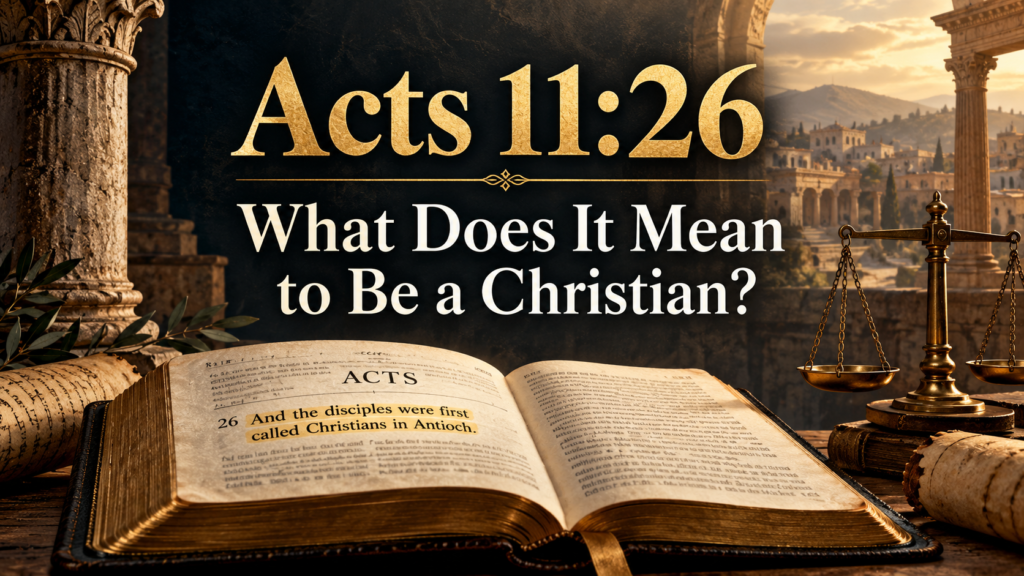
In modern speech, Christianity can mean a civilization, family tradition, denomination, moral outlook, or demographic category. Scripture begins elsewhere. The abstract noun “Christianity” does not appear in the New Testament. Acts 11:26 says that “the disciples were first called Christians in Antioch.” The biblical question, then, is first about the people called Christians: who were they, what did they believe, and how were they taught to live?
That starting point also requires restraint. Acts 11:26 does not provide a later creed, church constitution, sacramental system, or a complete conversion checklist. Those matters may be argued from wider Scripture, but they should not be placed into the single word Christian before the text itself has spoken. This is the kind of distinction demanded by the Berean test: receive claims seriously, then examine whether the Scriptures establish them.
Christians at Antioch: disciples of Messiah
Acts 11:19–26 supplies the immediate context. Believers scattered by persecution spoke the word in Phoenicia, Cyprus, and Antioch. Some proclaimed “the Lord Yeshua” to Greeks. Many believed and turned to the Lord. When the Jerusalem assembly heard, it sent Barnabas. Seeing the grace of God, he rejoiced and urged them all to remain faithful to the Lord with steadfast purpose. Barnabas then brought Saul to Antioch, and for a year they gathered with the assembly and taught a considerable number of people. Then Luke reports that the disciples were first called Christians in Antioch.
The sequence matters. Before the name appears, the narrative portrays proclamation concerning Yeshua, faith, turning to the Lord, grace, steadfastness, assembly life, and sustained teaching. Acts does not say that these people were Christians merely because of a cultural origin, a private admiration for Jesus, or a place on an institutional roll. They are called disciples—learners and followers—immediately before they are called Christians.
The Greek Christianos is related to Christos, “Messiah” or “Anointed One.” It reasonably identifies a person associated with, belonging to, or adhering to Messiah. Its form does not itself establish a complete doctrine of Messiah’s nature, a church polity, or later denominational boundaries. The word occurs only twice more: Acts 26:28 uses it as a recognizable public designation, and 1 Peter 4:16 speaks of suffering “as a Christian” and glorifying God in that name. Neither passage supplies an exhaustive entry requirement.
Nor does Acts identify who gave the Antioch believers this name, whether it began as mockery, or whether “were called” refers to popular, civic, or divine naming. Those proposals remain possible but unproved. The secure conclusion is narrower: in the New Testament, a Christian is first a designation for a disciple of Yeshua, not first a label for a later institution or culture.
The apostolic response: repentance, baptism, and a taught community
Acts 2:36–42 gives Luke’s earliest extended account of how hearers responded to apostolic proclamation. Peter declares that God made the crucified Yeshua both Lord and Messiah. The wording preserves a distinction: God is the one acting, and Yeshua is the risen and appointed Lord and Messiah proclaimed to Israel. Cut to the heart, the hearers ask what they should do. Peter answers with repentance and baptism in the name of Yeshua Messiah, linking this response with forgiveness of sins and the promised gift of the Holy Spirit.
Those who received the word were baptized and added to the community. Their response did not end at the water. They devoted themselves to the apostles’ teaching, fellowship, breaking of bread, and prayers. Acts 2 therefore gives no support to treating baptism or belonging among believers as insignificant. Yet it also does not settle every later dispute about baptism’s precise role or impose one inflexible order on every conversion narrative in Acts. The text closely joins repentance, baptism, forgiveness, Spirit, and communal perseverance; the detailed theological mechanics remain debated.
Yeshua’s commission in Matthew 28:18–20 confirms that the goal is disciples, not merely verbal decisions. He says that all authority in heaven and earth has been given to him, commands the eleven to make disciples of all nations, baptize them into the name of the Father, Son, and Holy Spirit, and teach them to observe all he commanded. The governing command is mathēteusate, “make disciples.” Baptizing and teaching belong to that work; neither replaces it.
The command to teach disciples to observe all Yeshua commanded excludes a faith defined as initial assent with no continuing instruction or practice. At the same time, Matthew 28 does not provide a complete modern membership manual. Its triadic baptismal wording explicitly coordinates Father, Son, and Holy Spirit, but does not state later conciliar terms. It establishes obedient, continuing discipleship under Yeshua’s given authority.
Romans 10: faith, confession, and calling on the Lord
Romans 10:9–13 must be read within Romans 9–11, where Paul discusses Israel, righteousness, the proclaimed word, and the inclusion of Jew and Greek. Paul explicitly says that salvation involves believing in the heart that God raised Yeshua from the dead and confessing with the mouth that Yeshua is Lord. He connects heart-belief with righteousness and confession with salvation. This is not a marginal Christian confession: trust in Yahweh’s raising of Yeshua and public allegiance to Yeshua’s lordship stand at its center.
Again, the verse distinguishes God from Yeshua: God raised him; Yeshua is confessed as Lord. Therefore Romans 10 should not be cited as though it erases that distinction. But neither should its force be minimized. It gives Yeshua extraordinary authority, saving significance, and the allegiance of a confession that can carry public cost.
In verse 13 Paul quotes Joel 2:32: everyone who calls on the name of the Lord will be saved. Joel’s Hebrew text speaks of calling on Yahweh’s name; the Greek wording Paul quotes uses kyrios, “Lord.” Because the surrounding verses repeatedly speak of confessing Yeshua as Lord, many interpreters understand Paul as applying Joel’s Yahweh text to Yeshua. Trinitarian and other high-Christology readings regard this as part of a cumulative case that Yeshua participates in Yahweh’s unique saving identity.
A serious alternative holds that Yahweh saves through His risen and exalted Messiah, with Romans 10:9’s God–Yeshua distinction controlling the conclusion. On this reading, the Joel promise is fulfilled through Yahweh’s appointed Lord without settling an ontological identification. Both readings must reckon with the full argument. Romans explicitly requires faith in God’s raising of Yeshua, confession of Yeshua as Lord, and calling upon the Lord; it does not use later metaphysical terminology. For related questions raised by John’s Gospel, see Does Thomas call Yeshua God in John 20:28?
Romans 10 is also not a detached formula. Earlier, Romans 6 rejects continuing in sin so grace may increase and describes a new life joined to Messiah. Romans 8 contrasts fleshly life with life led by the Spirit. Romans 12–13 calls believers to transformed worship, love, and the putting away of works of darkness.
One God and His Messiah
Christian faith belongs within biblical monotheism. Deuteronomy 6:4–5 confesses that Yahweh is one and commands Israel to love Him with the whole heart, soul, and strength. Yeshua affirms this as the foremost command in Mark 12:28–34. John 17:3 calls the Father “the only true God”; 1 Corinthians 8:4–6 speaks of one God, the Father, and one Lord, Yeshua Messiah; and 1 Timothy 2:5 speaks of one God and one mediator between God and humanity, Messiah Yeshua.
These texts distinguish the Father and Yeshua without making Yeshua unimportant. John’s stated purpose is that readers may believe Yeshua is the Messiah, the Son of God, and have life in his name (John 20:31). The New Testament also presents him as raised, exalted, authorized, confessed as Lord, and central to Yahweh’s saving work. A biblical account must not reduce him to a cultural teacher. But agency, lordship, worship, preexistence, and divine-language passages must each be considered in context rather than treated as automatic solutions to every ontological question.
Thus, Trinitarian readers may reasonably synthesize Matthew 28, Romans 10, Joel 2, and other texts into a doctrine of Father, Son, and Holy Spirit sharing the one divine identity. Non-Trinitarian readers may understand these texts through Yahweh’s agency, Messiah’s exaltation, and the persistent Father–Son distinction. Those are wider theological syntheses; they are not contained in the morphology of Christianos itself.
Grace that produces obedient faith
Scripture rejects both self-salvation and empty profession. Ephesians 2:8–10 says salvation is by grace through faith, not from works that permit boasting; the same passage says believers are created in Messiah Yeshua for good works. Titus 2:11–14 likewise presents grace as training a redeemed people to reject ungodliness and become zealous for good works. No sinner purchases forgiveness through moral performance or places Yahweh in debt.
Yet Yeshua repeatedly warns that words alone are insufficient. In Matthew 7:21–27, saying “Lord, Lord” is not the same as doing the Father’s will; hearing his words must issue in doing them. Luke 6:46 asks why people call him Lord but do not do what he says. John 14:15 joins love for Yeshua with keeping his commands. Matthew 16:24–27 calls disciples to deny themselves, take up their cross, and follow him.
The same pattern continues across the apostolic writings. Acts 20:21 joins repentance toward God with faith toward the Lord Yeshua. Romans 1:5 speaks of the obedience of faith. James refuses to recognize a barren claim of faith as living faith. Hebrews calls Yeshua the source of eternal salvation for those who obey him; 1 John tests knowing God by keeping His commands; Revelation 14:12 depicts the endurance of the saints who keep God’s commandments and the faith of/in Yeshua. These passages do not describe moral achievement as the price of grace. They do treat repentance, obedience, love, holiness, and endurance as weighty features of genuine allegiance.
Four claims should remain distinct. First, salvation originates in Yahweh’s grace, not human merit. Second, genuine faith bears fruit in a repentant and obedient life. Third, good works do not earn forgiveness. Fourth, a profession that makes continuing obedience irrelevant conflicts with Yeshua, Paul, James, and John. The New Testament can speak of believers as saved, being saved, and awaiting final salvation; that breadth helps explain why initial faith, baptism, Spirit-given life, perseverance, and judgment according to works all matter without becoming identical categories.
Torah, covenant, and later traditions
Christian obedience cannot simply mean submission to later denominational rules. Nor may every command given to Israel be assumed to apply identically to every disciple without considering covenant, audience, and apostolic instruction. Matthew 5:17–20 rejects abolishing the Law and Prophets; Romans 3:31 and 7:12 uphold the Law’s goodness; and Yeshua takes God’s commandments seriously in Matthew 19:16–22. These texts forbid casual lawlessness.
Acts 15, however, rejects imposing circumcision and the Mosaic yoke as a salvation requirement on Gentiles, while still giving concrete commands for holiness and fellowship. Galatians warns against receiving circumcision in a way that obligates one to the whole law and displaces Messiah’s sufficiency. First Corinthians 7:19, Galatians 5–6, and Hebrews 7–10 require further distinctions concerning covenant administration, Gentile inclusion, and the ethical life of Messiah’s communities. Scripture excludes making the full Mosaic yoke a Gentile condition of salvation; it does not authorize moral autonomy. Sabbath, food laws, festivals, and covenant continuity require contextual arguments beyond Acts 11:26.
Major traditions also differ over baptism, justification, and perseverance. Classical Protestant theology, at its strongest, says sinners are justified through faith in Messiah rather than works as the basis of acceptance, while insisting that renewed faith produces good works. This rightly guards grace, but it cannot support the slogan that nothing is required after belief. Catholic and Orthodox traditions likewise deny salvation by unaided human merit and commonly emphasize baptism, sacramental life, grace-enabled cooperation, transformation, and perseverance. Acts 2 supports taking baptism and communal life seriously, though it does not state every later sacramental formulation.
What Scripture establishes—and what remains debated
Explicitly, Acts says disciples were first called Christians at Antioch. It portrays them hearing the message of the Lord Yeshua, believing, turning to the Lord, gathering for teaching, and being urged to remain faithful. The wider New Testament explicitly commands repentance, baptism, obedience, love, holiness, and perseverance, and Romans 10:9 explicitly requires belief that God raised Yeshua from the dead and confession of Yeshua as Lord.
Reasonably inferred, a Christian is a disciple of Yeshua who responds to Yahweh’s good news concerning His risen Messiah with repentant faith and public allegiance, learns and practices Yeshua’s commands, and belongs among his people. This is grace-dependent allegiance, not merit-based self-salvation.
Still debated are baptism’s precise saving role, the relation of justification and works, Torah’s continuing application, the referent of “Lord” in Romans 10:13, and the ontological conclusions drawn from Father–Son–Spirit texts. Acts 11 does not settle them all.
The biblical verdict is therefore direct: Christianity is not first a denomination, civilization, political identity, cultural upbringing, or bare verbal profession. It is the life of Yeshua’s disciples under the one God, marked by trust in His risen Messiah and the obedient fruit of that trust. Later creeds, structures, sacramental definitions, and denominational boundaries may be defended only through wider arguments. They are not explicitly supplied as the definition of Christian in Acts 11:26.
Discussion
Join the Discussion
Test the claim with Scripture. Address the text and the argument, not the person. Comments may be held for moderation.
Keep it Berean: cite the text when possible, make the argument clearly, and keep disagreement respectful.