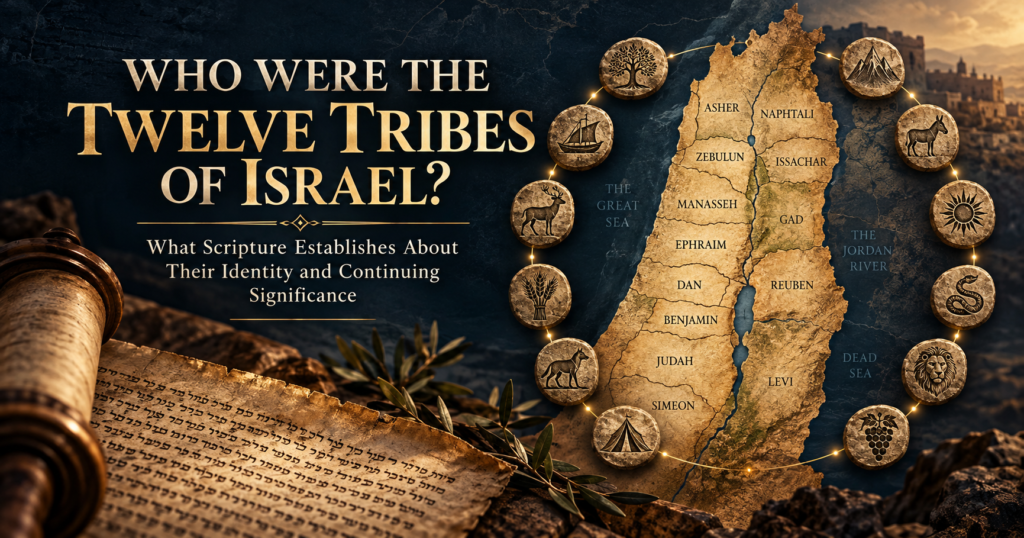
When Scripture speaks of the twelve tribes of Israel, it begins with Jacob, whom Yahweh also named Israel (Genesis 32:28; 35:10). The primary question is therefore genealogical before it is political, territorial, or prophetic: who were Jacob’s twelve sons, and how did their households become Israel’s tribes? From there, further questions follow. Why do some biblical lists use different names? What did Assyria’s conquest do to the northern kingdom? Do the “lost tribes” texts establish extinction, continued identity, or modern ethnic identifications? And what does Revelation 7 actually say?
A Scripture-first answer requires attention to each passage’s purpose. “Israel” (Yisra’el) can mean Jacob himself, all his descendants, the united people, the northern kingdom after the monarchy divided, or a restored people in a prophetic context. Likewise, a tribal list may be genealogical, military, territorial, priestly, poetic, or visionary. The stable expression “twelve tribes” does not require every passage to repeat the same twelve labels for every purpose. Historical reconstruction can clarify Assyrian policy and ancient conditions, but it cannot supply a modern genealogy that Scripture itself does not preserve.
This order of inquiry matters. First ask what a passage actually names and counts; then compare it with related passages; then consider reasonable historical implications. A political designation such as “Israel” for the northern kingdom should not automatically be treated as a complete map of where every descendant of Jacob lived. Nor should a later use of tribal language be made to carry more genealogical precision than its context supplies.
The foundational twelve: Jacob’s sons
Genesis 35:22–26 provides the basic list. Jacob’s sons were Reuben, Simeon, Levi, Judah, Issachar, Zebulun, Joseph, Benjamin, Dan, Naphtali, Gad, and Asher. Leah bore Reuben through Zebulun; Rachel bore Joseph and Benjamin; Bilhah bore Dan and Naphtali; and Zilpah bore Gad and Asher. These maternal lines explain the family history, but Genesis does not turn them into four separate tribal systems.
Genesis 49 confirms this foundation. As Jacob approaches death, he addresses these sons individually in a poetic, testamentary blessing. The chapter concludes by identifying them as the twelve tribes of Israel. This is the Bible’s simplest answer to the question: the tribes are the tribal houses descended from Jacob’s twelve sons. Jacob’s God-given name Israel supplies the name of the people.
Genesis 49 is important precisely because it combines individual sayings with a comprehensive conclusion. Its blessings speak to particular sons and their futures, but the chapter is not a modern ethnic key, a military roster, or a territorial survey. It establishes the foundational relationship between the sons and the tribes without requiring every later administrative list to repeat its sequence.
Two Hebrew terms commonly denote a tribe: shevet and matteh. Each can also mean a staff, rod, or scepter in other settings. That overlap may be suggestive in a particular context, but it does not establish a doctrine about tribal authority or prove modern descent. In census and inheritance texts, the terms identify recognized communal divisions within Israel.
Several categories overlap without being identical: biological descent from a son of Jacob; membership in a tribal body; a tribe’s territorial inheritance; a kingdom’s political boundaries; and faithfulness to Yahweh’s covenant. Confusing these categories produces many unnecessary claims. A tribe could remain part of Israel while lacking an ordinary territorial portion, and a person could be physically descended from Israel without thereby settling every question of covenant standing.
Why the lists differ: Levi and Joseph
The principal explanation for varying lists is found within the Torah itself. Levi never ceased to be Jacob’s son or an Israelite tribe. Genesis 49 names Levi alongside the others. Yet Numbers 3 sets the Levites apart for tabernacle service in place of Israel’s firstborn. Therefore Numbers 1 does not include Levi in its count of fighting men. This exclusion is functional, not genealogical. Levi is still Israel, but Levi is not counted as an ordinary military unit in that census.
Joseph accounts for the other major variation. In Genesis 48, Jacob receives Joseph’s sons Ephraim and Manasseh as his own for inheritance purposes. Joseph remains one of Jacob’s twelve biological sons; Ephraim and Manasseh do not become additional biological sons of Jacob. But Joseph’s inheritance is represented through two tribal branches. Jacob blesses both, with Ephraim receiving the greater blessing despite being younger.
This arrangement permits a list to maintain twelve landholding or fighting tribes while Levi is set apart: Ephraim and Manasseh appear separately in Joseph’s place. First Chronicles 5:1–2 further distinguishes related but different functions. Reuben’s birthright was given to Joseph’s sons, while Judah had preeminence. Birthright inheritance, royal leadership, and genealogical identity should not be collapsed into one category.
The concise summary is this: Jacob’s twelve sons form the genealogical foundation of Israel’s tribes, while later biblical lists preserve a twelve-tribe framework using different naming arrangements according to the purpose of the passage. A genealogical or blessing text may name Levi and Joseph. A military or land-allotment text may omit Levi and count Ephraim and Manasseh separately. Neither pattern denies Levi’s membership in Israel or Joseph’s place among Jacob’s sons.
Numbers and Joshua: census, inheritance, and cities
Numbers 1 is a wilderness military census. It numbers males able to go to war by tribe. Levi is excluded because of its sanctuary responsibilities, while Ephraim and Manasseh are separately counted. Numbers 26 follows the same broad arrangement in the second wilderness census: the ordinary tribal count concerns Israel’s fighting population, and Levi is counted separately. The distinction is deliberate administration, not uncertainty about the tribal fathers.
Numbers 3 makes the rationale more explicit by assigning the Levites to tabernacle service and counting them in their own framework. Therefore, the omission of Levi from Numbers 1 should not be described as a thirteenth-tribe problem or as an indication that Levi was outside Israel. The passage is counting available fighting men, whereas the Levites had a distinct sanctuary duty.
Joshua 13–21 applies a related convention to land. Reuben, Gad, and half the tribe of Manasseh receive inheritance east of the Jordan. The other half of Manasseh receives territory west of it, while Ephraim receives its own allotment. Thus Manasseh spans both sides of the Jordan; a tribe is not always confined to one compact region.
Levi receives no ordinary territorial inheritance. Joshua 13:14 and 13:33 state that Yahweh, the God of Israel, was Levi’s inheritance; Joshua 14:3–4 explains that the Levites instead received cities and pasturelands. Joshua 21 records those cities among the territories of the other tribes. The Levites therefore were neither excluded from Israel nor left without homes and provision. Joshua shows that tribe, land, and ancestry cannot simply be treated as interchangeable terms.
The land records also prevent a simplistic equation of tribal identity with a single modern-style boundary. Reuben and Gad were east of the Jordan; Manasseh had eastern and western portions; and Levites lived in assigned cities distributed among other tribal territories. The tribal order was genealogical and covenantal as well as administrative and geographical.
Other lists and the enduring language of twelve
| Passage | Setting and naming pattern | What it does not establish |
|---|---|---|
| Genesis 35; 49 | Genealogy and Jacob’s blessings: Jacob’s twelve sons, including Levi and Joseph. | A military census, land register, or modern ethnic map. |
| Numbers 1; 26 | Military censuses: Levi is separate; Ephraim and Manasseh appear as Joseph’s branches. | That Levi ceased to be a tribe. |
| Deuteronomy 33 | Moses’ poetic blessings use another arrangement; Simeon is not separately named. | That Simeon had disappeared. |
| Joshua 13–21 | Land and Levitical-city administration: two Joseph tribes receive inheritance; Levi receives cities. | That every tribe had one ordinary territory. |
| Ezekiel 47–48 | An ordered land vision includes Dan, gives Joseph two portions, and grants Levi a holy allocation. | A reproduction of Joshua’s geographical map. |
| Revelation 7 | A visionary list includes Levi, Manasseh, and Joseph, but not Dan or a separate Ephraim. | An explanation for its distinctive selection of names. |
Deuteronomy 33 illustrates why omission in a particular list must be read by genre. Moses blesses tribes in a poetic chapter and does not separately mention Simeon. Genesis, Numbers, Joshua, and later texts make clear that this is not evidence that Simeon ceased to exist. Ezekiel 47:13–48:35 likewise presents an idealized land arrangement rather than a simple restatement of earlier allotments. Biblical writers can use tribal names in different ordered patterns while retaining the fundamental twelve-tribe framework.
Yeshua’s sayings in Matthew 19:28 and Luke 22:30 also speak of the twelve tribes of Israel in an eschatological setting. These sayings show that the phrase retained significance in the Gospels. They do not supply a first-century tribal registry or identify modern descendants. Acts 26:6–7 and James 1:1 likewise preserve twelve-tribe language, but their implications must be considered alongside the exile and dispersion.
Assyria and the fall of the northern kingdom
The biblical account first establishes the reality of catastrophe. Second Kings 15:29 records an earlier Assyrian deportation in northern Israel during the days of Tiglath-pileser. Second Kings 17:1–24 and 18:9–12 then recount Samaria’s fall after siege, Israel’s removal to places within the Assyrian realm, and the resettlement of peoples from other lands in Samaria. The northern kingdom ceased to exist as an independent monarchy. Israelites were deported, and Samaria experienced major demographic and religious change.
Those texts do not provide a family-by-family census. They do not say every northern inhabitant was deported, every surviving inhabitant lost Israelite descent, or every tribal memory was erased. The account concerns imperial conquest and covenant judgment, not a complete demographic ledger. Its emphasis is sufficiently strong to establish exile and national collapse, but its wording should not be stretched into claims it does not make about every household.
Ancient Assyrian material broadly corroborates the historical setting. Neo-Assyrian rulers used conquest, tribute, deportation, resettlement, and provincial administration across their empire. Sargon II’s royal inscriptions claim the capture of Samaria, population transfer, resettlement, and imperial control. The frequently repeated figure of roughly 27,290 deportees comes from such royal records, with variant readings and damaged or complex textual transmission. It should be described as what the inscription reports, not as an uncontested total for all Israelites, all Samaritans, or the entire northern kingdom.
There is also a historical caution concerning the capture itself. Kings connects the siege with Shalmaneser V, while Sargon II’s inscriptions claim the conquest. Scholarly reconstructions of the change of reign and the chronology are plausible but not equally certain in every detail. The shared historical conclusion is firm enough: Assyria crushed the northern monarchy and imposed its normal imperial methods.
From Scripture and this historical context, one may reasonably infer severe social disruption: deportation, survival in place, migration, incorporation into Assyrian structures, intermarriage, and loss of local institutions. But the evidence does not quantify each outcome. “Lost” can mean politically conquered, geographically dispersed, demographically intermingled, or difficult for later historians to trace. Those are different claims and should not be treated as synonyms.
Did the northern tribes disappear?
The strongest historical-disruption reading deserves full weight. The northern kingdom was dismantled; deportation and resettlement occurred; later restoration narratives center heavily on Judah, Benjamin, Jerusalem, priests, Levites, and the temple. After centuries of displacement and intermingling, separate northern tribal identities would often have been difficult, and perhaps impossible, to document in ordinary historical terms. This explains why claims of ten intact tribes migrating as self-contained modern nations are historically weak.
Yet political collapse does not itself demonstrate biological extinction. Before Samaria’s fall, Hezekiah invited both Israel and Judah to Passover; Second Chronicles 30 says that some from Asher, Manasseh, Zebulun, and Ephraim humbled themselves and came to Jerusalem, though others mocked the invitation. The passage does not count all northerners, but it shows that northern tribal affiliations remained meaningful and that people from northern areas could join Judah-centered worship.
Second Chronicles 34:6–9, in its account of Josiah’s reforms and collection, refers to Manasseh, Ephraim, Simeon, Naphtali, and the remnant of Israel. Chronological and historical questions about Chronicles require care, but the text portrays a continuing northern constituency. Ezra and Nehemiah focus on the return to Judah and the rebuilding of Jerusalem. Their emphasis neither proves that every tribe returned nor proves all other tribes had vanished. Broad references to Israel are not equivalent to a complete twelve-tribe return register.
Later passages complicate total-disappearance claims further. First Chronicles 9:1–3 includes Ephraim and Manasseh among people associated with Jerusalem in the Chronicler’s presentation. Luke identifies Anna as being from Asher (Luke 2:36). Paul calls himself an Israelite from Benjamin (Romans 11:1) and speaks in Acts 26:7 of “our twelve tribes” serving God in hope. These texts show ongoing Israelite and tribal consciousness; they do not prove that every Jew could document his tribe or that each tribe remained a separate geographical unit.
James 1:1 is genuinely debated. Its address to the twelve tribes in the Dispersion may refer literally to dispersed Jewish believers, function as covenantal language for Messiah-believing communities, or carry both resonances. It cannot settle demographic totals or provide a tribal genealogy. The biblical evidence supports exile, scattering, migration, intermingling, and continued tribal language more directly than it supports either complete disappearance or complete public traceability.
Revelation 7: what the vision establishes
Revelation 7:4–8 states that 144,000 are sealed from every tribe of the sons of Israel, twelve thousand from each named group. The list is Judah, Reuben, Gad, Asher, Naphtali, Manasseh, Simeon, Levi, Issachar, Zebulun, Joseph, and Benjamin. The observations are straightforward: Levi is included; Manasseh is included; Joseph is named; Ephraim is not separately named; and Dan is absent.
This arrangement should be reported exactly as John gives it. It does not say that Joseph is simply another name for Ephraim, though that proposal is understandable when lists are compared. Nor does the list say that Ephraim ceased to exist. The passage names Joseph and Manasseh, and readers should not replace those names with an explanation the vision itself does not provide.
John does not tell readers why. Dan’s earlier association with idolatry in Judges 18 and 1 Kings 12 makes an idolatry explanation conceivable, but Revelation 7 does not state it. Theories that the antichrist must come from Dan, that Dan was extinguished, cursed beyond restoration, or genetically absorbed are later proposals. Neither the omission of Dan nor the use of Joseph provides a license to construct doctrine from an unexplained feature of the list.
The literal ethnic-Israel reading has substantial textual strengths. It takes seriously the repeated expression tribes of the sons of Israel, the equal tribal numbers, and the distinction in the vision between the numbered sealed group and the multinational multitude in Revelation 7:9–17. On this view, Yahweh can know ancestry even where modern records cannot. Its limitation is that Revelation is apocalyptic literature, marked by symbolic numbers and images, and its list is not a normal genealogical register.
The symbolic whole-people-of-God reading also has serious arguments. It emphasizes the highly stylized number, military-census imagery, the nonstandard tribal arrangement, and a possible hear-and-see relationship: John hears the numbered Israelite host and then sees the uncountable multitude from every nation. Many interpreters understand these as two portrayals of the same redeemed people. That conclusion, however, is an interpretation; Revelation does not expressly identify the two groups as identical. Nor can the phrase tribes of the sons of Israel simply be dismissed without explaining why John uses it so specifically.
A mediating reading holds that the number and arrangement are symbolic while tribal Israel remains a meaningful referent in the vision. This approach seeks to honor both Revelation’s symbolic character and its Israelite language. It is a theological synthesis rather than John’s stated explanation. At the passage level, Revelation 7 establishes deliberate, continuing use of twelve-tribe Israel imagery or reference. It does not explain the list, identify present-day descendants, or provide a method for modern tribal registration.
Ancestry, covenant, and faithful standing
Modern discussions often merge three distinct questions: physical ancestry, covenant identity, and faithful standing before Yahweh. Scripture relates them, but does not make them identical. Romans 9:6–8 teaches that physical descent alone does not settle who are the children of promise. That rules out ethnic salvationism. Yet Romans 11 also rules out Gentile arrogance and simple ethnic erasure: Paul remains an Israelite from Benjamin, says Yahweh has not rejected his people, and speaks of Israel, the nations, mercy, hardening, and irrevocable calling.
Galatians 3:26–29 establishes that those united to Messiah share Abraham’s promised inheritance. Ephesians 2:11–22 teaches that Gentiles once alienated from Israel’s commonwealth have been brought near through Messiah and formed into one new humanity with Jewish believers. Their scope is reconciliation, shared inheritance, and access to Yahweh. They do not assign Gentile believers to Ephraim, Dan, or another tribe; neither do they erase every historical distinction relevant to Paul’s argument in Romans 9–11.
This distinction protects two biblical truths at once. No ancestry claim can replace faith, repentance, and obedience to Messiah; yet Gentile inclusion must not be turned into a claim that Israel has become irrelevant to Scripture’s own argument. The passages address covenant mercy and faithful belonging, not a system for distributing tribal labels to modern Christians.
For this reason, asserted racial or national tribal identities require more than prooftexts, migration legends, linguistic similarities, or claimed revelations. Scripture names no modern population—Black Americans, Native Americans, Hispanics, Europeans, or any other group—as a specified tribe. Such an assertion would require a demonstrable textual, historical, and genealogical chain. The Bible does not supply that chain. Readers evaluating modern prophetic claims should apply a consistent Scripture-first standard rather than allowing asserted visions to authenticate themselves: How Scripture Tests Prophetic Claims: A Berean Framework for Discernment.
Berean verdict
What Scripture explicitly establishes: Jacob’s twelve sons are the foundation of the twelve tribes of Israel. Levi’s special sanctuary service and Joseph’s double inheritance through Ephraim and Manasseh explain many differing lists. Assyria conquered the northern kingdom, deported Israelites, and resettled foreign peoples in Samaria. Revelation 7 deliberately gives a distinctive twelve-name list of sealed groups from the tribes of the sons of Israel.
What may reasonably be inferred: northern Israel underwent profound dispersion, political destruction, demographic disruption, migration, survival, and intermingling. Later biblical references to northern tribes and to twelve tribes show that Israelite tribal language and consciousness did not simply vanish with Samaria’s fall.
What remains debated or unestablished: whether Revelation 7’s 144,000 is a literal ethnic-Israel census, a symbolic portrayal of the whole redeemed people, or symbolic imagery retaining a particular Israel reference; the precise scope of James 1:1; the extent to which tribal identities remained publicly traceable; and the reason Dan is absent from Revelation’s list. Scripture does not identify modern ethnic groups as particular tribes.
The warranted conclusion is therefore narrow but substantial: the twelve tribes were the tribal houses of Jacob’s twelve sons. Biblical lists vary because their purposes vary, especially in relation to Levi and Joseph’s sons. Scripture teaches real Assyrian exile and dispersion, but not that every northern Israelite vanished. It retains later tribal and twelve-tribe language, but it does not give modern readers a tribal-identity key. Where the text is silent, confidence should give way to disciplined uncertainty.
Discussion
1 Comment
Test the claim with Scripture. Address the text and the argument, not the person. Comments may be held for moderation.
Keep it Berean: cite the text when possible, make the argument clearly, and keep disagreement respectful.