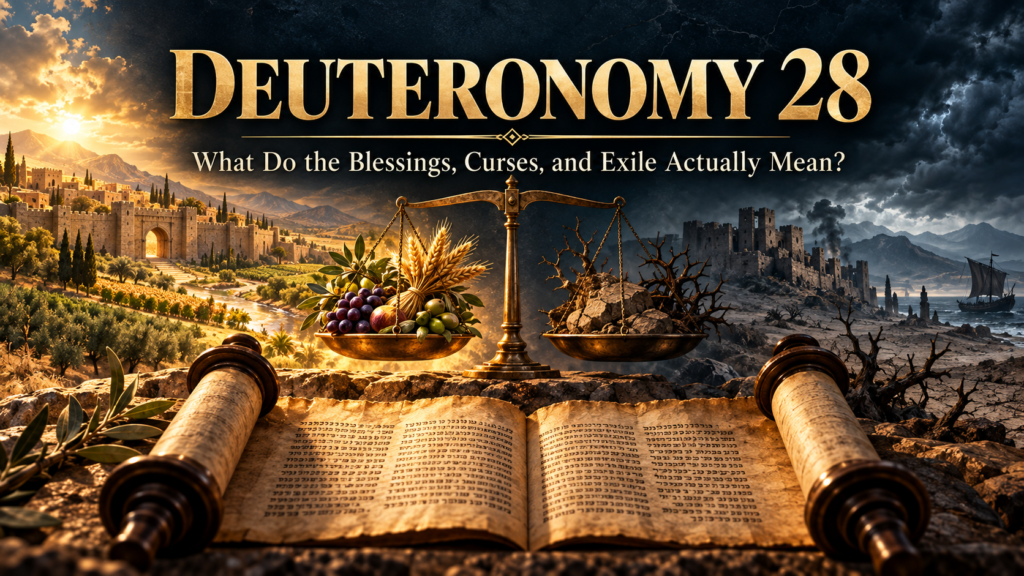
Deuteronomy 28 is often brought into modern arguments about slavery, exile, and ethnic identity. The chapter deserves closer reading than a list of apparent correspondences. Its own setting comes first: Yahweh speaks to Israel on the plains of Moab as the people prepare to enter the land. Only then should readers compare its warnings with later biblical history or modern claims. A striking resemblance is not, by itself, a textual identification.
The chapter establishes covenant sanctions for historical Israel: blessing for heedful obedience and escalating judgment for persistent rebellion. Later Scripture directly interprets the Assyrian and Babylonian catastrophes through this covenant framework. Yet Deuteronomy 28 does not name the Atlantic world, West Africa, Europe, the Americas, a racial category, or a modern ethnic population. This does not require denying the horrors of the transatlantic slave trade or refusing to examine proposed parallels. It requires distinguishing what the text says from what an interpreter concludes.
Israel’s covenant setting in Deuteronomy 26–30
Deuteronomy 28 belongs to a tightly connected covenant section. Chapter 26 closes with Israel’s confession of Yahweh’s saving acts, firstfruits, and commitment to walk in his ways. Chapter 27 publicly announces curses for specified covenant violations. Chapter 28 expands the blessing-and-curse framework. Chapters 29–30 renew the covenant, explain exile as the consequence of abandoning Yahweh, and promise restoration after Israel turns back.
The audience is not anonymous. It is Israel, addressed before entering and possessing the promised land. The chapter speaks of cities and fields, grain and flocks, enemies and fortified towns, a future king, siege, and being uprooted from “the land” Israel is entering to possess. These features govern interpretation. The speech concerns Israel’s national covenant life under Yahweh, not initially a hidden prediction puzzle concerning a later people whose identity must be inferred from suffering.
The repeated verb shamaʿ, “hear,” is important in this setting. In Deuteronomy 28:1, 15, 45, and 62, hearing Yahweh’s voice is not merely receiving sound; it is listening in a responsive, covenant-keeping way. The stated cause of the curses is Israel’s refusal to heed Yahweh and keep his commands. The chapter therefore does not make prosperity a universal proof of personal righteousness, nor does it make suffering a universal proof that a particular contemporary people bear Israel’s Mosaic-covenant curse.
Other Torah passages establish the same framework. Leviticus 26:14–45 warns of disease, defeat, desolation, scattering among the nations, confession, and Yahweh’s remembrance of the covenant. Deuteronomy 4:25–31 already anticipates corruption, dispersion, foreign gods, seeking Yahweh from exile, and mercy. Exile and restoration are thus covenant categories within the Torah before later historical disasters occur.
The structure of blessing, curse, and reversal
Deuteronomy 28:1–14 promises covenant blessing if Israel diligently obeys. Israel will be elevated among the nations; city and field will be fruitful; children, herds, crops, and stores will be blessed; enemies will be defeated; and Israel will lend rather than borrow. These are not detached guarantees of uninterrupted wealth. They describe Yahweh’s favor upon his covenant people in the land he gives them.
Verses 15–68 reverse those gifts. City and field become cursed. Agricultural provision becomes drought, blight, and loss. Bodily well-being becomes disease. Military victory becomes defeat. Secure possession becomes foreign exploitation. Children become loss. Freedom becomes service to enemies. Land inheritance becomes uprooting, exile, and scattering. The passage proceeds from ordinary covenant loss to national collapse, siege, deportation, and fear among the nations.
The imbalance is deliberate: fourteen verses of blessing are followed by fifty-four verses of curse. The lengthy curse section intensifies the warning. It does not establish that the entire section predicts one exclusive catastrophe in a distant future. Nor can the chapter responsibly be reduced to a few detached markers—ships, an iron yoke, slavery, or being a byword—while its land, king, agriculture, invasion, and siege language is ignored.
Verse 45 gives the chapter’s own explanation: the curses will pursue and overtake Israel because Israel did not obey the voice of Yahweh. Race, physical appearance, modern nationality, and generalized victimhood are not offered as causes or identifiers. The controlling theme is covenant fidelity and covenant rebellion.
The severe curses in their immediate context
Several verses frequently used in modern identity arguments must be read in sequence. Deuteronomy 28:32 says Israel’s sons and daughters will be given to another people. The parents watch in longing and have no power to act. Verse 41 similarly says that Israel will father children but not keep them because they go into captivity. These statements establish the agony of family loss under conquest and captivity. They do not specify an era, a commercial system of slavery, or a particular racial population.
Verses 36–37 add a major national feature: Yahweh will bring Israel and the king whom Israel sets over itself to an unknown nation, where they will serve gods of wood and stone. Israel will become an object of horror, proverb, and byword among the peoples. The reference to a king coheres naturally with Israel’s later monarchy and resonates strongly with the deportation of Judean kings and officials. It cannot simply be dropped from a proposed fulfillment that relies only on ships and servitude.
Verses 48–52 portray enemy domination in stark terms. Israel will serve enemies in hunger, thirst, nakedness, and lack. The enemy will place an “iron yoke” on Israel’s neck. The image communicates crushing subjugation; it is not a unique reference to a particular people’s restraints. Jeremiah 28 later uses iron-yoke imagery for Babylonian domination, showing that Scripture itself can employ the image in an ancient covenant-judgment setting.
Yahweh will bring against Israel a goy meraḥoq, “a nation from afar,” whose language Israel does not understand. The phrase identifies a foreign, distant invader, not a named empire. That nation will besiege Israel’s towns until their fortified defenses fall. Siege becomes the dreadful climax in verses 53–57, where deprivation reaches the point of parents consuming their own offspring in the distress caused by an enemy. This should be read soberly, not sensationally. It is a curse of enemy-caused confinement and starvation.
Verses 58–61 intensify the warning: refusal to do the words written in the book of the law and refusal to fear Yahweh’s glorious name bring extraordinary plagues and illnesses. The language is comprehensive, including sicknesses beyond those specifically listed. It is covenant-sanction language, not a coded chronological chart. Verses 62–67 then gather the national consequences: Israel is reduced in number, uprooted from the land, scattered among peoples, compelled toward foreign gods, and deprived of rest, security, and hope.
A reasonable literary inference emerges from the whole sequence. Israel, redeemed from Egyptian bondage to serve Yahweh in the land, is threatened with the reversal of that redemption: service to enemies, foreign gods, loss of inheritance, expulsion, and movement back toward Egypt. This exodus-reversal pattern explains the chapter more adequately than treating every phrase as a separate ethnic marker.
What Deuteronomy 28:68 says—and does not say
Verse 68 carries much of the modern transatlantic-identification argument and must be handled carefully. It announces that Yahweh will bring Israel back to Egypt in ships by a route previously forbidden or denied. There Israel will offer or sell itself to enemies as male and female slaves, but no buyer will be present. The verse contains Egypt, ships, enslavement, and the final statement that there is no purchaser. Each feature matters.
Mitsrayim ordinarily means Egypt. Deuteronomy gives no signal that it is a code word for America, the Americas, all Gentile lands, or a later slave society. Deuteronomy 17:16 warns Israel’s king against causing the people to return to Egypt, making Egypt an important intra-book symbol and literal location of exodus reversal. That connection does not settle every detail of 28:68, but it strongly cautions against replacing Egypt with a modern destination without textual warrant.
The plural ʾoniyyot means “ships.” It establishes maritime transport. It does not identify ocean-crossing ships, the Atlantic Ocean, West Africa, European traders, plantation economies, or the Americas. Those may be part of a proposed historical comparison, but they are not in the word itself.
The verb often rendered “you shall sell yourselves” is hitmakkartem, a Hithpael form of makar. Major translations differ between “sell yourselves” and “offer yourselves for sale.” The form does not straightforwardly state that a named outside captor successfully sells Israel into a named slave market, though the broader chapter plainly concerns coercive enemy domination. The following noun qoneh means buyer or purchaser. The immediate point is that, after the stated offer for sale, no buyer exists. Explanations such as market oversupply, cheap sale, execution, lack of redemption, or a theological meaning beyond the scene require additional argument.
Thus verse 68 presents profound humiliation and exodus reversal. It does not identify its precise historical realization within the verse. Its “no buyer” wording also complicates the claim that it simply predicts the successful purchase and sale of millions of captives in the transatlantic slave trade.
How later Scripture applies the covenant-judgment pattern
Later Scripture does not leave Deuteronomy’s covenant warnings as abstractions. Second Kings 17:5–23 interprets the fall of the northern kingdom and Assyrian deportation in explicitly covenantal terms. Israel sinned against Yahweh, rejected his covenant, and was removed from the land. This is not merely a later reader finding a resemblance; the biblical narrative itself connects national exile with Israel’s unfaithfulness to Yahweh.
The Babylonian devastation of Judah likewise corresponds closely to Deuteronomy 28. Second Kings 24:10–16 records the removal of the king, court, and leading population. Second Kings 25:1–21 narrates the siege and fall of Jerusalem, the destruction of the temple and city, and deportation. Second Chronicles 36:11–21 explains the catastrophe through Judah’s unfaithfulness and refusal of Yahweh’s warnings. These texts materially validate the historical-covenantal reading: king-exile, siege, loss, land devastation, and deportation are not speculative applications imposed from outside Scripture.
Jeremiah 5:15–19 is especially close to Deuteronomy 28:49–52. It warns Judah of a nation from afar whose language the people do not know, a nation that consumes harvest, children, livestock, and fortified cities. Jeremiah applies the covenant-warning pattern to Judah’s approaching judgment, even though he does not announce a formula by which every phrase of Deuteronomy 28 is exhausted in his generation.
Jeremiah 19:7–9 and Lamentations 2:20; 4:10 show that the horror of siege starvation and cannibalism was not merely hypothetical. Lamentations also bears witness to desolation, reproach, forced labor, grief, and the loss of children. The record is grim, but it prevents readers from relocating all severe curse language into a modern era while overlooking the ancient calamities Scripture itself describes.
Jeremiah 42–44 adds a particularly relevant datum. After Jerusalem’s fall, a Judean remnant goes into literal Egypt contrary to Yahweh’s warning. This does not prove that the episode exhausts every element of Deuteronomy 28:68; the narrative does not introduce itself as a formal fulfillment quotation. It does show that literal Egypt remained a real covenantal destination of rebellion and judgment, rather than functioning automatically as a code for another continent.
Daniel 9:4–19 and Nehemiah 1:5–9 provide later biblical interpretation. Daniel confesses that the curse and oath written in the law of Moses came upon Israel and Jerusalem because of sin. Nehemiah recalls the Torah pattern: unfaithfulness brings scattering, while return to Yahweh and obedience are joined with gathering. Scripture therefore supports repeated and historically concrete covenant judgments. It does not explicitly identify the Atlantic slave trade, a modern ethnic group, or one later event as the exclusive fulfillment of verse 68.
Exile is not the final word
Deuteronomy 28 should not end the discussion, because Deuteronomy does not end there. Chapter 29:22–28 imagines later observers asking why Israel’s land has become devastated. Its answer is direct: Israel forsook Yahweh’s covenant and served other gods. The explanation remains covenantal, not racial.
Then Deuteronomy 30:1–10 gives the restoration counterpart. After the blessing and curse have come upon Israel among the nations where Yahweh has driven them, Israel may return to Yahweh and obey his voice. Yahweh promises to gather them, bring them back to the land, prosper and multiply them, and circumcise their hearts so that they love him. Restoration is explicit in chapter 30; it is not denied by the dark conclusion of 28:68.
This context rejects two opposite errors. One error says every curse must have been exhausted in a single ancient crisis. The historical books and prophets portray more than one episode of covenant judgment. The other says exile proves permanent abandonment or supplies a warrant to despise scattered people. Deuteronomy 30 explicitly joins judgment with the possibility of repentance, mercy, gathering, and restoration. Covenant discipline calls for fear of Yahweh and return to him, never contempt for Jews, Africans, Black people, or any suffering community.
The strongest case for a transatlantic identification
Black Hebrew Israelite communities are diverse, and their claims should not be treated as uniform. A common transatlantic-identification reading argues that descendants of enslaved Africans, particularly in the Americas and wider diaspora, are Israelites described by Deuteronomy 28. Supporters observe cumulative correspondences: forced travel by ships, enslavement, family separation, deprivation, severe oppression, dispersion, social contempt, and enduring trauma. The transatlantic slave trade was a vast and brutal system of racialized human trafficking and chattel slavery. Its evil must not be minimized.
The strongest literary form of the argument does not merely count isolated details. It sees Deuteronomy’s exodus-reversal imagery as allowing a later experience of slavery to have typological significance. That is a more serious claim than simply asserting that “Egypt” always means America. Biblical patterns can recur, and later suffering may resemble prior biblical judgments without being identical to them.
Yet identification requires more than resemblance. The argument must establish that Egypt in verse 68 means America or the Americas; that the ships are uniquely transatlantic; that the covenant audience can be reassigned from historical Israel to a modern racial population; and that suffering under curse-like conditions proves biological or tribal descent. Deuteronomy 28 does not state these propositions.
Appeals to Revelation 11:8 do not resolve the issue. That verse calls a city “spiritually” Sodom and Egypt in its own symbolic setting. It does not reinterpret Deuteronomy 28:68 or establish Egypt as a fixed biblical code for the Americas. A typological echo between Egyptian bondage and later slavery may be argued as an analogy. But typology by itself does not identify descendants or settle ancestry.
Verse 68 also resists a simple transatlantic reading. It refers to Egypt, speaks of Israel offering or selling itself to enemies as male and female slaves, and concludes with no buyer. That is not a plain verbal description of captors successfully marketing captives to purchasers across the Atlantic. Nor does the wider chapter concern maritime slavery alone. It concerns Israel’s land, king, crops, siege, foreign invasion, uprooting, and scattering. A proposal that selects ships, slavery, and byword while leaving these controlling features unexplained is incomplete.
The real parallels should be acknowledged, and the historical suffering should be mourned. But moral recognition is not exegetical proof. The Berean test requires that a conclusion be proportionate to the evidence, not merely compelling because its correspondences are emotionally powerful.
What the evidence establishes—and what it does not
What Deuteronomy 28 explicitly establishes: Yahweh addresses Israel under his covenant. He promises blessings for heedful obedience and announces curses for disobedience: defeat, loss of children, captivity, king-exile, harsh foreign service, siege, uprooting from the land, scattering, fear, and a return to Egypt in ships followed by an offer for sale with no buyer.
What later Scripture explicitly identifies: Assyrian and Babylonian devastation, exile, siege, deportation, and scattering are interpreted as judgments connected with Israel’s covenant unfaithfulness. Scripture also explicitly preserves a restoration horizon after repentance and return to Yahweh.
What may reasonably be inferred: Deuteronomy presents an escalating, corporate covenant-judgment pattern that recurs in Israel’s biblical history. Later oppression, displacement, slavery, and contempt can resemble its imagery and may sometimes be discussed as analogies or possible typological resonances.
What remains debated: whether verse 68 corresponds primarily to an ancient Egyptian reversal, a Roman-era captivity, a future comprehensive judgment, or an Atlantic-era event. Deuteronomy names Egypt but does not date an event, name an empire, or identify a later population. Each proposed correspondence is an interpretation and should be labeled as such.
What the text does not establish: that descendants of enslaved Africans are Israelites; that a modern people can be assigned tribal ancestry from race, nationality, ships, captivity, cultural resemblance, dispersion, or suffering; or that any group’s hardship proves it is under a Mosaic covenant curse. Such ancestry claims require independent historical continuity, credible genealogical evidence, and carefully limited external evidence. For the biblical limits on identifying tribes in the present, see what Scripture establishes about the twelve tribes of Israel.
Berean verdict
Deuteronomy 28 establishes covenant blessings and curses for Israel, culminating in land loss, exile, scattering, and an exodus-reversal humiliation for persistent disobedience. Later Scripture materially connects these warnings to Assyrian and Babylonian judgments and supports a broader recurring pattern of covenant discipline. It does not require every phrase to be confined to one ancient event.
But the chapter does not identify a modern ethnic group. It does not name Africa, Europe, the Atlantic, the Americas, racial categories, a modern nation, or descendants of enslaved people. Egypt, ships, slavery, and suffering cannot bear that identification without additional assumptions that the passage does not supply. Readers should apply the same care used when testing other modern mappings of biblical geography and prophecy: Scripture must establish the proposed identification, not merely resemble it.
Therefore, Deuteronomy 28 must not become a weapon for racial boasting, ethnic accusation, or declarations of divine rejection over any people. Its central message is graver and more hopeful: Yahweh judges covenant rebellion righteously, and the wider Deuteronomic context summons Israel to return to him with hope for mercy, gathering, and restoration.
Discussion
1 Comment
Test the claim with Scripture. Address the text and the argument, not the person. Comments may be held for moderation.
Keep it Berean: cite the text when possible, make the argument clearly, and keep disagreement respectful.