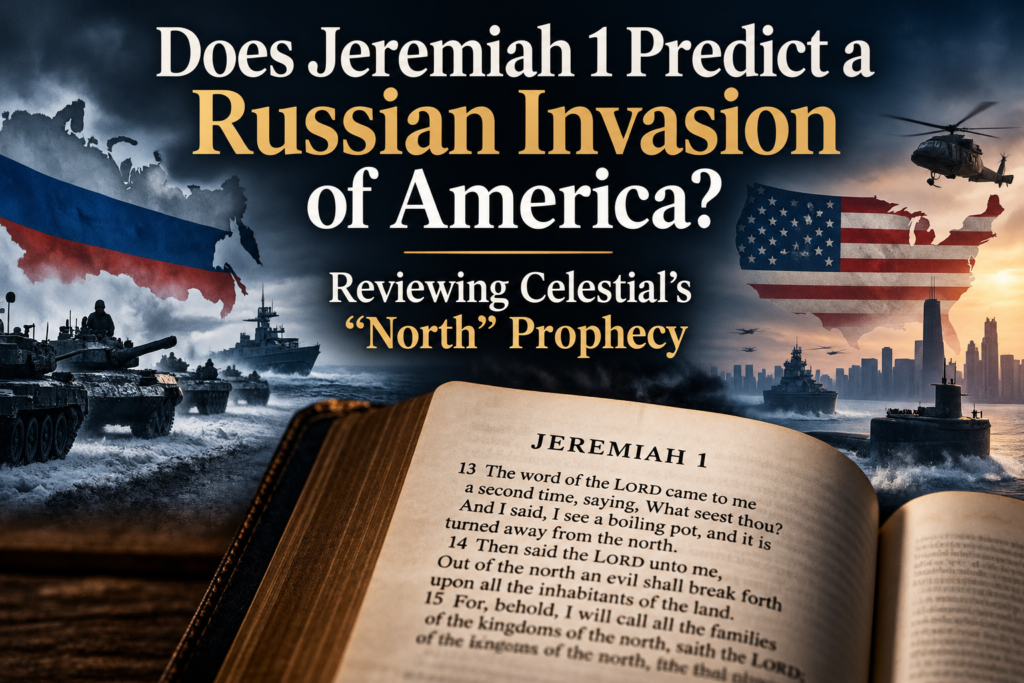
“North” – January 9, 2020 is a claimed revelation by Celestial, dated January 9, 2020 and published on January 12, 2020 at The Master’s Voice Prophecy Blog. The live page also displays June 7, 2021, but the supplied material does not establish whether that date marks an update, migration, or another metadata event.
The source explicitly says that “this prophecy speaks about you and Russia,” and it forecasts that “Russia will attack and destroy the nation of America.” It presents China as a partner and includes winter conditions, surprise attacks, ships, submarines, scuba forces, and advanced weapons. These are not offered merely as geopolitical concerns: the source presents the message as “This is the word of the Lord.” That claim requires careful biblical testing.
This review has a narrow purpose: to assess the source’s handling of Jeremiah and its specific predictive claims. It does not assess Celestial’s motives, character, or ministry as a whole. The question is whether Jeremiah 1 predicts the stated Russia-America scenario and, if not, whether the added claims have been established as a revelation from Yahweh.
What Jeremiah 1:13–16 Actually Addresses
Jeremiah 1 is the prophet’s commissioning narrative. Yahweh calls Jeremiah during Judah’s final monarchy, appoints him concerning nations and kingdoms, and gives him two visions. The first, involving an almond branch, confirms that Yahweh is watching over His word to perform it (Jeremiah 1:11–12). The second is the boiling-pot vision in verses 13–16.
Jeremiah sees a boiling pot facing away from the north. Yahweh explains that calamity will break forth from the north against the inhabitants of the land. He summons the families of the kingdoms of the north, which will set their thrones at the entrances of Jerusalem’s gates, against its walls, and against all Judah’s cities. Verse 16 supplies the stated reason for judgment: Judah has forsaken Yahweh, offered incense to other gods, and worshiped the work of its hands.
The named targets govern the interpretation. Jeremiah 1:15 identifies Jerusalem and the cities of Judah, while verse 16 identifies Judah’s idolatry as the immediate reason for judgment. The passage does not name America, Russia, China, a future nation across the ocean, or a second fulfillment in the United States.
Several Hebrew details reinforce that restraint. Ṣāpôn means north or a northern region; it does not lexically mean Russia. Rā‘â, rendered in context as calamity or disaster, can also denote evil or harm; its range does not identify the invaders’ nationality. Most importantly, verse 15 uses the plural expression mišpeḥôt mamlĕkôt ṣāpônâ, referring to families or clans of the kingdoms of the north. This is not the singular title king of the north. The kis’ôt set at Jerusalem’s gates are thrones or seats of authority, an image of conquerors exercising rule. The word should not be presented as a prediction of modern military camps or specialized tactics.
Jeremiah 1 therefore explicitly announces Yahweh’s judgment on Jerusalem and Judah through northern kingdoms. It does not explicitly describe winter warfare, naval landings, submarines, divers, modern weapons, Russia, China, or America.
The Northern Threat in Jeremiah’s Own Setting
The rest of Jeremiah develops the same warning within Judah’s historical crisis. Jeremiah 4:5–7 warns Judah and Jerusalem that disaster is coming from the north. Jeremiah 6:1 and 6:22–23 again portray danger against Jerusalem and a people coming from the north. These passages intensify the opening vision’s threat; they do not redirect it toward a future American target.
When Jeremiah is read as a whole, Babylon is the strongest historical-canonical identification. Jeremiah 25:8–11 expressly names Nebuchadnezzar, king of Babylon, as Yahweh’s servant brought against this land and surrounding nations. Jeremiah 39:1–3 narrates Jerusalem’s fall and reports Babylonian officials entering and sitting at the Middle Gate. That scene closely corresponds to Jeremiah 1:15’s image of northern rulers setting their thrones at Jerusalem’s entrances.
Babylon lay broadly east of Judah on a modern map, but that does not make Jeremiah’s northern language inaccurate. Mesopotamian armies normally entered the Levant through the northern corridor rather than crossing the Arabian Desert. From the north is direction-language centered on ancient Judah and Jerusalem, not a compass line projected from the United States.
There is a genuine interpretive discussion worth acknowledging. Some interpreters argue that the earliest northern-foe material may have referred more broadly to an unidentified ancient threat, Scythian pressure, or northern imagery not yet narrowed to Babylon. That debate concerns Jeremiah’s ancient setting and the development of the book’s material. It does not provide a textual bridge to Russia, America, or a transoceanic invasion. Even this more cautious reading leaves the oracle anchored in Judah and Jerusalem.
Thus, many Jewish and Christian interpreters understand the northern judgment in Jeremiah’s book as Babylon’s assault on Judah. This is a contextual conclusion from the book rather than a claim that north always means Babylon in every biblical occurrence. But it is substantially better grounded than a modern Russia-America mapping.
Does Jeremiah Identify Russia, America, or a King of the North?
The source’s principal move is to treat Jeremiah’s northern judgment as a future message about Russia coming against America. Yet Jeremiah gives no stated basis for treating Jerusalem or Judah as coded names for the United States. Scripture teaches the general principle that Yahweh judges persistent national rebellion. That principle does not establish that America is Jeremiah’s Judah or that a particular modern war is the event Jeremiah foresaw.
The expression king of the north requires particular care. It does not occur in Jeremiah 1:13–15; Jeremiah instead speaks of multiple families of multiple northern kingdoms. Daniel 11 does use the expressions king of the north and king of the south, so the source may be blending Danielic terminology with Jeremiah’s northern imagery. But that connection requires its own argument. Daniel 11’s latter referents are debated among interpreters, and neither the historical reading centered on Antiochus IV nor futurist readings establish America as the target or Russia as the northern king.
A reader may draw a limited typological lesson from Jeremiah: nations are not secure merely because of religious language, wealth, military power, or past privilege; Yahweh judges idolatry and rebellion. But typology or moral application must not be presented as the grammatical-historical meaning of Jeremiah 1. The passage does not identify the modern nations asserted by the source.
The Strongest Charitable Reading: A Claimed New Revelation
The fairest defense of the source is not that Jeremiah’s original audience would have understood Russia and America. Its stronger case is that Celestial claims a new revelation using Jeremiah’s judgment imagery as a confirming pattern for a future event. On that reading, the modern identifications rest on claimed divine speech rather than direct exegesis of Jeremiah 1.
That distinction matters. Scripture does not tell believers to despise prophecies, and Jeremiah’s vision does show that Yahweh rules over nations and judges entrenched evil. Yet resemblance to biblical imagery cannot prove that a new application is from Yahweh. Jeremiah 1 cannot serve as textual proof for Russia, America, China, winter conditions, or amphibious tactics when none of those matters appears in the passage.
Related posts such as D-DAY and Enemy At The Gates show that the source has repeated a similar scenario. Repetition may demonstrate internal consistency, but it is not independent corroboration because the same publisher remains the source of the claims. Readers comparing the recurring Russia-focused framework may also consult Does “FLESH!: The Role of Russia” Have Biblical or Factual Support?.
If North is offered as fresh revelation, it must be weighed as a prophecy claim. It cannot be established simply by attaching a modern scenario to Jeremiah’s ancient oracle.
The Invasion Details and Modern Military Claims
The forecast that Russia will attack and destroy America, particularly in winter, is a specific future prediction attributed to private revelation. So are the claims concerning ships, submarines, scuba forces, surprise landings, and tactical cold-weather advantage. Neither Jeremiah 1 nor the biblical passages used to test prophecy predicts these details.
The source provides no stated deadline or measurable fulfillment threshold for attack, destruction, Blitzkrieg revolution, winter wars, or the described tactical methods. Therefore, elapsed years alone do not conclusively invoke Deuteronomy 18’s test for a prediction that fails to occur. At the same time, an undated prediction is difficult to falsify and cannot be treated as confirmed prophecy now. A genuine fulfillment would need to correspond substantially in actors, target, conditions, methods, scale, and outcome—not merely general international tension or military exercises.
There is a limited factual point beneath the Russia-China claim. Public U.S. defense reporting describes continuing PRC-Russia military exercises and an enduring partnership. That supports the modest observation that Russia and China cooperate in some military settings. It does not document an operational plan for a joint invasion of the United States or verify the source’s prophetic scenario.
Likewise, public defense reporting documents major Chinese military modernization in naval, missile, ground, and other systems. It does not establish the undefined assertion that Chinese weapons are categorically superior. Superior to whom, in which domain, and by what measure? Without those definitions, the assertion is neither a biblical conclusion nor a precise factual claim. Military capability and geopolitical cooperation may be relevant facts, but they are not fulfillment.
The source also distinguishes human weapon-making from Yahweh’s foreknowledge, emphasizing human responsibility for evil. Scripture does hold people accountable for wickedness. But that true theological principle does not validate the particular forecast of a Russian-Chinese invasion.
How Scripture Requires Claimed Prophecy to Be Weighed
“This is the word of the Lord” is not a casual phrase. It presents a message as divine speech rather than personal concern, analysis, or possibility. Scripture therefore calls for careful discernment, neither ridicule nor automatic acceptance.
Deuteronomy 13:1–5 gives an allegiance test: even a sign or prediction does not validate a messenger who leads people away from exclusive loyalty to Yahweh. This is not evidence for or against the invasion scenario itself; it establishes that apparent predictive success alone is insufficient. Deuteronomy 18:20–22 adds an outcome test. A person who presumptuously speaks in Yahweh’s name is accountable, and a word that does not happen was not spoken by Yahweh. Since North gives no clear timetable, its final outcome test remains pending rather than already decisive.
Jeremiah’s own book is especially relevant. Jeremiah 23:9–32 condemns visions spoken from a prophet’s own mind and declarations attributed to Yahweh without His sending. Jeremiah 28 shows that confident prophetic speech is not self-authenticating; Hananiah’s reassuring prediction had to be tested against Yahweh’s actual word and eventual outcome. Ezekiel 13 likewise rebukes prophets who follow their own spirit and announce security without divine warrant. These passages do not prove every modern claim false, but they show that vivid language, certainty, and religious formulas cannot establish a claim by themselves.
The New Testament maintains the same balance. First Corinthians 14:29 instructs that prophetic speech be weighed. First Thessalonians 5:20–21 says not to despise prophecies but to test everything and hold fast what is good. First John 4:1 commands believers to test the spirits because many false prophets have gone into the world. Christians should not mock warnings about war, nor should they receive a geopolitical forecast as Yahweh’s word merely because it is dramatic, repeated, or joined to a Bible verse.
Berean Verdict
What Jeremiah explicitly establishes: Yahweh announces a northern calamity against Jerusalem and Judah. Northern kingdoms will exercise conquering authority at Jerusalem’s gates and against Judah’s cities because of Judah’s wickedness and idolatry.
What the wider context reasonably supports: Jeremiah’s northern judgment imagery is most plausibly connected with Babylon’s attack on Judah and Jerusalem, particularly in light of Jeremiah 25 and 39. The precise earliest referent of some northern-foe material remains debated, but that ancient debate does not produce a Russia-America application.
What the text does not establish: America as Jeremiah’s Judah; Russia as Jeremiah’s invader; a singular king of the north in Jeremiah 1; a Russia-China coalition against America; winter warfare; ships, submarines, scuba forces; or superior Chinese weapons. Those details are unsupported as exposition of Jeremiah 1.
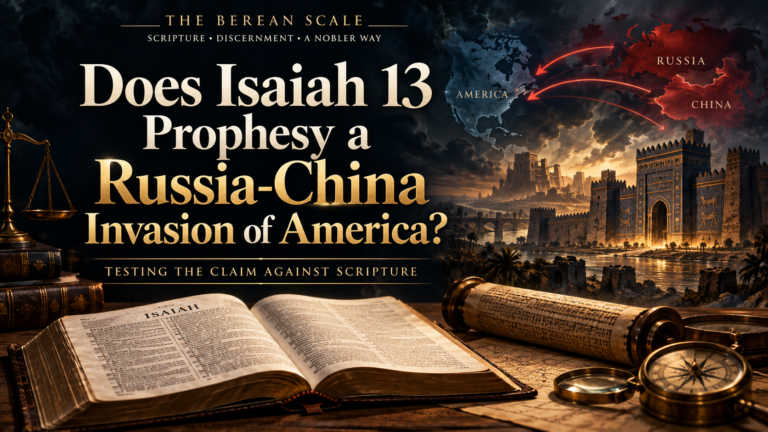
Result: The source correctly recognizes that Jeremiah announces judgment through northern powers, but it removes the oracle from its stated Judah-Jerusalem setting and adds modern nations and tactics absent from the text. The Russia-America scenario therefore fails as an interpretation of Jeremiah 1 and remains unverified as claimed private revelation. This assessment is part of The Berean Scale’s broader review of The Master’s Voice Prophecy Blog and its claimed revelations. Readers may also compare the related analysis, Does Isaiah 13 Prophesy a Russia-China Invasion of America?.

Discussion
Join the Discussion
Test the claim with Scripture. Address the text and the argument, not the person. Comments may be held for moderation.
Keep it Berean: cite the text when possible, make the argument clearly, and keep disagreement respectful.