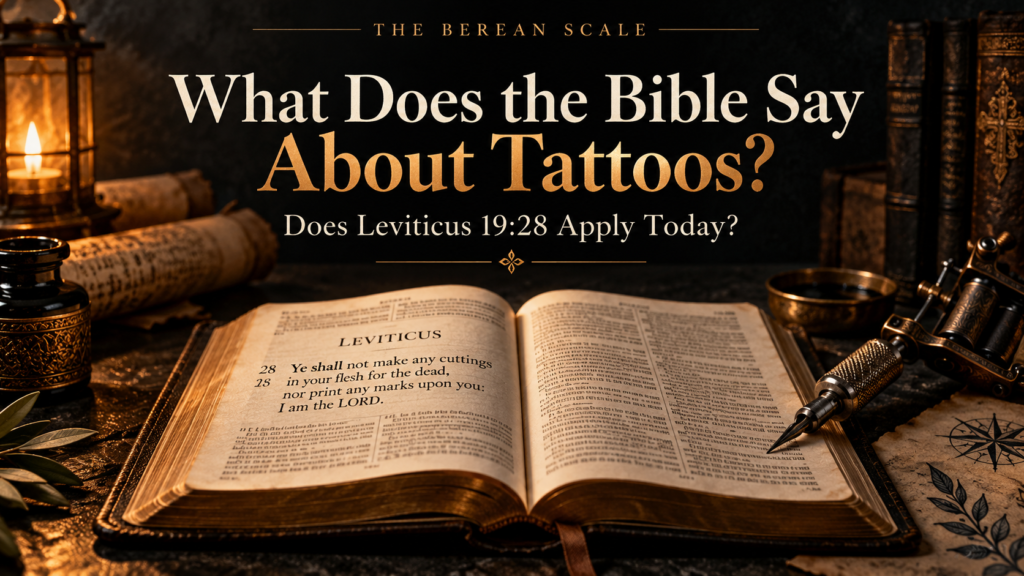
Does the Bible forbid tattoos? The central text is Leviticus 19:28, but a responsible answer requires more than placing that verse on a modern debate poster. The verse plainly forbids Israel from cutting the flesh in connection with the dead and also forbids a bodily inscription or mark. Yet the exact form of the second ancient practice is not fully recoverable from the Hebrew text alone. Nor does the New Testament give a direct command concerning tattoos.
Leviticus 19:28 therefore has real moral and interpretive weight. It cannot simply be dismissed as irrelevant. At the same time, neither this verse nor the New Testament explicitly says that every modern decorative tattoo is sinful. The proper task is to read the command in its Israelite covenant setting, weigh the leading interpretations fairly, and then apply the New Testament’s explicit principles concerning holiness, allegiance, conscience, love, and witness.
Leviticus 19:26–31: holiness and loyalty to Yahweh
Leviticus 19 opens with Yahweh speaking to “all the congregation of the sons of Israel” and commanding them to be holy because He is holy (Leviticus 19:1–2). That addressee matters. Before someone treats a particular command in the chapter as a direct new-covenant rule, he must first recognize that it was given to Israel within the Mosaic covenant. This distinction guards against both careless dismissal and careless transfer of Israel’s covenant commands.
Verses 26–31 form a compact collection of commands, not one uninterrupted discussion of tattooing. Israel is forbidden to eat over the blood, practice divination, or seek omens; certain hair and beard practices are prohibited; bodily cutting and marking are addressed; sexual exploitation is condemned; Sabbaths and the sanctuary are to be revered; and mediums and spiritists are rejected. The unit repeatedly grounds obedience in Yahweh’s authority and warns against defiling practices.
This context makes prohibited religious associations important background for verse 28. Divination, spiritism, and consulting the dead stand near the command. Israel was not to be shaped by practices that contradicted trust and loyalty to Yahweh. Still, proximity does not prove that every item in the paragraph was a pagan ritual, nor does it tell us precisely what every bodily mark signified. The text gives a clear prohibition, but not a complete cultural history of ancient tattooing.
What Leviticus 19:28 actually says
The verse contains two coordinated prohibitions. First, Israel must not make a śeret in the flesh la-nephesh, meaning in this setting “for a dead person.” Śeret refers to a cut, incision, or gash. The connection with mourning is not speculative: Deuteronomy 14:1–2 tells Israel not to cut itself or make baldness between the eyes for the dead, grounding the command in Israel’s holy identity. Leviticus 21:1, 5 similarly links a priest’s contact with the dead to prohibitions on baldness, shaving, and cuts in the flesh.
Other passages confirm that self-cutting and altered hair could accompany grief. Jeremiah refers to mourning practices involving cuts and baldness, and 1 Kings 18:28 depicts the prophets of Baal cutting themselves in an idolatrous ritual. These texts establish that bodily wounding could be associated with mourning or cultic action. They do not, however, define every term in Leviticus 19:28 or demonstrate that every body mark was performed for the dead.
The second prohibition concerns a ketovet qa‘aqa‘. Ketovet is related to writing or inscription. The accompanying word, qa‘aqa‘, occurs nowhere else in the Hebrew Bible. That rarity limits certainty. Major literal English translations reasonably render the combined phrase with language such as “tattoo marks,” while the underlying expression may more broadly indicate an inscribed, incised, imprinted, branded, or tattoo-like mark.
Several boundaries are important. Leviticus 19:28 does not mention modern electric tattoo machines, ink pigments, decorative designs, a particular god, a slave owner, or a specific mourning ceremony. It also does not state in so many words whether “for a dead person” governs both prohibitions. Grammatically, that phrase directly accompanies the cutting clause. Extending the death-related qualification to the inscription clause is possible and has contextual support, but it is an interpretation rather than an undisputed grammatical fact.
Three serious readings of the mark prohibition
The first and strongest opposing reading is the universal-prohibition view. It observes that the verse contains a distinct second command. Since the phrase “for a dead person” is not repeated with ketovet qa‘aqa‘, this reading concludes that Israel was forbidden to place any tattoo-like or permanently inscribed mark on the body. This view rightly takes the command seriously and refuses to evade it merely because ancient methods differed from modern tattooing. The command belongs to a holiness chapter, and English translations commonly use tattoo language.
Its limits should also be admitted. Because qa‘aqa‘ is a one-occurrence word, Scripture does not give complete lexical precision about the technique or all intended cases. A prohibition of an ancient inscribed or incised body mark may well include what people now call tattoos, but the verse itself does not catalog every conceivable form of modern body modification. More importantly, even if the command prohibited every tattoo-like mark for Israel, one must still give a covenantal argument for why it binds believers under the new covenant in precisely the same form.
A second reading understands both clauses principally within the sphere of mourning rites for the dead. Its strengths are the immediate juxtaposition of cutting and marking, the explicit phrase concerning the dead, and the close parallel in Deuteronomy 14:1–2. This reading properly recognizes that grief practices, death, and holy identity are central concerns in the Torah. Its weakness is that the death phrase directly modifies only the first clause. The passage does not expressly say that every ketovet qa‘aqa‘ was a memorial or funerary mark.
A third reading connects the second clause to allegiance: a brand or inscription indicating ownership by a human master or devotion to a foreign deity. The sense of “inscription” and the unit’s anti-idolatrous setting make this historically plausible. Ancient societies employed enduring bodily marks for varied reasons, including identity, status, punishment, ritual, protection, ownership, and devotion. But Leviticus 19:28 names no master, deity, slave, or cult devotee. Such background may illuminate a possibility; it must not replace the actual wording of the verse.
Later Jewish interpretation often understood the text as forbidding tattooing, sometimes giving particular attention to marks bearing a foreign god’s name. That reception history deserves respect, but it is not identical with proving the full original scope of the Hebrew expression. Likewise, Isaiah 44:5 and Revelation 19:16 should not be used as decisive proof of approved tattoos. The former has interpretive questions about writing or marking for Yahweh, while the latter is symbolic apocalyptic imagery and may place the written name on Messiah’s robe at His thigh rather than on His skin.
Does Leviticus 19:28 directly govern Christians?
Leviticus 19 was directly addressed to Israel. Christians differ over the continuity of particular Mosaic holiness commands, and the New Testament does not resolve the tattoo question by issuing a direct apostolic prohibition. Therefore, neither side should pretend that one verse settles every covenantal question without further argument.
First Corinthians 6:12–20 is often cited because Paul says believers belong to God and must glorify God in their bodies. That is an enduring and substantial truth. Yet Paul’s immediate argument is against porneia, sexual immorality, especially bodily union with a prostitute. He commands believers to flee sexual immorality because their bodies are members of Messiah and a temple of the Holy Spirit. Applying bodily stewardship to tattoos can be a reasonable moral analogy; claiming that the passage itself explicitly bans tattoos misstates Paul’s subject.
First Corinthians 8 and 10 provide further guidance. Knowledge must be governed by love. Not everything that may be technically permissible is beneficial or edifying. Believers must not participate in idolatry, must seek another person’s good, and must do all for God’s glory. These principles require more than asking, “Can I do this?” They require asking what an image, symbol, or public mark communicates and whether it genuinely serves faithful allegiance to Yeshua.
Romans 14 also matters, but only after the prior moral question is settled. Paul addresses disputed observances concerning food and days, calling believers to act from faith before God and not to despise or pass judgment on one another. It offers a framework for matters Scripture does not address with equal specificity. It does not make idolatry, occult devotion, immorality, or evil imagery permissible. A tattoo that expresses conduct already condemned elsewhere is not made acceptable by calling it a conscience issue.
Discernment for proposed tattoos
The following conclusions should remain distinct. Scripture explicitly teaches that Israel was not to cut its flesh for a dead person and was not to place a ketovet qa‘aqa‘ upon itself. Scripture also explicitly teaches believers to glorify God bodily, flee sexual immorality, reject idolatry, act in faith, seek their neighbor’s good, and pursue what builds up.
It is a reasonable moral inference that tattoos tied to occult practice, magical protection, necromancy, another god, hateful allegiance, sexual immorality, self-harm, or the celebration of violence should not be treated as religiously neutral. These cases involve more than personal style. A memorial tattoo for someone who has died also deserves special caution. Leviticus 19:28 expressly addresses cutting for the dead, and its adjacent clause concerns bodily marking. The verse does not expressly ban every modern memorial tattoo, but a body-marking grief ritual stands much closer to its stated concern than an unrelated decorative design.
For a tattoo not already implicated in such concerns, wise questions remain necessary:
- What does this image, name, or phrase actually communicate?
- Does it express an allegiance incompatible with Yeshua’s lordship?
- Is its content truthful, morally clean, and free from idolatrous or superstitious meaning?
- Is the decision driven by faith and sober judgment, or by pressure, vanity, fear, rebellion, unresolved grief, or a desire for self-harm?
- Will it help a credible witness, or needlessly trouble and wound others?
- Can it be received with thanksgiving and a clear conscience before Yahweh?
A Bible verse or Christian symbol does not automatically make a tattoo holy. It may express sincere faith, but it can also be treated superstitiously, commercialized, displayed pridefully, or separated from obedient life. Conversely, Scripture does not state that a sincere believer who bears such a symbol has necessarily sinned. The content, motive, permanence, setting, and effect on others all warrant careful judgment.
Churches should teach these principles without measuring spiritual maturity by appearance. A related question—how to distinguish an explicit prohibition from a recurring biblical pattern and prudent application—also arises in this study of cremation and burial. In both subjects, respect for Scripture requires neither dismissing difficult texts nor extending them beyond what they establish.
Berean verdict
Leviticus 19:28 directly governed Israel and clearly prohibited self-cutting connected with the dead, along with an ancient bodily inscription or mark. The second prohibition is separately stated, so the verse should not be reduced to a rule only against temporary acts of grief. The universal-prohibition reading is textually serious and should not be waved away.
Yet the rare vocabulary and Mosaic covenant setting mean that Leviticus 19:28 cannot simply be cited as an explicit New Testament ban on every modern decorative tattoo. The New Testament gives no direct tattoo command. It provides weighty governing principles: holiness, bodily stewardship, rejection of idolatry, love, faith, edification, and God’s glory.
Therefore, tattoos connected with idolatry, occult practice, immoral imagery, self-harm, or death-centered ritual should not be treated as morally neutral. In other cases, Christians must exercise prayerful, informed conscience rather than impose certainty where Scripture does not speak with equal specificity. Those who already have tattoos are not beyond grace, permanently defiled, or second-class members of Messiah’s people. If a past mark represented sinful allegiance, the biblical response is repentance and present faithfulness to Yeshua—not shame, nor the idea that physical removal earns forgiveness.
Discussion
Join the Discussion
Test the claim with Scripture. Address the text and the argument, not the person. Comments may be held for moderation.
Keep it Berean: cite the text when possible, make the argument clearly, and keep disagreement respectful.