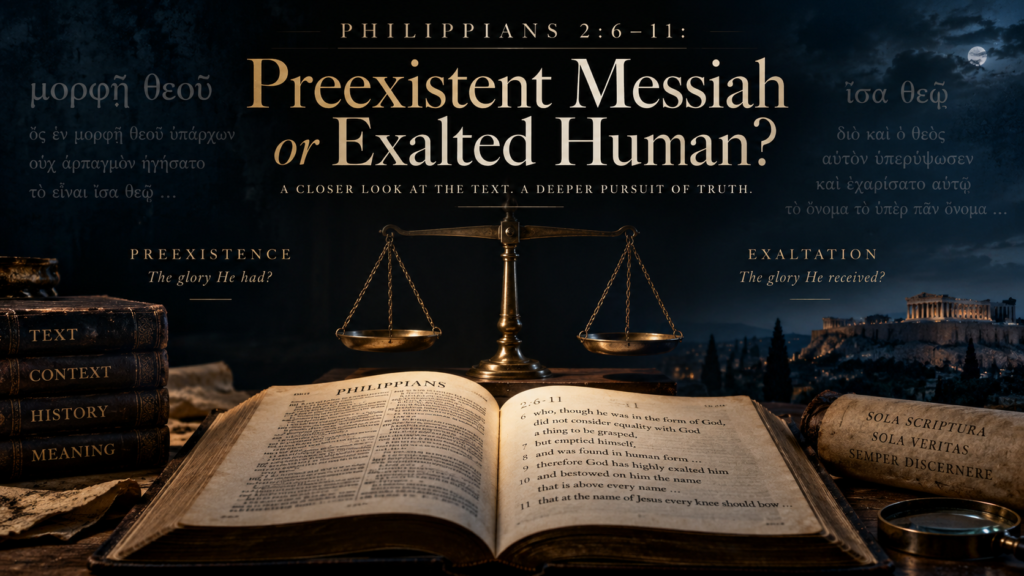
Philippians 2:6–11 is not introduced as a detached statement about Messiah’s metaphysical status. Paul has just told believers to reject selfish ambition and empty glory, to count others as more important than themselves, and to look to others’ interests (Philippians 2:1–5). Yeshua’s story is therefore the supreme pattern for the humble, other-serving mindset Paul commands.
The movement is clear: Messiah exists in God’s morphē (“form”), does not treat equality with God in a self-advantaging way, empties himself by taking slave-form and entering human likeness, humbles himself in obedience to crucifixion, and is then highly exalted by God. The cross is the hinge between descent and exaltation. The question is whether this narrates a conscious descent from a prior divine condition, or whether it chiefly portrays the obedient human Messiah as the anti-Adam who receives exaltation.
Form of God, equality with God, and self-emptying
Verse 6 begins, en morphē theou hyparchōn: Yeshua was “existing in the form of God.” The participle hyparchōn means existing or being in a condition. By itself, it does not mean “preexistent.” The argument for preexistence comes from its place in the sequence: existing in God’s form precedes taking slave-form and becoming in human likeness.
Morphē should not automatically be made equivalent to the later theological term “essence.” But neither is it naturally reduced to superficial appearance. Paul uses the same word again in verse 7: Yeshua takes morphēn doulou, “the form of a slave.” “Slave” is stronger than the softened English “servant”; it names a genuinely low and dependent condition. Since the slave-condition is real, the parallel strongly cautions against treating “form of God” as a mere outward disguise. The word plausibly communicates a real mode, condition, or status corresponding to God, without itself supplying a full doctrine of divine ontology.
The next expression is exceptionally elevated: to einai isa theō, “being equal with God.” The phrase does not settle whether Paul means equality of essence, glory, rank, prerogative, or vocation. Yet it is difficult to make it mean ordinary human likeness to God. Equality with God is central to how Yeshua’s prior condition is described.
The major difficulty is harpagmon. It can be rendered “something to be seized,” “a prize to be retained,” or “something to exploit/use for advantage.” If it means something to seize, Yeshua did not reach for equality with God. If it means a possession to retain, he did not cling to it. If it means an advantage to exploit, he did not use equality with God for self-benefit. The last reading fits Paul’s warning against self-seeking in verses 3–4 especially well. Still, contextually attractive as it is, “exploit” should not be treated as an undisputed dictionary result.
Verse 7 says that he “emptied himself” (heauton ekenōsen). Paul immediately explains this with participles: taking slave-form and becoming in the likeness of human beings. The grammar therefore favors abasement by addition and assumption, not an explicit surrender of divine attributes. Paul does not say that Yeshua discarded omniscience, power, or divine nature. Nor does “likeness of humans,” followed by being found in human appearance and dying, deny real humanity. The passage presents genuine human lowliness and obedience, not a merely apparent humanity.
The strongest immediate inference is consequently a preexistence reading: the transition from existing in God’s form to taking slave-form and becoming human most naturally describes voluntary descent from a prior God-related condition. That conclusion is stronger than a bare word study, but it remains an inference. Paul does not use the later terms “incarnation,” “two natures,” or “one essence.”
Exaltation, the supreme name, and Isaiah 45
Verses 9–11 prevent a reading that overlooks the Father’s initiative. “Therefore” directly connects Yeshua’s exaltation with his obedient death. God highly exalted him and graciously granted him the name above every name. God is the one acting; Yeshua is the obedient Messiah whom God exalts. The distinction is not incidental.
Paul does not explicitly identify the bestowed name by saying, “the name is Yahweh,” “the name is Jesus,” or “the name is Lord.” Yet the final confession—“Jesus Messiah is Lord”—makes kyrios, Lord, the leading contextual candidate. This climax strongly echoes Isaiah 45:22–24. There Yahweh declares His unique deity and says that every knee will bow and every tongue will swear allegiance to Him. Philippians applies corresponding universal homage across heaven, earth, and the underworld to confession of Yeshua’s lordship.
The divine-identity reading rightly observes the force of this transfer of Isaiah’s Yahweh-shaped language. It argues that Paul includes Yeshua within Yahweh’s unique sovereignty. The agency reading offers a serious alternative: Yahweh appoints His supreme Messiah as universal vice-regent, so homage to the Messiah honors the God who authorized him. That view explains God’s action in verse 9 and the ending, “to the glory of God the Father.” Its difficulty is explaining why an Isaiah passage centered on Yahweh’s exclusive universal acknowledgment is so comprehensively coordinated with Yeshua as Lord. The final phrase does not diminish Yeshua; it establishes that his lordship honors, rather than rivals, the Father.
The strongest Adamic reading
A non-preexistence reading should not be dismissed. Paul’s immediate subject is humility, and elsewhere he explicitly contrasts Adam and Messiah (Romans 5:12–19; 1 Corinthians 15:21–22, 45–49). On this view, Yeshua is the faithful true human. Where Adamic humanity grasped toward godlike status, Yeshua refused self-exaltation, accepted the lowest slave-like obedience, and was afterward rewarded with supreme messianic lordship.
This reading has genuine explanatory strength. It closely fits the ethical contrast between grasping and self-humbling, takes Yeshua’s obedience seriously, and gives full force to God’s post-cross exaltation. Genesis 3 can provide a conceptual backdrop, while Genesis 1’s image language can support the thought of a human vocation reflecting God.
But those connections are not explicit in Philippians. Paul does not name Adam, Eden, image, or the forbidden fruit. Genesis uses image terminology, not Paul’s paired morphē language. Further, an Adamic reading depends heavily on taking harpagmon as an unpossessed object to seize. Most importantly, “existing in the form of God,” followed by “taking the form of a slave” and “becoming in human likeness,” reads more naturally as movement into human existence from an earlier condition. Adamic resonance may be present, but it need not replace preexistence. A preexistent Messiah can also be the obedient anti-Adam.
What the passage establishes—and what it does not
The explicit text says that Yeshua exists in God’s morphē; does not regard being equal with God as harpagmon; empties himself through slave-form and human likeness; obeys to death on a cross; is highly exalted by God; and receives universal confession as Lord, to the Father’s glory.
Strong contextual inferences are that the downward sequence depicts a prior God-related condition before Yeshua’s human life; that morphē denotes something more substantial than external appearance; that emptying is self-humbling through assumption of lowly human slave-status rather than a stated loss of attributes; and that Isaiah 45 gives Yeshua’s lordship extraordinary Yahweh-associated significance.
Debated conclusions include whether morphē denotes essential divine nature, status, glory, or a combination; whether harpagmon means seize, retain, or exploit; whether the name above every name is specifically the divine name; and whether Adam is a deliberate allusion. It is also debated how Yeshua’s Isaiah-shaped homage relates to divine identity and authorized agency.
Philippians 2 does not state later conciliar formulas such as “Trinity,” “eternal generation,” or “one essence.” It cannot, by itself, settle every systematic question. But the Father–Son distinction cannot be used to erase the equality-with-God language, the descent pattern, or the cosmic Isaiah echo. For a related Pauline treatment of distinction and high Christology, see 1 Corinthians 8:6: Who Are the One God and One Lord?.
Berean verdict
Philippians 2:6–11 most directly supports the conclusion that Yeshua had a prior, genuinely God-related condition; that he did not use equality with God for self-advantage; that he voluntarily entered the lowly human slave-condition; and that God exalted him after his obedient death. This is a strong conclusion from the paragraph’s grammar and narrative flow, not an assertion that morphē alone means “preexistence” or that Paul gives a complete later doctrine of incarnation.
The Adamic and agency readings illuminate real features of the text: humility, obedience, divine appointment, and the Father’s supremacy as the one who exalts. Yet a wholly non-preexistent reading bears the heavier interpretive burden in explaining the movement from God’s form to slave-form and human likeness, as well as the Isaiah 45 climax. John 1:1–3, 14 and John 17:5 independently strengthen a canonical case for preexistence, while Colossians 1:15–20, Hebrews 1:1–4, and Revelation 5 show similarly high claims in other settings. They illuminate Philippians; they should not replace its own wording. For the Father’s designation as the only true God alongside Yeshua’s pre-world glory, compare John 17:3: Who Is “the Only True God”?.
The passage distinguishes Yeshua from God the Father while assigning him divine-significance language, status, and universal acknowledgment. It is compatible with Nicene Trinitarian synthesis, but does not state that formulation. A strict agency synthesis remains possible only if it does full justice to Paul’s unusually high claims about the Messiah.

Discussion
Join the Discussion
Test the claim with Scripture. Address the text and the argument, not the person. Comments may be held for moderation.
Keep it Berean: cite the text when possible, make the argument clearly, and keep disagreement respectful.