
The “Berean test” is a useful later label, not a phrase Luke uses in Acts 17:11. It describes the pattern Luke commends: people received the proclaimed word with eagerness while examining the Scriptures day by day to determine whether the matters proclaimed were true. It is neither a command to distrust every teacher nor permission to accept a persuasive message without verification.
The setting matters. In Thessalonica, Paul had reasoned from the Scriptures that the Messiah had to suffer and rise, and that Yeshua is the Messiah (Acts 17:1–3). Opposition followed, so the brothers sent Paul and Silas away by night to Berea (Acts 17:10). There they entered the synagogue. The central question before the Bereans was therefore a Scripture-based messianic proclamation: Does Paul’s claim about Yeshua accord with Israel’s sacred writings?
Luke’s comparison should be read narrowly and fairly. He says the Bereans were more noble than those in Thessalonica, but Acts 17:4 also says that some Thessalonians were persuaded. Luke is not condemning every person in one city or praising every person in another. He commends the particular response he proceeds to describe.
What Acts 17:11 Explicitly Says
Acts 17:11 explicitly presents three connected actions. The Bereans received the word with eagerness; they examined the Scriptures day by day; and their purpose was to see whether “these things” were so. The next verse reports the result: many believed (Acts 17:12).
The sequence must be held together. The Bereans were not gullible hearers who treated Paul’s authority as a substitute for evidence. Yet they were not hostile skeptics who rejected an unfamiliar message before hearing it. They listened willingly and investigated seriously. Eagerness without examination would become credulity; examination without readiness to hear could become a method for protecting a settled prejudice. Luke commends neither extreme.
The Greek reinforces this basic reading, though individual words should not carry more weight than the context allows. Eugenesteroi, often rendered “more noble,” “more noble-minded,” or “better disposed,” can have associations with good birth in other settings. Here, however, the surrounding description strongly favors commendation of disposition and response rather than social rank. Luke immediately identifies what distinguished them: eager reception and continuing examination.
Prothymias denotes eagerness, readiness, or willingness. It should not be reduced to the modern ideal of being “open-minded,” as though all claims deserve equal acceptance regardless of content. The Bereans were ready to hear a message presented from Scripture. Anakrinontes describes active examination or investigation. The term can be used in other contexts for inquiry, but Acts 17:11 does not thereby establish a technical judicial procedure. It does establish that their engagement with Scripture was real scrutiny, not passive exposure.
The phrase kath’ hēmeran means “day by day” or “daily.” Luke portrays repeated examination rather than a casual, one-time check. He does not prescribe a modern reading plan, a required number of study hours, or whether every act of examination was private rather than shared in the synagogue community.
Finally, the purpose clause matters: they searched the Scriptures to see whether “these things” were so. They were not testing whether Scripture itself was reliable. They were testing whether Paul’s proclamation corresponded to what Scripture taught. The immediate context favors Paul’s claims about Messiah’s suffering, resurrection, and Yeshua’s identity, although the phrase may include the wider message proclaimed in Berea.
What Scriptures Did the Bereans Search?
Luke calls the writings they examined “the Scriptures.” In this first-century, synagogue-centered setting, that means Israel’s sacred writings available to the audience. It does not mean that the Bereans opened a completed New Testament canon. The New Testament had not yet been completed in the period Acts narrates.
Acts 17:2–3 explains why Scripture was the proper standard for the claim. Paul had been reasoning from the Scriptures, explaining that the Messiah had to suffer and rise, and identifying Yeshua as that Messiah. The Bereans therefore had reason to ask whether Paul’s fulfillment reading followed from the texts in their contexts.
The passage does not identify every scroll they consulted, every text Paul used, or whether the searching occurred privately, corporately, or both. It also does not tell us how long each person investigated. But one limited conclusion does follow: a teacher’s ability to quote biblical language is not enough. A claim must be tested by whether the relevant texts actually support it in context.
John 5:39–40 offers a needed cautionary parallel. Yeshua speaks of the Scriptures as bearing witness about him, while rebuking hearers who refused to come to him. Searching Scripture mechanically does not guarantee a faithful conclusion. The Berean pattern includes both careful examination and a willingness to follow the truth Scripture establishes.
Does Acts 17:11 Establish a Universal “Berean Test”?
Acts 17:11 narrates a commended historical response. It does not issue the command, “Use the Berean test,” and it does not provide an exhaustive procedure for every doctrinal, prophetic, historical, or pastoral question. The expression “Berean test” is later terminology.
Still, a reasonable inference may be drawn from Luke’s favorable portrayal. When people hear teaching presented as biblical, they should receive it fairly and examine it under the governing witness of Scripture. This is an application from the narrative, not wording Luke explicitly commands in this verse. The wider canon supplies more direct instructions for particular forms of discernment.
Deuteronomy 13:1–5 warns Israel that even a sign or wonder does not validate a messenger who leads people after other gods. Deuteronomy 18:20–22 addresses presumptuous speech in Yahweh’s name and the failure of a prophetic word. Isaiah 8:19–20 directs God’s people away from forbidden spiritual sources and toward instruction and testimony. These passages concern different circumstances, but each denies that impressive spiritual claims should be accepted without biblical testing.
The New Testament continues this pattern. Galatians 1:8–9 rejects a gospel contrary to the one received. First Thessalonians 5:19–22 forbids both despising prophecies and accepting them untested: believers are to test and hold fast what is good. First Corinthians 14:29 requires prophetic speech to be weighed. First John 4:1–6 commands believers to test spirits because false prophets have gone into the world.
These texts should not be flattened into one context-free formula. Deuteronomy addresses covenant loyalty and false prophecy; Galatians addresses a contrary gospel; Corinthians addresses congregational prophecy; John addresses deceptive spiritual claims. Together, however, they establish a broad biblical duty of discernment. Acts 17:11 supplies a particularly clear picture of the needed posture: receptive, diligent, and Scripture-governed.
The Strongest Caution Against Overextending the Passage
The strongest contrary reading deserves full weight. Acts 17:11 is narrative, not an imperative addressed to every later believer. Luke may primarily be reporting the favorable reception of the gospel during a particular missionary episode. Its immediate object is Paul’s synagogue proclamation about Messiah, not every modern sermon, podcast, doctrinal dispute, claimed dream, or institutional question.
This caution rightly prevents several errors. Acts 17:11 does not make private interpretation infallible. It does not command every Christian to follow a particular daily schedule. It does not settle how individual study, shared discernment, teachers, elders, languages, historical evidence, and church tradition relate in every situation. Nor does it establish every step of a modern discernment system as though Luke had supplied a formal checklist.
But the caution has a limit. It should not erase Luke’s commendation. He deliberately joins eager reception and examination as the features associated with the Bereans’ favorable description. Nor should Acts be detached from passages that directly command the testing of prophecy, spirits, and contrary gospels. The balanced conclusion is therefore modest but meaningful: Acts 17:11 does not establish an exhaustive formal test, but it portrays a genuinely exemplary response when read alongside Scripture’s direct calls to discernment.
What the Berean Test Is Not
The Berean pattern is not reflexive suspicion. The Bereans did not dismiss Paul because his message was disruptive, unfamiliar, or delivered by an outsider. A person who rejects every challenge to inherited belief without hearing it has not followed their example.
It is also not uncritical traditionalism. Longstanding interpretations, popular teachers, denominational statements, and family customs may deserve careful consideration, but none is self-authenticating merely because it is familiar. Nor does a claim pass simply because it contains many Bible verses. Proof texts must be read in literary and historical context and measured against the conclusion they are being used to support.
Neither dreams, impressions, social-media confidence, nor claimed revelation should be treated as though they were Scripture. Acts 17:11 does not settle the debate between continuationist and cessationist views of spiritual gifts. That question requires its own careful study, as considered in Do Prophets Exist Today?. Whatever position one reaches, no claimed revelation should be insulated from biblical examination. For a fuller framework, see How Scripture Tests Prophetic Claims.
Finally, “Berean” is not a rhetorical badge for anyone who opposes mainstream doctrine or says, “I did my own research.” The posture Luke commends requires willingness to hear correction, address counterevidence, and revise a conclusion when the evidence does not sustain it. Collecting only supportive verses or sources is not examination.
A Responsible Modern Berean Method
Evidence levels should remain clear. Explicit text: the Bereans received the word eagerly and examined the Scriptures day by day to see whether the proclaimed matters were so. Contextual conclusion: those matters concerned Paul’s Scripture-based proclamation about Messiah. Reasonable inference: believers should evaluate teaching fairly under Scripture. Debated application: the exact balance among personal study, congregational discernment, teachers, and church authority in every case.
A responsible method can be stated in seven steps:
- State the claim accurately. Test what a teacher actually says, not a caricature. A vague assertion cannot be examined as carefully as a specific doctrinal claim, prediction, or interpretation.
- Identify the texts being used. Read the cited passages in their immediate contexts rather than relying on a clipped quotation or a verse graphic.
- Separate observation from conclusion. Ask what the passage explicitly says before deciding what inference may reasonably follow.
- Compare relevant Scripture with Scripture. Respect genre, covenantal setting, speaker, audience, and purpose. A proverb, prophecy, narrative, and apostolic instruction should not be handled as though each functions identically.
- Distinguish inference from speculation. A theological synthesis may be sound, but it should not be described as though one verse stated every part of it directly.
- Consider the strongest competing reading. This includes relevant grammar, context, and factual evidence. A doctrinal study such as Does John 8:58 Mean Yeshua Claimed to Be Yahweh? illustrates why immediate context and alternative readings must be addressed rather than dismissed.
- Stop where the evidence stops. State only the confidence the text and available evidence permit. “Unproven,” “possible,” and “false” are not interchangeable conclusions.
Different claims require different evidence. A doctrinal claim calls for careful exegesis and whole-Bible synthesis. A prophecy claim also requires attention to biblical criteria, specificity, timing, and actual fulfillment. Broad fears, elastic predictions, and widely foreseeable developments should not be counted as confirmation merely because they can be connected to a prior statement after the fact. A historical, linguistic, scientific, or geopolitical claim requires appropriate external evidence; Scripture should not be used as a substitute for facts the biblical text does not itself address.
This applies to sermons, theological traditions, podcasts, social-media teaching, and private revelations. For example, a modern claim that a biblical symbol identifies a particular nation must show that identification from the text rather than assume it. A practical example is the review Does Scripture Identify America as Babylon the Great?. The goal is not cynicism toward every claim, but disciplined refusal to call an unsupported inference biblical certainty.
Some questions remain debated. In 1 Corinthians 14:29, interpreters differ over whether “the others” who weigh prophecy means other prophets, the gathered assembly, or designated evaluators. In 1 Thessalonians 5:21, “test everything” may be read broadly or closely with the preceding reference to prophecies. Across these readings, neither passage permits a religious claim to be exempt from examination.
Verdict: Receive Truth Eagerly and Test Claims Carefully
The Berean test is a helpful later shorthand for the pattern in Acts 17:11: receive teaching willingly while examining Scripture carefully and repeatedly to see whether the claim is true. It is not biblical terminology, a mandate for suspicion of everything, or an exhaustive method contained in one narrative verse.
Acts 17:11 explicitly describes the Bereans’ response. The surrounding narrative indicates that they were assessing Paul’s messianic proclamation from Israel’s Scriptures. A reasonable canonical principle is that believers should welcome truth without gullibility and test teaching without contempt. The verse by itself does not settle every question about canon, church authority, private interpretation, or modern prophecy.
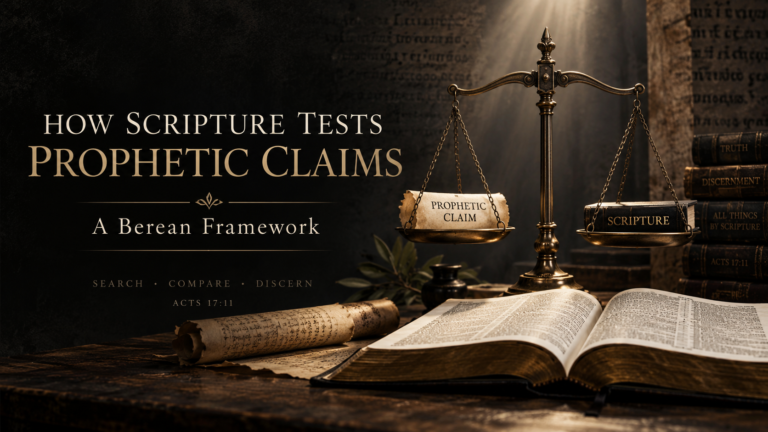
Put the claim on the scale. Test the words, read the context, compare Scripture with Scripture, consider the evidence fairly, and stop where the text stops.


Discussion
Join the Discussion
Test the claim with Scripture. Address the text and the argument, not the person. Comments may be held for moderation.
Keep it Berean: cite the text when possible, make the argument clearly, and keep disagreement respectful.