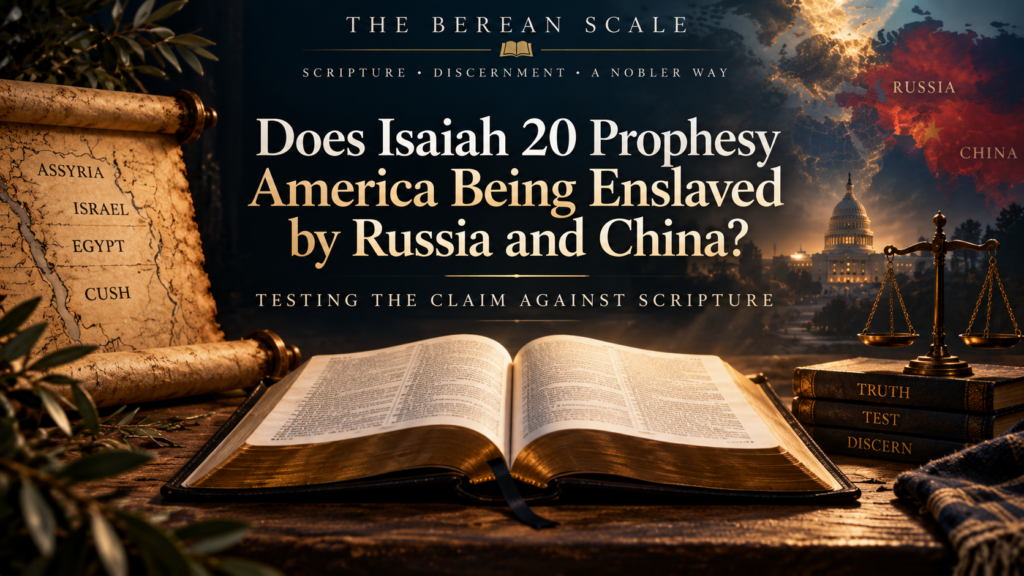
In “SEND FOR THEIR FLESH!” at The Master’s Voice Prophecy Blog, Celestial presents Isaiah 20 as confirmation of a future American defeat by Russia and China. The source further describes mass deportation into forced labor, connects the event to national debt and historic atrocities, calls the judgment irreversible, and distinguishes those who will escape from professing Christians who will not.
These are grave claims. Scripture does speak seriously about captivity, public shame, oppression, national arrogance, and Yahweh’s judgment. The historic sins invoked by the source—including slavery, racial oppression, violence, and sexual evil—are not morally small matters. Yet moral outrage at real evil is not itself evidence that a particular modern forecast has been revealed. The controlling question is narrower: does Isaiah 20 identify America, Russia, China, or the proposed sequence of war, deportation, forced labor, and selective escape?
The provisional answer is no. Isaiah 20 contains a real prophecy of conquest, captivity, humiliation, and failed political confidence. But the chapter names Assyria, Ashdod, Egypt, and Cush, and it explains Isaiah’s sign-act as concerning Egypt and Cush. The modern scenario comes not from the chapter’s stated meaning, but from the source’s reported revelations and its application of an ancient pattern to the United States.
What Isaiah 20 Actually Says
Isaiah 20:1 begins with a historical anchor: it refers to the year when the tartan, an Assyrian high military official, came to Ashdod at the command of Sargon king of Assyria, fought it, and captured it. This is not an undated heading for a final-world-crisis oracle. It places the account within the Assyrian imperial world and the conflict surrounding Ashdod.
In verses 2–3, Yahweh commands Isaiah son of Amoz to remove the sackcloth from his waist and his sandals from his feet. Isaiah then walks naked and barefoot for three years. Yahweh gives the action’s interpretation within the passage: Isaiah’s conduct is “a sign and a portent concerning Egypt and Cush.” The Hebrew phrase ’ot u-mophet marks the act as a communicative sign, but its stated referents are Egypt and Cush—not an unnamed latter-day country.
Verse 4 explains the coming humiliation. The king of Assyria will lead away Egyptian captives and Cushite exiles, young and old, naked and barefoot, with exposed buttocks, to Egypt’s shame. The warning has future force in the narrative. It should not be flattened into a claim that every part of the Egypt-and-Cush defeat had already occurred at Ashdod. Ashdod supplies the dated Assyrian setting; the sign points forward to the disgrace of Egypt and Cush under Assyrian power.
Verses 5–6 then show the effect on those who had looked to Cush and boasted in Egypt as a hoped-for deliverance from Assyria. They will be dismayed and ashamed. The inhabitants of “this coastland” ask how they can escape when the power to which they fled for help has fallen.
The source therefore observes several genuine features: a conquering empire, captives, exposure, humiliation, and a prophet’s enacted sign. But Isaiah 20 does not mention America, Russia, China, modern national debt, ships, overseas labor, historic American slavery, a permanent decree against a future nation, or a protected class of modern Christians. A Bible citation establishes what its words, context, and warranted implications establish; it cannot establish added details merely because they are attached to the citation.
Assyria, Ashdod, Egypt, and Cush in Context
The surrounding chapters reinforce the chapter’s own identifications. Isaiah 18 concerns Cush. Isaiah 19 is an oracle concerning Egypt. Isaiah 20 supplies a sign concerning Egypt and Cush, and Isaiah 21 continues with oracles involving foreign powers. This sequence strongly favors an ancient regional reading. It does not read like a concealed code in which every named people must be replaced by a modern nation.
Sargon II ruled Assyria in the late eighth century BCE, and his campaign against Ashdod is conventionally dated around 711 BCE. Assyrian evidence supports an Ashdod campaign, although historians discuss how individual inscriptions, military agents, Egypt/Cush, and the biblical presentation fit together. Those debates call for care in reconstructing events; they do not create a bridge from Assyria to Russia and China.
Isaiah’s broader Assyrian-era preaching also matters. Isaiah 30:1–7 and 31:1–3 rebuke Judah for seeking Egypt’s military help rather than relying on Yahweh. Read beside those passages, Isaiah 20 strongly warns against misplaced geopolitical trust. That is a contextual inference, not an explicit sentence in Isaiah 20, but it fits the named powers and the coastland’s alarm.
The identity of “the inhabitants of this coastland” in Isaiah 20:6 is debated. It may refer especially to the Philistine coast, or more broadly to Judah’s regional political world. Across either reading, the people in view have depended on Egypt and Cush against Assyria and now see that confidence collapse. Neither plausible option identifies the United States.
What “Naked and Barefoot” Means—and Does Not Mean
The sign-act is deliberately humiliating. The Hebrew ’arom can mean naked or shamefully exposed, and yaheph means barefoot. Interpreters differ on whether Isaiah was entirely nude or minimally clothed in a way that still communicated public exposure. The text does not settle every detail of his undress. What remains certain under either reading is the enacted message: abasement, vulnerability, conquest, and disgrace for the captives of Egypt and Cush.
Isaiah 47:1–3 and Nahum 3:5–7 show that bodily exposure can function as judgment imagery elsewhere in the prophets. They are thematic parallels, not evidence that each occurrence of exposure imagery is one continuing prophecy. Repeated biblical imagery may illuminate a symbol’s general force without making one text the fulfillment of another.
Isaiah 20 calls the people “captives” and “exiles” led away by Assyria. It does not call them slaves received as a reward, explain a debt repayment system, mention ships, identify destination countries, describe a modern labor structure, or state sexual motives or acts. Modern trafficking and sexual violence are grave sins, and Christians should oppose them without hesitation. But their gravity does not authorize readers to insert such logistics into Isaiah’s prophecy.
Why the America, Russia, and China Mapping Has No Textual Bridge
The source’s central identification fails at the point of textual control. Isaiah 20 names Assyria as the aggressor and Egypt and Cush as the peoples whose humiliation Isaiah’s sign signifies. It provides no interpretive key by which Assyria becomes Russia and China, Egypt and Cush become America, or the coastland becomes a present geopolitical audience.
Captivity, imperial expansion, public shame, military defeat, and misplaced reliance on powerful allies recur in Scripture and in human history. That resemblance can support analogy. A modern people may learn from Isaiah 20 not to trust military alliances, national wealth, or geopolitical strength in place of Yahweh. Such an application is reasonable if it is honestly called an application. It cannot establish that Isaiah predicted a Russian-Chinese conquest and enslavement of America.
Daniel 4:17, 32 and Acts 17:26–27 teach that Yahweh rules over kings, nations, and their appointed times. Those truths should restrain national pride. But general divine sovereignty is not a decoding method for current headlines. Neither passage tells readers which present nation will conquer another, or gives Isaiah 20’s ancient names a different modern reference.
The strongest charitable version of the source’s case is therefore not that Isaiah 20 explicitly predicts America. Rather, it is that Yahweh may use an ancient judgment pattern to warn America through a contemporary revelation given to Celestial. That is a different claim. It depends entirely on whether the reported revelation is from Yahweh; it does not arise from Isaiah 20’s grammar, names, or historical setting. Isaiah 20 cannot serve as biblical proof of the named America-Russia-China scenario.
Testing the Added Claims
War, deportation, and forced labor. Isaiah 20 supports the ancient pattern of Assyrian-led captives and shame. It does not predict an American military defeat, assign roles to Russia and China, mention ships, forecast overseas labor, or say that America will be emptied of its people. The prediction gives no fulfillment date and remains unverified. General international conflict, national indebtedness, or cooperation between Russia and China would not verify mass American deportation and forced labor; such developments are far broader than the source’s concrete forecast.
Debt as the mechanism of enslavement. Isaiah 20 says nothing about debts, creditors, financial repayment, or labor arrangements. The asserted mechanism would require independent economic and geopolitical evidence. If it is advanced as prophecy, it also requires a revelation that can be tested. It cannot be derived from Isaiah 20.
Historic slavery, atrocities, and national guilt. Scripture condemns kidnapping, oppression, unjust gain, bloodshed, sexual wickedness, pride, and ethnic partiality. It also records corporate judgments. Deuteronomy 28 includes captivity, scattering, foreign domination, and slavery among covenant curses addressed to Israel. But this does not make the United States a direct party to Israel’s covenant, nor does it establish a fixed punitive debt payable through this particular scenario.
Ezekiel 18:20–23 and 33:10–20 emphasize personal accountability and Yahweh’s call for the wicked to turn and live. These passages should not be used to deny every form of corporate judgment or the lasting consequences of national sin. But neither do they establish that later generations must personally suffer the exact punishment described in this prophecy because of crimes committed by previous generations. That specific judgment still requires independent biblical or prophetic warrant.
An irreversible decree. Isaiah 20 does not say that a future judgment on America cannot be averted. Jeremiah 18:7–10 establishes a broader prophetic principle: when Yahweh announces judgment against a nation, repentance may affect the announced outcome. Yahweh can also declare judgment that He explicitly presents as settled or unavoidable. The issue here is therefore not whether irreversible judgment is biblically possible, but whether this particular claimed decree against America has been established as Yahweh’s word. Isaiah 20 does not establish it. The claim of irrevocability depends on the claimed modern revelation itself.
Escape for only genuine believers. Matthew 7:21–23 and 2 Timothy 2:19 rightly warn that verbal profession does not equal genuine allegiance to Messiah. The call to repentance is sound. Yet John 16:33, Acts 14:22, 2 Timothy 3:12, and 1 Peter 4:12–19 also show that true believers can suffer grievously. First Corinthians 3:10–15 concerns the testing of Christian labor, not rescue from invasion or deportation. Scripture gives no general physical-immunity promise for a recognizable class of Christians during the calamity proposed here. No one should judge another person’s future suffering as proof that he or she lacked real faith.
The Strongest Opposing Reading and the Test of Prophecy
Ancient judgment oracles do have enduring theological force. Yahweh judges proud, violent, and exploitative nations. Scripture records corporate judgments, and captivity and shame are real biblical motifs. Isaiah 20 can rightly warn modern readers against national complacency and confidence in worldly power. Historical distance must not be used to excuse present injustice.
But a typological or pastoral application must preserve the original referents and identify textual controls for a later fulfillment. Isaiah 20 contains no latter-day marker, dual-fulfillment statement, symbolic decoding key, or names that map Assyria to Russia, Egypt/Cush to America, or any ancient figure to China. A pattern is not a prediction simply because it is morally serious or vividly presented.
Scripture commands neither gullibility nor contempt toward prophetic claims. Deuteronomy 13:1–5 and 18:20–22 require testing those who speak in Yahweh’s name. First Thessalonians 5:19–22 says not to despise prophecies but to test everything; 1 John 4:1 likewise tells believers to test the spirits. Biblical language, intense imagery, and a plausible geopolitical setting do not authenticate a forecast by themselves.
Responsible testing asks whether a prediction was specific beforehand, whether its claimed date can be distinguished from publication or later page metadata, and whether objective fulfillment criteria exist. The source page displays June 27, 2019 and also a February 19, 2020 date string; readers should not automatically treat either visible date as independently establishing the time of the reported vision. Nor should vague developments be counted as confirmation of a detailed deportation prophecy. The contemporary-revelation reading remains an unverified personal claim, not Isaiah 20’s demonstrated meaning.
What Is Explicit, What Is Inferred, and the Berean Verdict
Explicitly stated: Isaiah performed a three-year naked-and-barefoot sign-act; Yahweh said it concerned Egypt and Cush; the king of Assyria would lead Egyptian captives and Cushite exiles away in shame; and those who relied on Egypt and Cush against Assyria would be dismayed.
Reasonably inferred: Isaiah 20 warns against confidence in political and military powers rather than Yahweh. Modern readers may answer that warning through repentance, justice, prayer, care for victims of oppression, and rejection of national pride. None of these faithful responses requires accepting an America-in-chains forecast.
Claims Not Established by Isaiah 20: Isaiah 20 does not identify America, Russia, or China; it does not predict debt-based enslavement or shipborne deportation; it does not assign modern people punishment for historic slavery through this event; it does not call the judgment irreversible; and it does not promise physical exemption for all genuine believers. These assertions depend on Celestial’s reported revelations and go beyond the cited text. The claims of irreversibility and blanket believer protection also conflict with relevant biblical teaching about repentance and the suffering of faithful disciples.
The source passes in recognizing that Scripture speaks soberly about sin, judgment, captivity, humiliation, and false security. It fails when it presents Isaiah 20 as proof of a named modern geopolitical prediction. Christians should pursue repentance, justice, prayer, and prudent readiness without fear-driven certainty or verdicts about whose future suffering proves false faith.
The Berean Verdict
Isaiah 20 does not prophesy that America will be enslaved by Russia and China. The chapter explicitly concerns an Assyrian conquest setting and Isaiah’s sign concerning Egypt and Cush. Its themes of captivity, humiliation, judgment, and misplaced geopolitical trust can legitimately warn later generations, including modern nations. But thematic similarity is not textual identification.
The claims that America will be defeated by Russia and China, transported overseas, enslaved to repay debt, punished specifically for historic American slavery, and selectively spared according to the spiritual condition of individual Christians do not come from Isaiah 20. They depend upon Celestial’s claimed revelation.
That does not mean modern prophecy should be dismissed merely because it is modern. Scripture commands believers to test prophetic claims. But Isaiah 20 cannot be presented as biblical proof of this prediction. The text does not make that identification.
This study is part of The Berean Scale’s ongoing review of The Master’s Voice Prophecy Blog and its claimed revelations; readers may also examine the related review of America, Russia, and China claims and the broader Scripture-first framework for testing prophetic claims.
Discussion
2 Comments
Test the claim with Scripture. Address the text and the argument, not the person. Comments may be held for moderation.
Keep it Berean: cite the text when possible, make the argument clearly, and keep disagreement respectful.