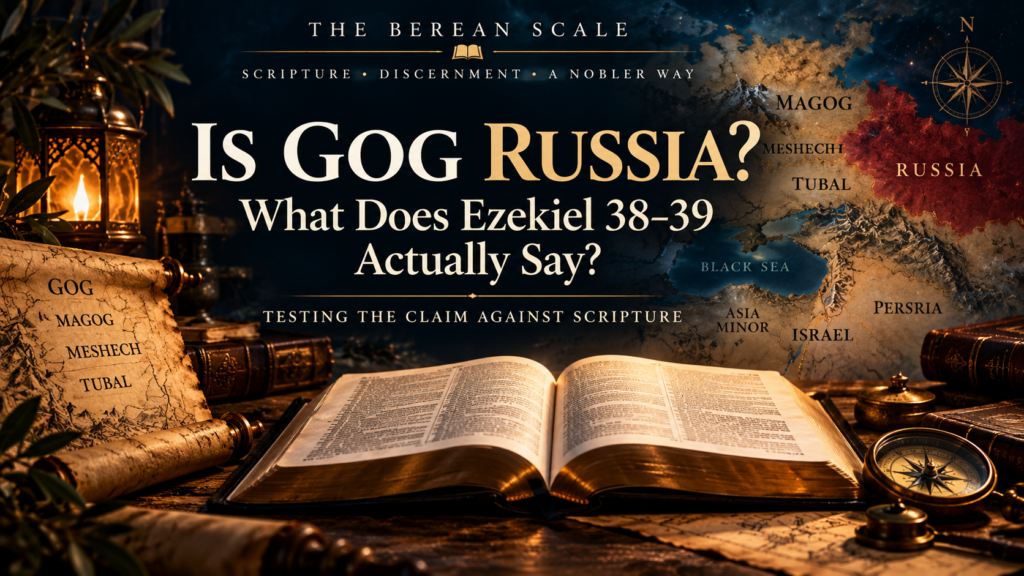
Ezekiel 38–39 does not identify modern Russia as Gog. It identifies Gog as a ruler associated with “the land of Magog” and with Meshech and Tubal, leading a large coalition against restored Israel. The conclusion that Gog is Russia requires further steps: reading rosh as a place-name, connecting that proposed name to Rus or Russia, linking Meshech with Moscow and Tubal with Tobolsk, and treating “the remote parts of the north” as a uniquely Russian marker. Some of those steps are genuinely debated; others are historically weak. None is stated by Ezekiel.
This limited conclusion does not settle every question about fulfillment. Interpreters disagree over whether Ezekiel’s vision awaits a future historical conflict, presents an idealized final-enemy scene, or has a more symbolic function. Nor does Ezekiel’s failure to name Russia prove that Russia could not participate in a future war. The question here is narrower and more important: does the prophet himself identify Russia as Gog? Scripture should answer that question before present alliances, headlines, or maps are brought into the passage.
Gog’s invasion belongs to Ezekiel’s restoration message
Ezekiel 38–39 stands within the book’s restoration section. Ezekiel 36 promises Israel’s regathering, cleansing, a new heart, and Yahweh’s Spirit. Ezekiel 37 portrays national restoration through the valley of dry bones, reunification of the divided people, rule under Yahweh’s Davidic shepherd, a covenant of peace, and Yahweh’s sanctuary among them (Ezekiel 36:22–38; 37:21–28). The Gog oracle follows this sequence and precedes the temple-and-land vision of Ezekiel 40–48.
Its own language deliberately continues that setting. Gog comes against a land restored from war and against people gathered from many peoples (Ezekiel 38:8, 12). The closing verses return to Yahweh’s restoration of Jacob, his gathering of Israel from the nations, and his pouring out of his Spirit (Ezekiel 39:25–29). Thus Gog’s assault is not an isolated prediction about foreign powers. It is an attack on a people Yahweh has restored.
The oracle also repeatedly emphasizes Yahweh’s agency and purpose. Yahweh declares that he is against Gog, that he will bring him forth, and that he will make his holy name known among Israel and the nations (Ezekiel 38:3–4, 16, 23; 39:1–7). The controlling concern is Yahweh’s public vindication: the nations will know that he is Yahweh. That purpose does not forbid future application, but it does warn against treating the chapter primarily as a codebook for identifying twenty-first-century states.
Literary placement gives Gog’s defeat a climactic role in the restoration sequence. Yet the order of visions in Ezekiel does not, by itself, settle every proposed end-times chronology. A reader may regard the conflict as future without assuming that its ancient names directly equal modern national labels.
What Ezekiel explicitly says
Ezekiel is commanded to set his face against “Gog, of the land of Magog,” a ruler connected with Meshech and Tubal (Ezekiel 38:1–3; 39:1). The wording distinguishes Gog, the leader, from Magog, the land with which he is associated. Gog gathers a formidable force of horses, horsemen, shields, and swords (Ezekiel 38:4).
The named allies are Persia, Cush, Put, Gomer, and the house of Togarmah “from the remote parts of the north,” together with “many peoples” (Ezekiel 38:5–6). Gog himself comes from the “remote parts of the north” relative to Israel (Ezekiel 38:15; 39:2). His target is Yahweh’s people Israel, living securely in the restored land after regathering (Ezekiel 38:8, 11–18).
Yahweh defeats the invaders through a great earthquake, panic and mutual violence, pestilence and bloodshed, torrential rain, hailstones, fire, and sulfur (Ezekiel 38:18–23). Chapter 39 expands the aftermath: Israel burns the invaders’ weapons for seven years and buries Gog’s multitude for seven months in the Valley of Hamon-gog, east of the sea (Ezekiel 39:9–16). The judgment reveals Yahweh’s holiness before the nations (Ezekiel 39:21–24).
That is the explicit textual foundation. Ezekiel names Gog, Magog, Meshech, Tubal, Persia, Cush, Put, Gomer, Togarmah, and many peoples. It does not name Russia, the Russian Federation, Moscow, Tobolsk, a Russian president, or a present Russia-Iran alliance. Any such identification is therefore an interpretation added to the text, not an identification supplied by it.
Rosh, Meshech, and Tubal in Ezekiel’s world
The most disputed phrase is the Hebrew description of Gog: nasi rosh Meshekh we-Tubal. Nasi means ruler, leader, or prince. The usual meaning of rosh is “head,” with extensions such as chief or foremost. This yields the familiar translation, “chief prince of Meshech and Tubal.” But some interpreters take rosh as a geographical proper name: “prince of Rosh, Meshech, and Tubal.” Hebrew writing does not use capitalization to distinguish those alternatives, so English capitalization cannot decide the question.
The proper-name reading has real ancient support. The Septuagint, the early Greek translation of the Hebrew Scriptures, transliterates the word as Rhos rather than translating it as “chief.” This shows that an ancient translation tradition understood the term as name-like. It does not prove that the Hebrew syntax can only be read that way, nor does it identify Rhos with Russia. The translation issue should remain open where the evidence remains contested.
Meshech and Tubal should first be read within Ezekiel’s own ancient geographical vocabulary. Magog, Meshech, and Tubal appear in the Table of Nations in Genesis 10:2. Meshech and Tubal appear together again as trading partners of Tyre in Ezekiel 27:13 and as warrior peoples in Ezekiel 32:26. That repeated pairing strongly favors ancient peoples or regions recognizable in Ezekiel’s world, not hidden references deciphered through later place names.
A common historical reconstruction links Meshech with the Mushki and Tubal with Tabal, groups or regions associated broadly with Anatolia and eastern Asia Minor. This reconstruction is not an inspired explanatory note within Ezekiel, and its details remain debated. Still, it works by comparing ancient names with ancient regional evidence. It is considerably stronger than equating Meshech with Moscow or Tubal with Tobolsk because of sound resemblance alone.
Likewise, “the remote parts of the north” establishes a distant northern origin or approach relative to Israel. It may also echo the broader biblical pattern of danger coming from the north. But a direction is not a modern border line. It cannot uniquely identify the Russian Federation, especially when Gog’s coalition includes peoples from a broad range of regions.
Persia offers a useful comparison. Persia in Ezekiel 38:5 has a substantial territorial relationship to the core of modern Iran. Yet ancient Persia cannot simply be equated with the present borders, government, population, or alliances of the modern Iranian state. The same restraint is even more necessary where the textual link to a modern state is far less direct.
The strongest case for Russia as Gog
The Russia identification should be heard in its strongest form. Its advocates often argue first that rosh is a proper geographical name rather than “chief,” appealing in part to the Septuagint’s Rhos. They then connect Rosh with Rus and Russia. Meshech and Tubal are sometimes associated with Moscow and Tobolsk, and Gog’s arrival from the far north is said to fit Russia’s geographical position north of Israel.
Futurist interpreters also observe that Persia is expressly included in Gog’s coalition. They compare this with modern Russian-Iranian cooperation and reason that Ezekiel’s restored-Israel setting points beyond an ancient event. This position correctly recognizes several textual facts: Gog leads a real hostile coalition; Persia is named; the north is named; and Ezekiel’s setting has led many serious interpreters to expect a future fulfillment.
Those observations make a future-oriented Russia hypothesis understandable. But even this strongest form of the argument must concede that Ezekiel says neither “Russia” nor “Russian.” The conclusion depends on a chain of grammatical, historical, geographical, and geopolitical inferences. The chain must be tested link by link rather than accepted because some parts of it appear plausible.
Why the identification does not follow
First, if rosh means “chief,” the usual Rosh-to-Russia argument loses its textual starting point. If rosh is a place-name, only the first step has been granted. A separate, documented historical connection from an ancient Rosh to medieval Rus and then to modern Russia would still be necessary. The terms Rus and Russia belong to medieval and later eastern European history, many centuries after Ezekiel. Similar sounds across languages and millennia do not establish identity.
Second, Meshech equals Moscow and Tubal equals Tobolsk are phonetic proposals, not demonstrated lexical or historical derivations. They ask readers to move from ancient Hebrew ethnogeographic names to much later Russian city names on the basis of resemblance. By contrast, Ezekiel’s repeated use of Meshech and Tubal beside Genesis 10 directs attention toward peoples known in the ancient Near East. The Mushki-and-Tabal reconstruction is not beyond question, but it is methodologically more responsible than modern sound matching.
Third, a northern direction cannot single out one modern nation-state. “Far north” is relative to Israel, not an encoded national designation. It must also be read alongside the coalition’s varied membership. Persia, Cush, Put, Gomer, Togarmah, and “many peoples” portray a multinational force, not a simple prediction about one northern country.
Fourth, current cooperation between Russia and Iran is an observable political fact, but it is not fulfillment proof. Persia provides a limited territorial point of comparison with modern Iran; it does not identify current governments or alliances. A claimed event-level fulfillment would need to account for the full prophetic setting: restored Israel, Gog’s stated coalition and invasion, Yahweh’s catastrophic intervention, the seven-month burial, the seven-year weapon burning, and the stated worldwide recognition of Yahweh. Selective correspondence is not confirmation.
History supplies a further warning. Gog and Magog have repeatedly been attached to the feared powers of particular eras. That history neither proves nor disproves every contemporary application. It does show why present anxiety must not choose the referent before the text has done so. Readers assessing wider Russia-centered predictions may also consult this examination of a Russia-specific prophecy claim.
Revelation 20: related imagery, not a shortcut to Russia
Revelation 20:7–10 plainly evokes Ezekiel. After Satan’s release, he deceives nations called “Gog and Magog,” gathers them for battle, and they surround the camp of the saints and the beloved city. Fire comes down from God and consumes them. The shared names, assault on Yahweh’s people, and divine destruction show a deliberate literary relationship.
Yet Revelation’s scene is not simply Ezekiel repeated word for word. Revelation speaks of nations from the “four corners of the earth” and places the rebellion after the thousand years. It does not repeat Ezekiel’s named coalition, seven-month burial, or seven-year burning of weapons. Some interpreters therefore equate the events; others understand Revelation as using Gog and Magog typologically for final worldwide rebellion; still others retain a future Ezekiel conflict distinct from Revelation 20.
Each view must reckon with both the parallels and the differences. None converts Gog into an explicit biblical name for Russia. Revelation’s worldwide language may, in fact, caution against treating Gog and Magog as permanently fixed labels for one modern ethnic or national entity.
Berean verdict: explicit, inferred, debated, and unsupported
- Explicit text: Gog, associated with Magog and with Meshech and Tubal, leads a multinational force against restored Israel. Persia, Cush, Put, Gomer, Togarmah, and many peoples are included. Gog comes from the remote north, and Yahweh decisively judges the invaders and vindicates his holy name.
- Reasonable inference: Meshech and Tubal should first be investigated as ancient peoples or regions, and the north language is relative to Israel. The correlations with Mushki and Tabal are more plausible than Moscow and Tobolsk, while remaining historical reconstruction rather than Ezekiel’s own explanation.
- Debated interpretation: Whether rosh means “chief” or is a place-name; Gog and Magog’s precise ancient referent; whether the conflict remains future; and whether Ezekiel 38–39 is the same event as Revelation 20.
- Unsupported claim: Ezekiel itself identifies modern Russia as Gog, Moscow as Meshech, Tobolsk as Tubal, a current Russian ruler as Gog, or a present Russia-Iran alliance as the fulfillment of the prophecy.
The Berean judgment is therefore restrained but plain: Russia equals Gog should not be taught as biblical fact. At most, it is a contested modern-prophecy inference lacking adequate textual and historical warrant. Conversely, Ezekiel’s silence does not prove Russia cannot be involved in any future conflict; it prevents claiming that Ezekiel has already named it. The same method should govern other national mappings, including claims that Scripture identifies America as Babylon the Great: begin with what the passage says, then label modern applications according to the evidence they actually possess.
Discussion
Join the Discussion
Test the claim with Scripture. Address the text and the argument, not the person. Comments may be held for moderation.
Keep it Berean: cite the text when possible, make the argument clearly, and keep disagreement respectful.