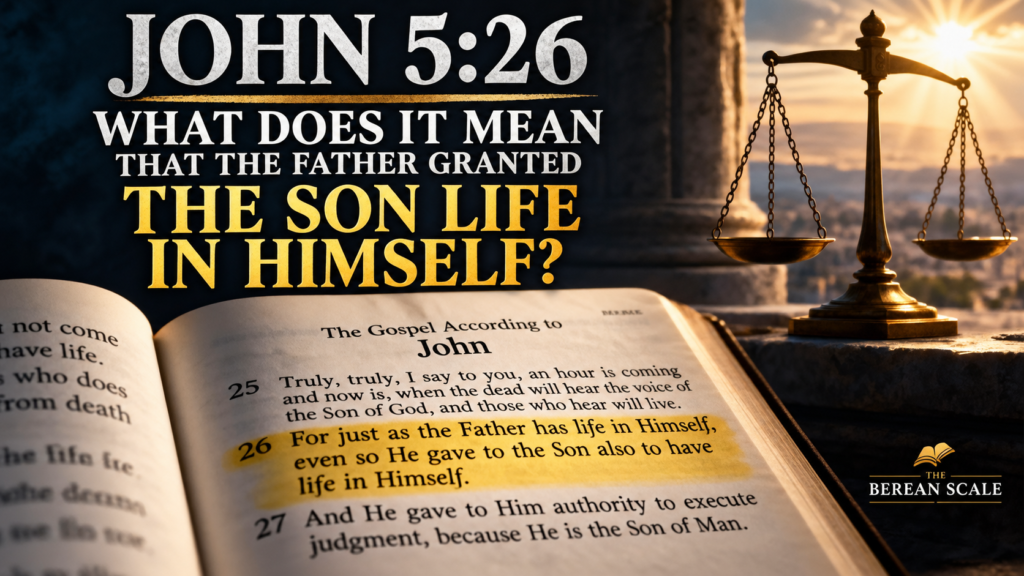
John 5:26 means that the Father possesses life in Himself and has granted the Son to possess life in himself. Within John 5:19–30, this is the stated basis for the Son’s own life-giving work: people hear his voice and live now, and all in the tombs will hear his voice in the coming resurrection. The statement is too strong to reduce Yeshua to an ordinary human messenger who merely asks for power afresh in each case. Yet the same discourse repeatedly identifies the Father as the giver and sender, while the Son sees, hears, receives, and acts in relation to Him.
That combination sets the boundaries for interpretation. John 5:26 does not itself define aseity, explain eternal generation, state one essence, specify when the Father gave the Son this life, or directly identify the Son as Yahweh. Those may be argued from a larger theological reading of John and Scripture. But the verse itself makes a remarkable claim: the Son has life in himself, in direct correspondence to the Father’s having life in Himself, and that possession is from the Father’s grant.
Read John 5:19–30 as One Argument
The setting is Yeshua’s response to the Sabbath-healing dispute. John 5:18 reports that his opponents regarded his calling God his own Father as making himself equal with God. Yeshua’s answer neither simply repeats that description nor retreats into a claim of ordinary prophetic agency. Instead, he explains his relation to the Father through shared works, received authority, life-giving power, judgment, honor, and obedience.
He begins: the Son can do nothing “from himself” except what he sees the Father doing; yet whatever the Father does, the Son likewise does (vv. 19–20). Both clauses govern the passage. The first excludes independent rivalry with the Father. The Son is not a second god acting from a separate initiative. The second makes a merely ordinary-prophetic reading difficult: John does not portray the Son as simply one more servant occasionally commissioned to perform an isolated divine work. For a fuller examination of that opening statement, see John 5:19: What Does “The Son Can Do Nothing by Himself” Mean?
The sequence then rises: as the Father raises the dead and gives life, the Son gives life to whom he wills (v. 21). The Father has given all judgment to the Son, with the purpose that all may honor the Son just as they honor the Father (vv. 22–23). Those who hear Yeshua’s word and believe the Father already pass from death to life (vv. 24–25); later, all who are in the tombs will hear the Son’s voice and come out (vv. 28–29). Verse 30 returns to the relational frame: Yeshua judges as he hears and seeks the will of the One who sent him. John 5:26 belongs within this connected argument.
What John 5:26 Explicitly Says
“For just as the Father has life in Himself, even so He gave to the Son also to have life in Himself.”
At the level of the text itself, four points are clear. First, the Father has life in Himself. Second, the Son has life in himself. Third, the Father gave or granted this possession to the Son. Fourth, the comparison directly joins the Father’s and Son’s possession of life: “as” the Father has it, “so also” the Son has it.
The verse is not detached speculation about an abstract attribute. Its immediate purpose is to explain the Son’s life-giving activity in verses 21 and 24–29. The Father’s gift means that the Son is able to give life through his own voice and work. This is why the phrase cannot naturally mean only that life is available somewhere outside the Son for him to report or request.
At the same time, the grants in the paragraph should not be collapsed. The Father gives all judgment to the Son (v. 22), gives the Son to have life in himself (v. 26), and gives him authority to execute judgment (v. 27). They belong together, but John uses different wording for them. Further, the phrase “because he is Son of Man” directly explains the authority to execute judgment in verse 27; it does not explicitly explain the life-in-himself grant in verse 26. A messianic reading has contextual support, but it must not make verse 27 say more than it says.
Life in Himself Grounds the Son’s Life-Giving Work
Verse 21 supplies the nearest explanation: “As the Father raises the dead and gives them life, even so the Son also gives life to whom he desires.” The Son is not merely announcing that the Father will act. He gives life, and John attributes a will to him in that life-giving work. Verse 26 provides the stated ground: the Son has life in himself.
The discourse places this work on two horizons. In verses 24–25, an hour “now is” in which the dead hear the voice of the Son of God and live. In context, this is commonly understood as present passage from death to life through hearing and believing, in contrast with the future resurrection of those in the tombs in verses 28–29. Faith in the Father who sent him brings a present passage from death to life. In verses 28–29, an hour is coming when all in the tombs will hear the Son’s voice and rise, either to a resurrection of life or of judgment. John thus connects life in the Son with both present salvation and future bodily resurrection.
A reasonable inference follows: this life is not portrayed as a merely external resource supplied anew for isolated miracles. The life that gives life is said to be in the Son himself. The surrounding claims reinforce the scale of the statement. The Son gives life, judges all, and is to receive honor “just as” the Father is honored. That demand for corresponding honor is examined more fully in John 5:23: Why Must Everyone Honor the Son as They Honor the Father?. These claims exceed normal prophetic agency, even while the Son’s activity remains inseparable from the Father who loves, shows, gives, and sends.
The Greek Wording: Life, in Himself, and Gave
The noun zōē (ζωή), “life,” has rich use in John. It can refer to the eternal life believers receive, present deliverance from spiritual death, and resurrection life. The word itself, however, is not a technical lexical label for the later philosophical doctrine of aseity. Its force in John 5:26 comes from the context: the Father has this life in Himself, the Son has it in himself, and the Son uses it in life-giving activity.
The phrase en heautō (ἐν ἑαυτῷ), “in himself,” appears for both Father and Son. It should not be weakened to mean merely that life is accessible to the Son or entrusted to his custody. The Son is said to possess it in himself. Still, the phrase alone does not define self-existence as independence from every relational origin. The very same sentence says that the Father gave the Son to have this life. The parallel is extraordinary; the gift is equally explicit.
The verb edōken (ἔδωκεν), “he gave” or “granted,” is an aorist form of didōmi. It requires readers to preserve the Father’s role as giver. But its aorist form presents the giving as a whole and, by itself, does not settle when it occurred. It cannot independently prove an eternal grant, an incarnational grant, a resurrection grant, or a particular historical moment. Those proposals must be tested by context and broader theology.
John does not merely say that the Father gave life to the Son. He says He gave the Son echein (ἔχειν), “to have” or possess, life in himself. The construction hōsper … houtōs kai (ὥσπερ … οὕτως καί), “just as … so also,” emphasizes a real correspondence between Father and Son. The language therefore holds together two truths that interpreters must not divide: an unparalleled correspondence in the possession of life and a real reception from the Father.
John’s Wider Witness About Life From the Father
John’s other writings illuminate this pattern without simply repeating John 5:26. John 1:4 says that life was in the Word. That supports John’s high presentation of the Word as possessing life, but it does not explain the Father’s giving in John 5. John 3:35 says that the Father loves the Son and has given all things into his hand; verse 36 places eternal life in relation to believing the Son. Likewise, 1 John 5:11–12 says that eternal life is in God’s Son and that whoever has the Son has life. Life is located in and mediated through the Son.
John 6:57 is especially important. Yeshua says that he lives because of the Father, then compares this with the believer living through him. The verse strongly supports real Father-to-Son life-from language. Yet the comparison does not make the Son’s status identical to that of believers. In John 5, the Son has life in himself, gives life to whom he wills, calls all the dead from their tombs, and receives honor corresponding to the Father’s. John 6:57 establishes a relation of life from another; it does not erase the Son’s unique status in John’s Gospel.
John 17:2 also confirms a mission-shaped dimension: the Father gives the Son authority over all flesh so that he may give eternal life to those given to him. That is strong evidence that John can describe the Son’s saving office in terms of bestowed authority. But it does not simply restate the distinctive assertion that the Son has life “in himself.” John 10:17–18 similarly joins extraordinary authority—the Son lays down his life and takes it up—with received command from the Father. And John 17:5 may make an eternal reading more plausible if it is read as personal preexistence, but it does not itself define the giving in John 5:26. See John 17:5: What Glory Did Yeshua Have Before the World Existed?.
The Strongest Eternal-Generation Reading
The pro-Nicene reading takes the Father’s giving as the eternal communication of the one divine life to the eternally begotten Son. On this account, the Son has life in himself truly and eternally, not as a creature who first lacked life and later acquired it. “Gave” names the Father-Son relation, not a temporal act of creation or the bestowal of life upon an otherwise ordinary man.
This reading has substantial textual strengths. Verse 26 compares the Son’s possession of life directly with the Father’s. Verses 19–23 describe corresponding works: the Son does whatever the Father does, gives life to whom he wills, receives all judgment, and is honored as the Father is honored. John 1:4 and a preexistence reading of John 17:5 fit naturally within this high-Christology account. The view also takes seriously both sides of John 5:26: the Son really has life in himself, while the Father remains the giver.
It is therefore mistaken to portray the eternal-generation reading as necessarily denying the Father’s priority. It seeks to preserve that priority without making the Son a creature or a temporary recipient of a delegated office. Historically, Augustine read the Father’s giving here as begetting rather than as an event after which the Son first became alive.
Its limits must also be stated plainly. John 5:26 does not use the terms “eternal generation,” “essence,” “consubstantial,” “uncreated,” or “aseity.” The aorist edōken does not prove eternal giving. The reading is a theological synthesis of this verse with wider Johannine and Trinitarian claims; it is not simply the bare lexical meaning of one clause.
The Functional and Resurrection Readings Tested
The strongest functional-messianic reading begins with the discourse’s repeated language of showing, giving, sending, hearing, command, and authority. The Father gives judgment to the Son in John 5 and gives him authority to give eternal life in John 17:2. John 6:57 says Yeshua lives because of the Father. On this view, the Father endows the Messiah with life-giving capacity for his saving mission, and that endowment resides in the Son rather than being sought afresh for every act.
This reading rightly preserves the Father-Son distinction, the Father’s primacy as giver and sender, and the mission-shaped setting. It also rightly warns against importing later metaphysical definitions into a phrase without argument. But it becomes inadequate if “life in himself” is reduced to only authority to distribute a life held elsewhere. Verse 26 says that the Son has life in himself in an “as the Father … so also the Son” comparison. The reading must also account for the Son’s own life-giving will, universal judgment, and corresponding honor in verses 21–23.
A resurrection-exaltation proposal can appeal to the resurrection horizon of verses 28–29 and to the grammatical possibility that “gave” refers to a historical bestowal. Yet verse 25 says the life-giving hour already “now is,” and verse 26 gives no marker locating the grant at resurrection, ascension, or exaltation. The immediately present Father-Son relationship of verses 19–23 also makes a strictly post-resurrection reading less natural. A functional dimension is plainly present; a merely office-based or temporary empowerment reading does not fully explain the paragraph.
Berean Verdict
John 5:26 explicitly establishes that the Father has life in Himself and gave the Son to have life in himself. In its immediate context, that possession grounds the Son’s own life-giving voice and work in present salvation and future resurrection. The Son also gives life to whom he wills, judges all, and receives honor corresponding to the Father’s honor.
A reasonable inference is that the Son’s authority cannot be reduced to normal human or prophetic agency. Yet the passage also preserves a real Father-Son distinction: the Father gives, loves, shows, and sends; the Son sees, hears, receives, and seeks the Father’s will. The Father is explicitly the giver named by the discourse, while the Son possesses and exercises life in an unparalleled way.
What remains debated is whether this grant is eternal generation, a grant within the incarnate Messiah’s mission, or includes an exaltation dimension; whether “life in himself” entails aseity in the later theological sense; and how this text contributes to a broader doctrine of divine identity. John 5:26 does not permit minimizing the Son to an ordinary delegate, nor does it permit denying his stated reception from the Father. It is wisest to stop there before claiming that this verse alone settles every later doctrinal question.
Discussion
Join the Discussion
Test the claim with Scripture. Address the text and the argument, not the person. Comments may be held for moderation.
Keep it Berean: cite the text when possible, make the argument clearly, and keep disagreement respectful.