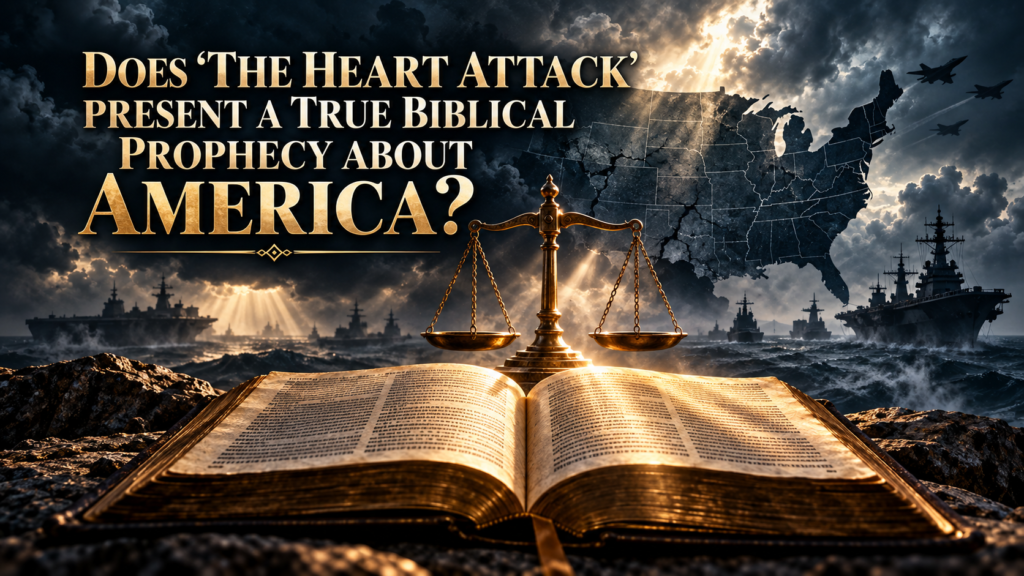
“The Heart Attack – December 9, 2019” is a post attributed to Celestial and published at The Master’s Voice Prophecy Blog. The page says the words and images were received on December 9, 2019, and it displays a December 21, 2019 publication date. It also displays June 7, 2021; without a documented edit history, that later displayed date should not be assumed to identify either a revision or a new revelation.
The source presents much more than a general concern about national decline. It says it gives “the exact words and images I saw and heard from the Lord” and concludes, “This is the word of the Lord.” It describes a sudden foreign sea-and-air invasion of the United States, failed warning systems, widespread terror and death, domestic cooperation with hostile forces, a coming coup, and national judgment. Such claims deserve serious attention precisely because they are attributed to Yahweh. The issue is not whether Yahweh can judge nations, or whether believers should pray for their societies. The question is whether Scripture establishes this particular claimed revelation and its application to America.
Separate the Biblical Call From the Specific Forecast
Several exhortations in the source are sound in themselves. Scripture calls people to repentance, prayer, mercy, obedience, and genuine knowledge of God. Yahweh judges evil impartially; no nation is beyond His rule or beyond moral accountability. Calls to study Scripture and seek mercy do not become suspect merely because they occur alongside a prophecy claim.
Yet a true general principle does not prove a detailed modern forecast. The source makes further assertions that need their own warrant: America is allegedly the object of a divine warning; foreign forces will mount a coordinated invasion; a hidden internal collaborator is working with them; and a coup will follow. None of those propositions follows simply from the biblical truth that Yahweh judges sin.
The distinction matters especially because the forecast is only partly testable as presented. The source names no invading power, supplies no date or date range, gives no measurable definition of “coup,” and offers no public means of identifying the alleged internal conspirator. A prediction without such boundaries is not thereby disproved. But neither may it be verified by indefinitely waiting for some future crisis. Elections, political unrest, border controversies, cyberattacks, foreign wars, intelligence failures, and widespread public fear should not be retrospectively counted as fulfillment of a stated sea-and-air invasion scenario.
Further, allegations of treason and a concealed “worker of iniquity” are factual insinuations about unnamed people or institutions. They require public evidence. The claim that a message came from the Lord is the very matter under examination; it cannot serve as independent proof of hidden criminal conduct. Deuteronomy 29:29 distinguishes Yahweh’s secret things from what He has revealed. It does not deny the possibility of prophecy, but it does warn readers not to treat inaccessible accusations as settled knowledge.
How Scripture Tests a Word Claimed in Yahweh’s Name
Deuteronomy provides two foundational safeguards. Deuteronomy 13:1–5 teaches that an apparently successful sign or wonder does not authenticate a prophet who leads people away from exclusive loyalty to Yahweh. That is a deeper test than prediction alone. The source does not explicitly tell readers to worship other gods, so this passage does not by itself demonstrate that its warning is false. But biblical vocabulary, appeals for mercy, and alarming imagery do not authenticate the warning either. A message can sound religious while still requiring examination.
Deuteronomy 18:20–22 treats it as gravely serious to speak presumptuously in Yahweh’s name. The passage gives an outcome test: when a stated word does not happen or come to pass, Yahweh did not speak it. Its immediate setting is Israel’s covenant law, including civil penalties that contemporary Christians are not authorized to impose. Its enduring principle remains: divine attribution must be truthful and must not be insulated from testing. A claim of “word of the Lord” is not a shield against accountability.
Deuteronomy 18 is often misused in both directions. It does not say that every person who voices a concern about a nation has claimed infallible prophecy. Here, however, the source expressly presents “exact words and images” from the Lord, so the passage is relevant to the level of authority being claimed. Conversely, the text does not allow readers to pronounce final failure before a prediction with no stated date could possibly be assessed. It requires neither premature vindication nor premature declarations of fulfillment; it requires sober accountability when a claimed word has a discernible outcome.
Jeremiah 23 and Ezekiel 13 sharpen that warning. Jeremiah rebukes prophetic leaders in Judah who spoke visions from their own minds, claimed dreams, and offered assurances Yahweh had not given. Ezekiel condemns prophets in Israel who followed their own spirit and “have seen nothing,” though they said, “Yahweh declares.” Both chapters address historical crises in ancient Judah and Israel. They do not authorize modern readers to pronounce Celestial knowingly deceptive, nor does every mistaken warning make a speaker identical to Jeremiah’s or Ezekiel’s opponents. Their lasting methodological force is nevertheless clear: claimed visions, dreams, and divine messages must be tested rather than presumed true.
The New Testament guards against the opposite errors of contempt and credulity. First Thessalonians 5:20–21 directs believers not to despise prophecies, but to test everything and hold fast what is good. The verb dokimazō means to test or examine with a view to recognizing and approving what proves genuine. It does not mean accepting a claim because it is vivid, frightening, politically plausible, or sincerely delivered. First Corinthians 14:29 likewise requires that prophetic speech be weighed by others.
First John 4:1 says believers must test the spirits because many false prophets have gone out into the world. In its immediate context, John’s explicit test concerns confession of Yeshua Messiah as having come in the flesh (1 John 4:2–3). That Christ-centered test must not be reduced to political agreement or emotional intensity. Matthew 24:23–27 also records Yeshua’s warning against dramatic claims designed to mislead His disciples. These texts establish vigilance; they do not predict the source’s American invasion scenario.
The relevant criteria, then, include fidelity to the biblical God and gospel, conformity to Scripture, responsible and truthful speech, appropriate evaluation of stated outcomes, and refusal to present unverified hidden matters as established fact. For a fuller discussion of those principles, see How Scripture Tests Prophetic Claims: A Berean Framework for Discernment.
Does Hosea 6:5–6 Identify America or Predict This Disaster?
The source closes its warning with Hosea 6:5–6. That passage must be read within Hosea 5:8–6:11, where the named covenantal subjects are Ephraim/Israel and Judah. The wider section concerns Yahweh’s judgment, the people’s inadequate return, and their fleeting loyalty. It exposes religious practice detached from covenant faithfulness and true knowledge of God.
Hosea 6:6 plainly supports a moral and covenantal priority: Yahweh desires ḥesed—steadfast or loyal love, often translated “mercy”—and the daʿat ʾelohim, knowledge of God, rather than sacrifice offered without faithful obedience. The source may rightly echo this call away from empty religious performance and toward mercy and genuine knowledge of Yahweh.
But the passage does not name the modern United States. It does not disclose an amphibious or airborne invasion, identify a domestic conspirator, or predict an American coup. Applying Hosea’s moral concerns to a contemporary society may be a reasonable sermon application. Treating the passage as a direct oracle about America requires additional evidence. The source does not supply that evidence.
This contextual limit is significant. Hosea’s audience was not a generic collection of later nations that readers may assign at will; the book names and addresses covenant communities with a defined historical relationship to Yahweh. Modern readers may draw moral analogies from its exposure of shallow repentance. But an analogy is not an identification, and identification is what the source would need before Hosea could function as evidence for a particular American military and political future.
Hosea 6:5 also requires restraint in translation arguments. Some English renderings use “like lightning,” while the difficult Hebrew and textual tradition have produced other renderings, including judgment going forth “like the light.” The latter coheres with the chapter’s dawn imagery. Whatever translation one adopts, neither wording provides a precise forecast of a modern military strike. A disputed phrase cannot bear the weight of a detailed national prediction.
Thus Hosea can deepen a biblical call to repentance, mercy, and covenant faithfulness. It cannot establish the source’s claims about invasion, conspiracy, or coup. Similar questions arise whenever America is assigned a direct role in biblical prophecy; readers may find a related examination in Does Scripture Teach That America Was Married to God and Will Be Enslaved by Russia and China?
The Strongest Case for Receiving It as a Warning
The strongest sympathetic reading deserves to be heard fairly. Many Christians hold that noncanonical prophecy may continue in the church. On that continuationist reading, 1 Thessalonians 5:20–21 requires believers to remain open to possible contemporary messages while testing them carefully. A reader could take the source’s military imagery as a literal future warning whose timing Yahweh has not disclosed.
Biblical judgment announcements can also function as warnings that summon repentance. Jonah 3 shows that Nineveh’s announced destruction did not unfold in the declared way after the city repented and Yahweh relented from the disaster. A sympathetic reader may therefore regard the source’s appeals to prayer and mercy as pastorally serious rather than as an attempt to create fear.
There is also a symbolic alternative. Biblical prophecy often uses vivid imagery, and ships, soldiers, a heart attack, and fire ants could be read as figures for social collapse, political coercion, or national destabilization. That reading can account for the absence of a literal invasion thus far.
The cessationist alternative reaches a different conclusion about contemporary revelatory prophecy, often regarding apostolic-era prophecy as uniquely foundational. Under that approach, calling a modern forecast “the word of the Lord” is itself a grave problem. Yet this review need not resolve that larger debate to assess the post. Both continuationist and cessationist readers can agree that Scripture never makes a claimant’s own certainty sufficient evidence, and that general biblical themes cannot supply missing details for a specific geopolitical prediction.
These considerations set real limits on a hasty dismissal, but they do not confirm the claim. Continuationism permits testing; it does not establish that this vision came from Yahweh. Jonah shows that some biblical judgment warnings are responsive to repentance, but the source does not explicitly state that its invasion-and-coup forecast is conditional. A symbolic recasting also lacks stated interpretive controls and softens the source’s repeated language about physical invasion, soldiers, bodily effects, and armed violence. Most importantly, none of the cited texts identifies America, its enemies, or this sequence of events.
What Is Explicit, Inferred, and Still Debated
What Scripture explicitly establishes: Yahweh calls His people to faithfulness; He judges sin; false prophets exist; claims of prophecy must be tested; and believers must not despise genuine prophecy. Hosea addresses Ephraim/Israel and Judah. First John’s immediate test is Christological, centering on the confession of Yeshua Messiah come in the flesh.
Reasonable inferences: a post that claims direct words from the Lord deserves more scrutiny than ordinary political commentary; fear-inducing specificity should not be accepted without warrant; and a call to prayer or repentance may be beneficial even when attached to an unverified prediction.
Debated matters: Christians differ over whether contemporary prophecy continues, whether this warning should be treated as conditional, whether its imagery is literal or symbolic, and how broadly Old Testament patterns of national judgment may apply to modern nations. Those are interpretive questions; they are not settled merely by quoting the passages above.
What remains unsupported at present: that the United States is Hosea’s covenantal subject; that Yahweh revealed a coming foreign invasion, hidden internal conspiracy, or coup through this post; and that undefined future political events should be treated as fulfillment. The absence of a timetable means delay alone does not disprove the forecast. The same absence, however, means indefinite possibility cannot verify it.
Berean Verdict
Scripture supports the source’s general exhortation to seek mercy, repent, pray, and study Yahweh’s word. It also commands Christians to test claimed revelations seriously, without ridicule and without gullibility. Those are important biblical truths.
What does not receive biblical establishment is the source’s specific American forecast. Hosea 6:5–6 does not identify America or validate a coming invasion, internal conspiracy, and coup. Deuteronomy, Jeremiah, Ezekiel, 1 Thessalonians, First John, and Matthew provide criteria for discernment; they do not certify Celestial’s claim merely because it is framed as a word from the Lord.
Accordingly, The Heart Attack should not be received or circulated as established biblical prophecy. It remains an unverified claimed revelation. Readers should not repeat unsupported conspiracy allegations as facts or interpret every troubling political development as fulfillment. They should remain prayerful, morally alert, and willing to revise their judgment according to Scripture and publicly observable reality.
This study is part of The Berean Scale’s ongoing review of The Master’s Voice Prophecy Blog and its claimed revelations, seeking to distinguish biblical exhortation from assertions Scripture does not establish.

Discussion
Join the Discussion
Test the claim with Scripture. Address the text and the argument, not the person. Comments may be held for moderation.
Keep it Berean: cite the text when possible, make the argument clearly, and keep disagreement respectful.