The Short Answer
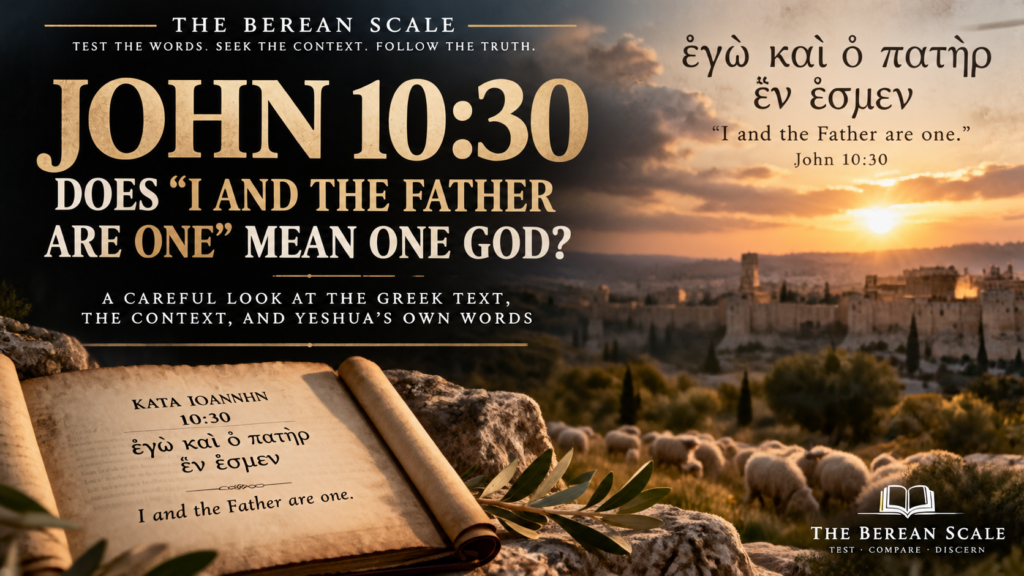
John 10:30 does not explicitly say that Yeshua and the Father are “one God,” “one being,” or “one essence.”
It says: “I and the Father are one.”
The immediate context shows an extraordinary unity between Yeshua and His Father in protecting the sheep, exercising authority, performing works, and carrying out the Father’s mission.
The Greek word translated “one,” hen, does not by itself tell us that this is a statement about one divine essence. But neither does the grammar prove that Yeshua means only agreement or purpose. The meaning has to come from the context.
And when we read the entire conversation, Yeshua identifies Himself not as the Father or as Yahweh, but as the Son of God whom the Father sanctified and sent into the world. That distinction matters.
Read the Conversation Before John 10:30
John 10:30 does not appear by itself. Yeshua is in Jerusalem during the Feast of Dedication. His opponents surround Him and ask Him to settle a question: Is He the Messiah? That is the issue immediately placed before Him in John 10:24.
Yeshua responds by pointing to His works. He says that the works He performs in His Father’s name testify about Him (John 10:25).
Notice the relationship already being established. There is the Father whose name and authority stand behind the works, and Yeshua who performs those works in His Father’s name.
Yeshua then speaks about His sheep. They hear His voice. He knows them. They follow Him. He gives them eternal life, and no one will snatch them from His hand (John 10:27–28). Then He says that no one can snatch them from the Father’s hand (John 10:29).
Immediately after describing the sheep as secure in both His hand and the Father’s hand, Yeshua says: “I and the Father are one.”
That context cannot be ignored. At minimum, John 10:30 expresses a profound unity between the Father and the Son in their action toward the sheep. The sheep are not safe with Yeshua but unsafe with the Father. They are not protected by the Father while Yeshua operates independently. The Father and Son act in complete unity.
The question is whether John intends us to go further and understand this as a direct statement that they are one divine being. That requires more examination.
What Does the Greek Actually Say?
The Greek of John 10:30 is: egō kai ho patēr hen esmen. Literally: “I and the Father are one.”
The grammar is important. Esmen means “we are.” Yeshua does not say, “I am the Father.” There are two subjects: I and the Father. The plural verb maintains that distinction.
The word hen, “one,” is neuter singular. That means Yeshua is not saying that He and the Father are one individual person. This is one reason Trinitarian theology itself does not normally interpret John 10:30 as saying that the Father and the Son are the same person.
But what does the neuter hen positively prove? Not as much as is sometimes claimed.
Does Hen Mean “One Essence”?
Some interpreters argue that because hen is neuter rather than masculine, Yeshua is declaring that He and the Father are one in essence or substance. That interpretation has a long history.
But the grammatical form itself does not contain the word “essence.” There is no Greek word for “substance,” “nature,” or “being” in John 10:30. Hen simply means one.
The context must tell us the respect in which the Father and Son are one. Some Trinitarian commentators therefore argue that the immediate context begins with unity of power and action but ultimately implies unity of divine nature. Other interpreters understand the verse primarily as unity of authority, purpose, work, and protective power.
The grammar alone cannot settle that theological debate. That is important.
We should not say: “Hen proves they are one essence.” But we should also not say: “Hen proves they are only one in purpose.” Both conclusions go beyond what one Greek adjective can establish by itself. We have to keep reading.
The Son’s Hand and the Father’s Hand
The immediate argument begins with the security of the sheep. Yeshua says no one can snatch His sheep from His hand. Then He says no one can snatch them from the Father’s hand. Then: “I and the Father are one.”
This strongly connects the oneness statement with shared action and authority. What the Father is accomplishing toward the sheep, Yeshua is accomplishing. Their work is not divided.
This is an extremely high claim. Yeshua is not speaking like an ordinary teacher who simply agrees with Yahweh. He gives eternal life. He knows the sheep. They hear His voice. Their security is associated with His hand and the Father’s hand. Those facts deserve their full weight.
But notice something else. Throughout the passage, Yeshua still speaks as the one who receives from and acts in relation to the Father. His works are done in the Father’s name. The sheep are given to Him by the Father. Later in the same conversation, He says the Father sanctified Him and sent Him into the world. Unity does not erase distinction.
“You, Being a Man, Make Yourself God”
The reaction comes immediately. John 10:31 says that Yeshua’s opponents picked up stones.
Unlike John 8:59, where the exact accusation is not stated, John 10 tells us what the charge was. They accuse Yeshua of blasphemy because, as they understand Him: “You, being a man, make Yourself God.”
The Greek contains theon, the accusative form of theos, “God” or “god” depending on context.
This accusation must be taken seriously. It would be weak to simply say, “They misunderstood Him,” and move on. John intentionally records their reaction. They clearly believed Yeshua had crossed a boundary. But their accusation is not the end of the conversation. Yeshua answers them.
If we want to understand His claim, His own response deserves greater weight than His opponents’ accusation.
Yeshua Answers With Psalm 82
Yeshua responds by quoting Psalm 82:6: “I said, you are gods.”
The Hebrew word in Psalm 82 is elohim. The same word frequently used for God is being applied in Psalm 82 to others. Who exactly are the elohim of Psalm 82? That is debated. Some interpret them as human rulers or judges. Others understand the Psalm as addressing heavenly or divine beings under Yahweh’s supreme authority.
The debate does not need to be settled for Yeshua’s argument to work. The crucial point is simpler: Scripture itself can use divine terminology for beings who are not Yahweh.
Yeshua says that Scripture called them theoi—”gods”—and then adds that Scripture cannot be broken (John 10:34–35). He is exposing a problem in their accusation. If Scripture itself can use the term “gods” in a subordinate sense, then merely hearing exalted language does not automatically establish blasphemy.
But Yeshua does not stop there. He contrasts those figures with Himself.
“Whom the Father Sanctified and Sent”
Yeshua then describes Himself in John 10:36. He is the one whom the Father sanctified and whom the Father sent into the world. Then He states the claim for which they are accusing Him of blasphemy:
“I am the Son of God” (Huios tou Theou eimi).
That is enormously important. His opponents say: “You make yourself God.” Yeshua describes His own claim as: “I am the Son of God.” We should not casually collapse those two statements into the same sentence.
Nor should we overstate the other direction. Yeshua is not saying that He is merely an ordinary human ruler like everyone else in Psalm 82. His argument can reasonably be understood as moving from the lesser to the greater: If Scripture can use exalted terminology for those addressed in Psalm 82, how much more can such language appropriately apply to the unique one whom the Father sanctified and sent into the world?
Psalm 82 therefore does not lower Yeshua to the level of ordinary men. But neither does Yeshua respond by saying: “Yes. I am Yahweh.” He identifies Himself as the Son of God sent by the Father.
The Father Is in Yeshua
Yeshua then returns to His works. If He does not perform His Father’s works, they should not believe Him. But if He does them, He tells them to believe the works so that they may understand: the Father is in Him, and He is in the Father (John 10:37–38).
This is profound language. It cannot simply be reduced to two people agreeing with each other. John repeatedly describes a deep mutual indwelling between the Father and the Son.
But once again, we have to distinguish what the text says from what later theology may infer from it. “The Father is in Me, and I in the Father” describes extraordinary unity and mutual indwelling. It does not literally say: “I am the Father.” Nor does it say: “We are one person.” The very language of one being “in” the other maintains relationship and distinction.
Does John 17 Help Explain “One”?
John gives us another important use of hen later in the Gospel. In John 17, Yeshua prays for His disciples and asks the Father that they may all be one. The Greek word is again hen. That same prayer also contains John 17:3, where Yeshua addresses the Father as “the only true God” and distinguishes Himself as the Messiah whom the Father sent.
That matters. Obviously, Yeshua is not praying for all believers to become one literal person. Neither is He saying that the disciples will become one divine essence. Their oneness is relational: a deep unity produced through shared life, love, mission, glory, and communion with Yahweh through Messiah.
Does that prove John 10:30 means only unity of purpose? No. The comparison should not be pushed further than the text allows. The relationship between Father and Son is unique, and John attributes things to Yeshua that he never attributes to ordinary disciples.
But John 17 does demonstrate something important: The word hen itself does not mean “one divine essence.” John can use the same word for a profound unity that does not collapse multiple persons into one being. So John 17 should control exaggerated grammatical claims about John 10:30. It does not settle the entire theological question, but it prevents the word hen from being forced to carry more weight than it can bear.
The Strongest Trinitarian Reading
A fair study must present the strongest opposing case. The Trinitarian argument does not have to rest on hen alone. It can appeal to the entire passage.
Yeshua gives eternal life. No one can remove the sheep from His hand. The same absolute security is associated with the Father’s hand. Yeshua then says that He and the Father are one. His opponents hear blasphemy. Yeshua speaks of the Father being in Him and He in the Father. Elsewhere in John, Yeshua receives extraordinary honor, exercises divine authority, speaks of sharing glory with the Father, and is described using remarkably exalted language.
From this perspective, John 10:30 fits within a larger Johannine picture in which the Son shares the divine identity or essence of the Father while remaining personally distinct from Him.
That is a serious argument. It should not be dismissed by pretending that John 10 is ordinary agency language. But there is still an important distinction between saying: John 10:30 fits a theological case for shared divine essence and saying: John 10:30 explicitly teaches that the Father and Yeshua are one God or one essence.
The first is an interpretation constructed from the wider Gospel. The second claims more than the wording of the verse itself. Those are not the same thing.
What the Text Explicitly Says
John 10 explicitly tells us several things:
- Yeshua and the Father are distinct in the conversation.
- The Father sends. Yeshua is sent.
- The Father sanctifies. Yeshua is sanctified.
- Yeshua performs works in His Father’s name.
- The Father gives to the Son.
- Yeshua gives eternal life to His sheep.
- The sheep are secure in Yeshua’s hand and the Father’s hand.
- Yeshua and the Father are one.
- The Father is in Yeshua, and Yeshua is in the Father.
- Yeshua identifies Himself as the Son of God.
Those statements should all remain on the table. We should not use one of them to erase the others.
Reasonable Inference
John 10 presents a relationship between Father and Son far beyond casual agreement. Yeshua acts with extraordinary heavenly authority. Their unity is real, powerful, and central to the identity John presents for Yeshua.
It is reasonable to describe John 10:30 as teaching profound unity of mission, action, authority, and purpose between the Father and the Son. The passage may also contribute to a broader argument about Yeshua’s nature. But that further conclusion must be argued from the wider evidence. It cannot simply be inserted into the word hen.
The Berean Verdict
John 10:30 presents one of the strongest statements of unity between Yeshua and His Father in the Gospel of John. We should feel the full weight of it.
Yeshua gives eternal life. His sheep are secure in His hand and the Father’s hand. He performs the Father’s works. The Father is in Him, and He is in the Father. This is not ordinary human authority.
But the verse still does not explicitly say that Yeshua and the Father are “one God” or “one essence.” The Greek hen establishes oneness but does not define that oneness as metaphysical identity by itself. The context establishes profound unity of work, authority, mission, and action.
And when Yeshua answers the charge of blasphemy, He identifies Himself as the Son of God whom the Father sanctified and sent.
So we should neither diminish Yeshua nor rewrite His words. Yahweh is the One who sends. Yeshua is His sanctified and sent Son, Messiah, Shepherd, and King. The Father and Son are profoundly one.
But if we want to claim that John 10:30 specifically means “one God” or “one essence,” we have moved from the explicit wording of the verse into theological inference. That inference can be argued, but it should not be presented as though Yeshua actually said the words.
We don’t read Scripture to defend an inherited system. We put the claim on the scale. We test the words. We read the context. And we stop where the text stops. ⚖️📖
Discussion
2 Comments
Test the claim with Scripture. Address the text and the argument, not the person. Comments may be held for moderation.
Keep it Berean: cite the text when possible, make the argument clearly, and keep disagreement respectful.