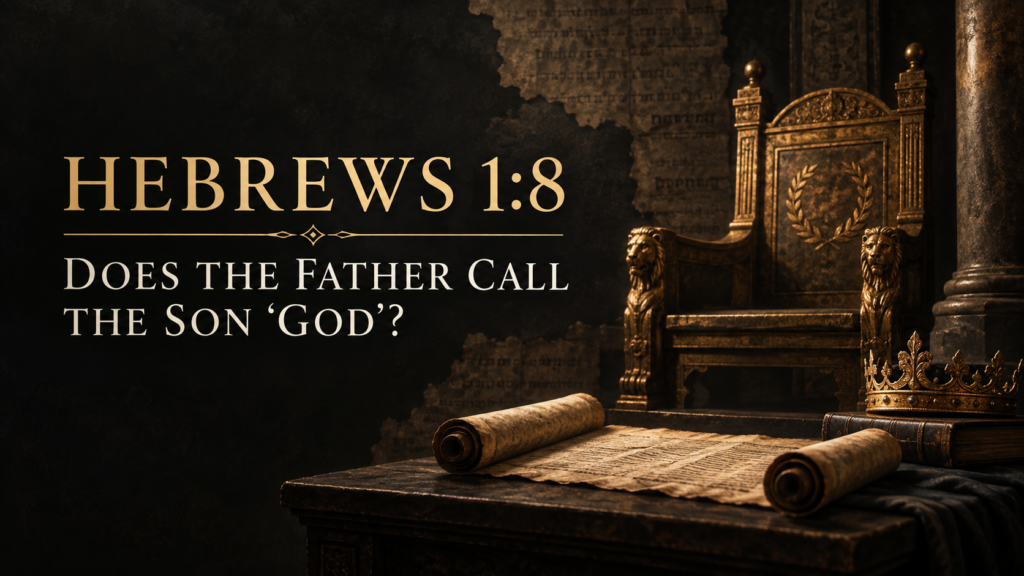
Short answer: Hebrews 1:8 most naturally applies the direct address “O God” to the Son: “Your throne, O God, is forever and ever.” In Hebrews 1, Scripture is presented as divine speech concerning angels and the Son, so God is best understood as the strongly implied speaker of the catena. Within the letter’s Father-Son framework, identifying that speaker as the Father is a reasonable inference. Yet Hebrews does not explicitly say, “The Father said to the Son, ‘You are God.’” Verse 9 also distinguishes the Son from “God, your God,” who anoints him. Alternative readings are grammatically conceivable, but less persuasive in the Greek text Hebrews quotes.
Unless otherwise noted, the English Scripture renderings below are supplied translations intended to show the wording under discussion. The argument turns on the Greek form quoted in Hebrews and, where relevant, the Hebrew of Psalm 45.
Hebrews 1 is contrasting the Son with angels
Hebrews 1:8 belongs in a sustained argument, not a detached doctrinal slogan. Hebrews 1:1–4 has already described the Son in extraordinary terms: God made the ages through him; he is the radiance of God’s glory and the exact imprint of his being; he made purification for sins and sat down at the right hand of the Majesty on high. Verses 5–14 then assemble Scripture quotations to establish that the Son is incomparably greater than angels.
The controlling question appears in verses 5 and 13: To which of the angels did God ever say, “You are my Son” or “Sit at my right hand”? Angels are servants—described in verse 7 as winds or spirits and ministers associated with flame, and in verse 14 as “ministering spirits” sent to serve those inheriting salvation. The Son, by contrast, receives Davidic sonship language, angelic homage, an enduring throne, a righteous scepter, and enthronement at God’s right hand.
Hebrews’ immediate purpose is therefore the Son’s superiority to angels. But that purpose gives weight to the language: the Son’s superiority is established by applying to him a combination of royal, enduring, and exalted language that Hebrews does not apply to any angel in this catena.
What does Hebrews 1:8 introduce?
Hebrews 1:7 says, pros men tous angelous legei, roughly, “with reference to the angels he says.” Verse 8 contrasts this with pros de ton huion: “but to the Son,” or “but with reference to the Son.” The preposition pros with “he says” can bear either sense, so this is a genuine translation question.
For that reason, verse 8 alone does not contain the full formula, “The Father directly says to the Son.” Still, the wider catena repeatedly treats the citations as divine speech: it asks what God ever said to an angel, contrasts statements about angels and the Son, and concludes with God’s invitation to the enthroned figure in verse 13. God is therefore best understood as the strongly implied speaker in the catena, even though the precise force of pros de ton huion and the scope of the introduction require interpretation. Whether one translates “to the Son” or “concerning the Son,” Hebrews identifies the Son as the one to whom Psalm 45’s royal language applies.
Psalm 45 and Hebrews’ Greek quotation
Hebrews 1:8–9 cites Psalm 45:6–7 in standard English numbering (Psalm 45:7–8 in Hebrew numbering; Psalm 44:7–8 in the Septuagint). Psalm 45 is a royal wedding or court psalm, praising a king’s splendor, military strength, just rule, throne, scepter, bride, and descendants. Its first setting is a royal setting commonly understood in relation to Davidic kingship, though the psalm does not securely identify a particular king or occasion.
That setting matters. The psalm was not originally an abstract discussion of later creedal categories. Israel’s kings could be described in exalted terms as Yahweh’s appointed representatives; Solomon, for example, is said to sit on “the throne of Yahweh” in Chronicles. This background helps explain why interpreters have debated whether Psalm 45 calls the king God, describes his throne as God-founded, or uses another form of elevated royal language.
The Hebrew clause, kis’akha elohim ‘olam va‘ed, is syntactically difficult. Proposed renderings include “Your throne, O God,” “Your throne is God,” and “Your throne is the throne of God.” Yet Hebrews does not freshly translate the Hebrew. It cites an LXX-like Greek form, so the Greek wording actually used in Hebrews must be primary for interpreting Hebrews 1:8.23
The strongest reading: “Your throne, O God”
The central Greek phrase is ho thronos sou ho theos eis ton aiōna tou aiōnos. Greek can omit the verb “is” in verbless clauses, so the question is whether ho theos means “O God” or functions as the subject or predicate of the sentence. The presence of the article does not mechanically settle that question.
The most natural reading is vocative: “Your throne, O God, is forever and ever.” Although ho theos has a nominative form and article, Koine and Septuagint Greek can use an articular nominative in direct address. Here, word order, context, and this known vocative use together favor “your throne, O God.” The quotation also continues in the second person: “You loved righteousness and hated lawlessness,” followed by “God, your God, anointed you.”14
This reading also fits the argument. Angels are servants, while the Son is associated with an everlasting throne, a righteous scepter, and a kingdom. The immediate conclusion should therefore be stated clearly: Hebrews applies the address “O God” to the Son. Since the catena frames these citations as divine speech, it is a strong inference that God addresses the Son; calling the speaker the Father is natural within Hebrews’ Father-Son framework, though it is not the quotation’s explicit standalone wording.
Are the alternatives viable?
The main alternative reads, “God is your throne forever and ever,” treating God as the king’s foundation or security. A related proposal says, “Your throne is God,” meaning the king’s rule rests on God. These readings are not meaningless as abstract grammatical possibilities, and they rightly take Psalm 45’s royal setting seriously.
Nevertheless, they are less persuasive in Hebrews’ Greek. “God is your throne” is a strained metaphor; the word order more readily supports “your throne, O God”; and the vocative use of the articular nominative suits the direct address throughout the citation. Translating pros de ton huion as “concerning the Son” does not settle the grammar inside the quotation. It identifies the Son as the subject of the citation but does not make ho theos non-vocative.1
Verse 9 must qualify every conclusion
Verse 9 must remain attached to verse 8: “Therefore God, your God, anointed you with the oil of gladness beyond your companions.” The one addressed as theos has “God” as his God and is anointed by him. Verse 9 therefore explicitly distinguishes the Son from the God who anoints him.
This prevents two opposite errors. Hebrews 1:8–9 does not collapse Father and Son into one undifferentiated person, nor does it itself state later conciliar language such as “one essence.” In Trinitarian terms, the distinction in verse 9 entails personal distinction; the passage itself, however, does not define the later doctrinal account of that distinction. But verse 9 cannot erase verse 8: the text holds together an address to the Son as “O God” and a distinction between him and “God, your God.” Trinitarian readers see personal distinction without denying the Son’s full deity. Royal-agency or non-Trinitarian readers stress the Son’s dependence on the anointing God and the Psalm’s royal context. Both approaches must account for both verses.
The chapter further heightens the Son’s status. Hebrews 1:10–12 cites Psalm 102’s words to the enduring Lord who founded the earth and remains while creation changes. Many interpreters understand the introduction to the Son in verse 8, joined by “and” in verse 10, to extend to this citation. That is a strong reading, though it remains a related exegetical question. Verse 13 then returns to the contrast: no angel receives the invitation to sit at God’s right hand.
What Hebrews 1:8 supports—and what it does not settle
Hebrews 1:8–9 should be read alongside passages that distinguish the Father and Son while giving the Son an exalted role, including 1 Corinthians 8:6. John 20:28 is another significant comparison, since Thomas addresses the risen Yeshua as “my Lord and my God,” but it does not decide Psalm 45’s grammar. Questions about the Father as “the only true God” likewise require their own close reading, as discussed in this study of John 17:3.
Berean verdict: In the Greek text Hebrews quotes, “Your throne, O God, is forever and ever” is substantially stronger than “God is your throne.” Hebrews therefore applies “O God” to the Son. At the same time, verse 9 explicitly distinguishes the Son from “God, your God,” who anoints him. The passage is strong evidence for an exceptionally high view of the Son and for a real distinction between the Son and the God who anoints him; it does not, by itself, settle every later theological formulation.
Discussion
Join the Discussion
Test the claim with Scripture. Address the text and the argument, not the person. Comments may be held for moderation.
Keep it Berean: cite the text when possible, make the argument clearly, and keep disagreement respectful.