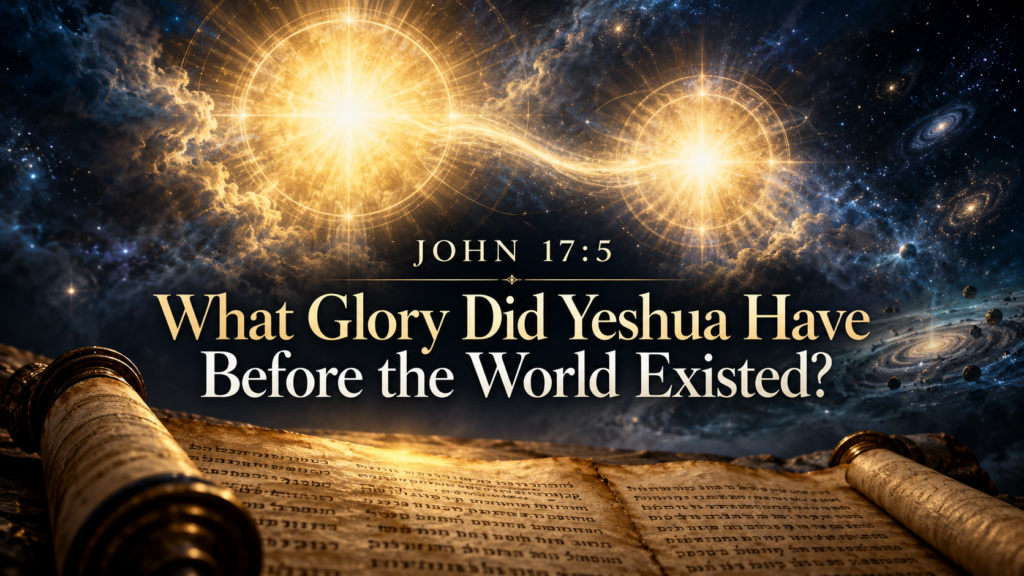
What did Yeshua mean when he prayed, “And now You, Father, glorify Me together with Yourself, with the glory which I had with You before the world existed” (John 17:5, NASB 1995)? The most natural reading is that Yeshua personally possessed glory in relationship with the Father before the created world existed, and now asks to be glorified in the Father’s presence as his earthly mission reaches its climax.
This is a weighty claim, but the verse must not be made to say either less or more than it says. It clearly distinguishes Yeshua from the Father: this is an address from one person to another. It does not, by itself, use later creedal terms such as “one essence,” explain eternal generation, or give a complete account of Father-Son unity. The right approach is to begin with John 17:1–5, examine the wording of verse 5, and then test both personal-preexistence and foreordination readings against John’s wider witness.
The Prayer’s Setting: Glory, Mission, and Return
John 17 opens Yeshua’s prayer immediately after the farewell discourse. The preceding context supplies an important framework: “I came forth from the Father and have come into the world; again, I am leaving the world and going to the Father” (John 16:28). John 17:5 belongs to this movement of coming into the world, completing the Father’s work, and returning to the Father.
Yeshua begins, “Father, the hour has come; glorify Your Son, that the Son may glorify You” (17:1). The Father gave the Son authority over all flesh so that he might give eternal life to those given to him (17:2). Eternal life is defined as knowing the Father, “the only true God,” and Yeshua Messiah, whom the Father sent (17:3). Yeshua then says that he glorified the Father on earth, having accomplished the work entrusted to him (17:4).
The prayer therefore does not portray glory as detached rank or self-exaltation. In John, glorification is bound to the impending cross and its revelation of the Father. John 12:23–28 and 13:31–32 place Yeshua’s glorification in the hour of his suffering, obedience, resurrection, and return. His request in 17:5 comes from the obedient Messiah whose mission has reached its appointed climax.
At the same time, verse 3 prevents a careless conclusion. The Father is called “the only true God,” while Yeshua is identified as the Messiah sent by him. Verse 5 does not collapse Father and Son into the same person. Whatever pre-world glory means, the prayer itself presents an I–You relationship: the Son petitions the Father.
What John 17:5 Says in Greek
The central clause reads: doxason me sy, Pater, para seautō tē doxē hē eichon pro tou ton kosmon einai para soi. A close rendering is: “Father, glorify me alongside Yourself with the glory that I had alongside You before the world existed.” The NASB’s “glorify Me together with Yourself” communicates the same central relationship.
First, doxa, “glory,” has a broad biblical range. It can refer to honor, splendor, majesty, revealed presence, or exalted status. Yahweh’s glory in the Old Testament is uniquely associated with his majestic self-disclosure (Exodus 33:18–23; 34:5–7; Isaiah 42:8). Yet the noun by itself does not settle whether the glory in John 17:5 is intrinsic, bestowed, participatory, or includes more than one of those ideas. The surrounding wording must carry that question.
Second, Yeshua says hē eichon, “which I had” or “which I was having.” Eichon is a first-person imperfect form of “have.” It presents the glory as Yeshua’s past possession within the time frame that follows. The imperfect does not prove timeless existence, endless duration, or uncreatedness. But neither does its grammar naturally mean, “a glory that was only planned for me.” A plan may be inferred from a wider theological proposal; it is not the plain meaning of the verb itself.
Third, John uses para twice: para seautō, “with Yourself,” and para soi, “with You.” With the dative, para can convey association, proximity, presence, or being alongside. English versions may say “with,” “in Your presence,” or “at Your side.” The repeated relational language is significant. Yeshua asks to be glorified in relation to the Father and identifies the prior glory as glory held in relation to the Father. This makes an entirely impersonal reading—glory existing only as an idea in the Father’s mind—less direct.
Finally, pro tou ton kosmon einai means “before the world existed” or “before the world came to be.” It is an ordinary temporal construction. In this setting, “world” most naturally refers to the world at its coming into existence, not merely to Yeshua’s public ministry or to the later unbelieving human order sometimes denoted by kosmos in John.
Thus, the grammar establishes that Yeshua asks the Father for glory and identifies it as glory he had with the Father before the world existed. It does not independently establish that Yeshua is the Father, explicitly call him uncreated, or provide a complete metaphysical definition of their unity.
John’s Pattern of Coming From and Returning to the Father
John 17:5 is not an isolated phrase. The Gospel repeatedly frames Yeshua’s mission as a coming from God and a return to God. John 13:3 says that Yeshua knew “that He had come forth from God and was going back to God.” John 16:27–28 says that he came forth from the Father, came into the world, and was leaving the world to go to the Father. John 6:38 adds, “For I have come down from heaven,” in the context of doing the will of the One who sent him.
These sayings do not merely predict future honor for an earthly Messiah. Read in their ordinary narrative sense, they describe descent, mission, and return. They strongly reinforce the reading of John 17:5 as a request for restored personal fellowship and glory with the Father. They also preserve distinction: the Father sends, gives, and commissions; the Son comes, obeys, reveals, and returns. Readers considering how John joins Yeshua’s extraordinary works to his dependence on the Father may also find it useful to examine John 5:19 and the Son’s relation to the Father.
Later in the same prayer, Yeshua says that the Father loved him “before the foundation of the world” (John 17:24). That is not identical to verse 5: love is not glory. Still, it supplies a second pre-creation statement within the same prayer and fits a real relationship between Father and Son before creation.
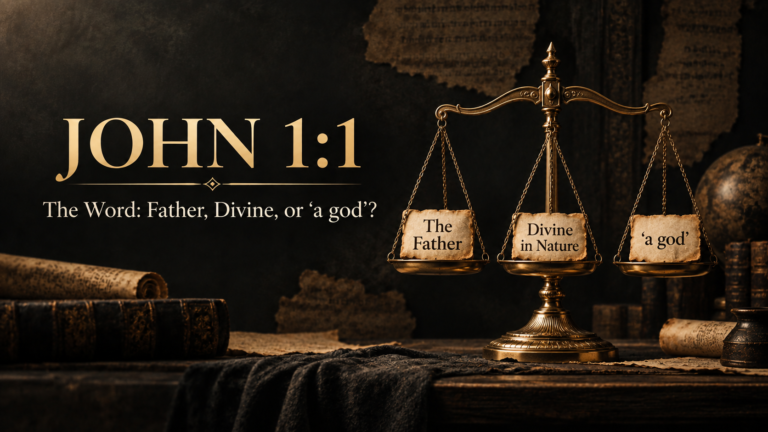
John’s Prologue is the Gospel’s major literary backdrop. It says that the Word was in the beginning, was with God, and that all things came into being through him; then it says that the Word became flesh (John 1:1–3, 14). The dominant Christian reading identifies the incarnate Word with Yeshua. On that reading, the Prologue and John 17:5 mutually illuminate a pre-world personal relation without identifying the Word as the Father. The difficult questions surrounding John 1:1 deserve their own treatment; see this study of whether the Word is the Father, divine in nature, or “a god”.
John 8:58 is often introduced here, but caution is appropriate. It is relevant to Johannine preexistence and high Christology, yet its exact force remains disputed. It should not be used as a shortcut that settles John 17:5 without attending to John 17:5’s own wording.
The Case for Personal Preexistence and High Christology
The cumulative case is straightforward. “The glory which I had,” “with You,” and “before the world existed” naturally describe Yeshua’s own prior possession of glory in relation to the Father. John’s repeated coming-from and returning-to-the-Father language gives that statement a coherent narrative setting. John 17:24 adds pre-world love between Father and Son. Taken together, these texts make a merely human-Messiah reading increasingly difficult.
Classical Trinitarian theology draws a wider conclusion: the preexistent Son, personally distinct from the Father, shared glory with the Father before creation and now, as the incarnate and obedient Messiah, asks for glorification as his redemptive work reaches completion. This reading does not make the request meaningless. John can distinguish prior pre-world glory from the historical glorification of the Son through obedient suffering, resurrection, ascension, and the completed revelation of the Father.
A person may also affirm genuine personal preexistence without affirming every later Trinitarian formulation. A non-Trinitarian agency reading may identify Yeshua as Yahweh’s unique heavenly agent, existing with the Father before creation. But John 17:5 does not call him created, angelic, or merely creaturely. Such a model must also reckon carefully with John’s claims about the Word and creation, the Son receiving the honor due to the Father (John 5:19–23), and Thomas’s confession in John 20:28. Verse 5 alone does not settle all of those larger questions, but it cannot be made neutral toward them.
The Strongest Foreordination Reading
The strongest alternative is not that the words have no meaning, but that they speak proleptically: Yeshua’s glory was his in the certainty of the Father’s pre-creation purpose, rather than in Yeshua’s conscious personal existence. Scripture certainly speaks of God’s purposes before historical realization. Jeremiah was known before birth (Jeremiah 1:5); believers were chosen in Messiah before the foundation of the world (Ephesians 1:4–5); grace was granted before the ages began (2 Timothy 1:9). Future inheritance, election, and vocation can be described from the standpoint of Yahweh’s settled purpose.
The immediate context gives this argument a real foothold. In John 17:4, Yeshua says he has accomplished the work given to him, though the passion has not yet been narrated as completed. Interpreters reasonably debate whether this refers to the revelatory work already completed, speaks anticipatively of the cross, or includes both. Therefore, anticipated fulfillment is a legitimate category in the prayer.
John 17:22 adds another important caution: Yeshua tells his disciples, “The glory which You have given Me I have given to them.” Glory can be bestowed and shared. Believers who receive glory are not thereby identical with Yahweh or personally preexistent. This prevents an argument that treats the word glory as a one-word proof of a complete ontology.
Yet those observations do not remove the central difficulty for the foreordination reading. None of the cited foreknowledge texts combines a first-person possession statement, repeated relational language—“with Yourself” and “with You”—and a clause locating that possession before the world existed. John 17:5 does not say that the glory was prepared, promised, reserved, or foreknown. It says, “which I had with You.” Nor does verse 22 erase the difference between glory given to disciples during the historical mission and glory Yeshua says he had with the Father before the world existed.
Prolepsis is therefore biblically intelligible and should not be dismissed merely because it is nontraditional. But it bears the greater explanatory burden in this verse. It must explain why Yeshua speaks of personally having glory with the Father before the world, and why John repeatedly describes his mission as coming from the Father and returning to him.
What Is Explicit, Inferred, and Debated
Explicitly, the Father sent Yeshua, gave him authority, and is called the only true God (John 17:2–3). Yeshua glorified the Father in his earthly work, asks the Father to glorify him, and identifies the requested glory as glory he had with the Father before the world existed (17:4–5). The Father-Son distinction is explicit throughout the prayer.
By reasonable inference, the combined force of “I had,” “with You,” and “before the world existed” favors Yeshua’s personal preexistence and prior heavenly glory. John 1, 6, 13, 16, and 17:24 substantially reinforce that conclusion. The Father’s being “the only true God” in verse 3 must remain in view; it cannot be sidelined by appeals to verse 5. For a focused examination of that immediately preceding statement, see John 17:3: Who Is “the Only True God”?.
What remains debated is whether this prior glory proves Yeshua’s uncreatedness, full equality in every respect, eternal generation, Nicene Trinitarian doctrine, or a particular created-agent model. Those conclusions require synthesis with more passages and theological premises. John 17:5 is strong high-Christology evidence, but it is not a complete creed.
Verdict: Pre-World Glory With the Father
John 17:5 most naturally teaches that Yeshua personally had glory with the Father before the world existed and now asks to be glorified in the Father’s presence as his earthly mission reaches its climax. The foreordination reading rightly recognizes Scripture’s language of Yahweh’s settled purpose and the participatory character of glory, but it does not explain the verse’s first-person, relational, and temporal wording as directly as personal preexistence does.
The passage strongly supports high Christology while preserving a real distinction between Father and Son. It coheres well with Trinitarian theology as part of a wider Johannine and canonical synthesis, but it does not by itself articulate every later creedal category, nor does it say that the Son is the Father. The safest conclusion is also the textual one: before the world existed, Yeshua says he had glory with the Father.
Discussion
Join the Discussion
Test the claim with Scripture. Address the text and the argument, not the person. Comments may be held for moderation.
Keep it Berean: cite the text when possible, make the argument clearly, and keep disagreement respectful.