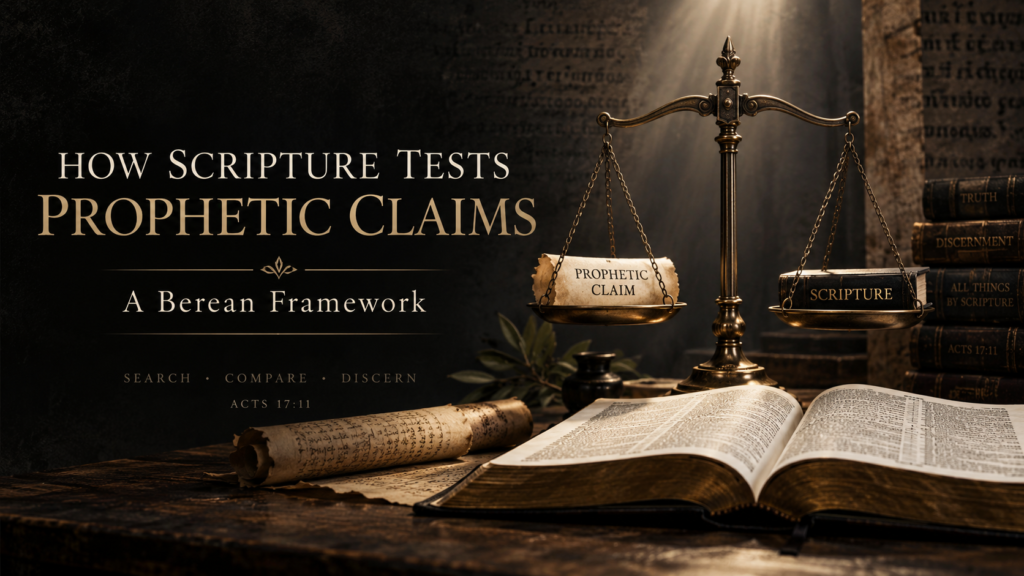
Claims of prophecy, dreams, visions, revelations, and predictions deserve neither automatic belief nor automatic scorn. In Scripture, prophecy can include warning, comfort, exhortation, covenant accusation, disclosure, and prediction. Therefore, a date-setting test cannot evaluate every claim. Yet Scripture repeatedly requires Yahweh’s people to examine those who speak in his name.
The governing posture is reverent openness under Scripture’s authority. A vivid dream, urgent tone, spiritual vocabulary, apparent sacrifice, popularity, sincerity, or unusual event does not establish that Yahweh has spoken. Neither does unusual content by itself prove deception. The Bereans received preaching eagerly while examining the Scriptures daily to see whether the claims were so (Acts 17:11). Their example directs attention first to what Yahweh has already revealed, not to a modern messenger’s charisma.
This framework evaluates public claims and their evidence. It does not authorize readers to diagnose mental health, declare an experience demonic, pronounce on salvation, or assume hidden motives. A message may be rejected firmly while its claimant is treated truthfully and without contempt.
Deuteronomy’s foundational order: loyalty before signs
Deuteronomy 13 presents a deliberately difficult case. A prophet (navi’) or “dreamer of dreams” (ḥolem ḥalom) announces a sign or wonder (’ot or mofet), and the announced event occurs. The passage does not deny the occurrence. Yet the speaker then calls Israel to follow gods they have not known. Israel must not listen. Yahweh is testing whether his people love him with all their heart and soul.
The opening command is numbered Deuteronomy 12:32 in many English Bibles and Deuteronomy 13:1 in others: Israel must not add to or take away from what Yahweh commands. That framing, together with Deuteronomy 4:2, matters. The question is not merely, “Did something impressive happen?” It is, “Does this message preserve faithful allegiance to Yahweh and his revealed instruction?” Deuteronomy 13:4 calls Israel to follow, fear, obey, serve, and hold fast to Yahweh.
This establishes an explicit biblical priority: an occurring sign cannot validate a message that draws people from Yahweh. Canonically, Galatians 1:6–9 makes the same kind of point concerning a contrary gospel, even if an angel were the messenger. Second Thessalonians 2:1–3 warns believers not to be quickly shaken by a claimed spirit, word, or letter. Apparent supernatural origin is not self-authenticating.
Applied carefully, a message must be rejected if it contradicts Scripture’s teaching about Yahweh, redirects worship, denies the gospel, excuses sin, or places private revelation above the written word. This does not mean Deuteronomy 13 labels every fulfilled prediction demonic. It means accuracy, even if established, is not the decisive test of truth or divine approval.
Deuteronomy’s civil penalties belonged to ancient Israel’s covenantal legal order. Christians should receive the passage’s theological seriousness about falsely invoking Yahweh’s name, but not use it to justify coercion, harassment, or punishment of contemporary claimants.
Unauthorized speech, failed predictions, and conditional warnings
Deuteronomy 18:20–22 addresses a related danger: someone who speaks in Yahweh’s name what Yahweh has not commanded. The passage calls such speech presumptuous; the Hebrew zadon conveys arrogance or presumption. It is not a label to apply to every ordinary interpretive mistake. Its immediate concern is unauthorized use of divine authority.
The predictive criterion is plain. When a speaker claims Yahweh’s name for a concrete word and it does not happen or come to pass, Yahweh did not speak that word; Israel need not fear that speaker. Jeremiah 28 supplies a narrative example. Hananiah promised a near, identifiable restoration; Jeremiah said a prophet promising peace is known when the word occurs. The narrative records the outcome of the competing claims.
Careful testing begins by preserving the original wording. What was predicted? Was a time frame given? Was the claim unconditional? What event, place, or people were identified? A prayer, concern, symbolic image, exhortation, or possibility should not be recast as a failed prediction merely because it was delivered with urgency.
Scripture also provides an explicit category that prevents simplistic verdicts. Jeremiah 18:7–10 says announced judgment or blessing may be responsive to a nation’s conduct. Jonah’s warning to Nineveh did not culminate in destruction because Nineveh repented (Jonah 3:4–10), and Jeremiah 26:12–19 recalls Yahweh’s relenting after Hezekiah’s response. Some warnings are designed to call forth repentance.
But conditionality cannot become an escape hatch. It should arise from the message itself or from a clear biblical warning context, not be added after a forecast fails. A specific, unconditional, time-bounded prediction is not rescued by moving its deadline, redefining its terms, or appealing to an undisclosed condition after the fact.
Jeremiah, Ezekiel, and Yeshua on deceptive assurance
Jeremiah 23:16–32 and Ezekiel 13 broaden the issue beyond failed forecasts. They condemn visions from the speaker’s own mind, dreams falsely attributed to Yahweh, messages Yahweh did not send, and assurances that cause people to hope in a word he has not spoken. The danger is not only an incorrect future date. It is the attaching of Yahweh’s authority to self-generated explanations, promises of safety, hidden causes, or invented details.
Yeshua likewise warns against false prophets. In Matthew 7:15–23, fruit matters, and prophecy, exorcism, and mighty works do not by themselves establish that a person belongs to him. Fruit should not be reduced to a personality test. The context joins conduct, obedience to the Father’s will, and the enduring effect of teaching. Matthew 24:23–26 and Mark 13:21–23 also warn that deception may be accompanied by great signs and wonders. These warnings echo Deuteronomy 13: phenomena cannot settle a message’s truth.
Practical questions follow. Does a ministry cultivate humility, truthfulness, repentance, love, obedience, and accountable discipleship? Or does it produce fear, dependence upon the messenger, isolation from correction, immunity from scrutiny, manipulative urgency, and financial exploitation? Harmful fruit reasonably warrants caution and may warrant rejection of a message. It does not permit casual claims that every unusual experience is fraudulent or demonic.
The apostolic pattern: test, weigh, and retain what is good
The New Testament continues this pattern without flattening it into one mechanical rule. Acts 17:11 concerns examination of apostolic preaching rather than a dream, but it models eager reception joined to scriptural scrutiny. First Corinthians 14:29 requires that prophetic speech in the gathered assembly be weighed by others. This communal instruction alone excludes the idea that every claimed utterance is beyond assessment.
First Thessalonians 5:19–22 holds two duties together: do not quench the Spirit or despise prophecies; test everything, hold fast what is good, and abstain from evil. The verb dokimazō means to test or examine and then approve what proves sound. It does not mean accepting a claim unless it can be conclusively disproved. In 1 Corinthians 14:29, diakrinō carries the sense of distinguishing or weighing. The apostolic pattern is neither contempt nor credulity, but accountable discernment.
First John 4:1–3 commands believers not to believe every spirit because many false prophets have gone into the world. John’s immediate test concerns confession of Yeshua Messiah’s coming in the flesh. Second John 7–11 similarly treats deviation from this apostolic confession as serious. This doctrinal test is foundational, but it is not a one-formula solution to every prediction, factual assertion, or private story.
Second Peter 1:19–21 teaches that genuine prophecy did not arise from human will, but that people spoke from God as carried along by the Holy Spirit. Verse 20’s phrase often translated “one’s own interpretation” is debated in context. It should not be used as a ban on individual Bible study, nor as automatic validation for modern private messages. The surrounding verses emphasize the divine origin claimed for genuine prophecy, not a shortcut for authenticating every later revelation.
These commands do not require a decision on whether revelatory gifts continue. Cessationists and continuationists alike must reject claims that contradict Scripture, evade examination, or demand authority that Scripture does not grant.
A fair hearing for the major disagreement
The strongest continuationist reading observes that Paul commands churches not to despise prophecies and to weigh them. On this view, congregational prophecy may continue as a subordinate gift for edification, encouragement, and comfort, while the human reporting or interpretation of an impression may require testing. This position does not require modern messages to equal Scripture; at its best, it insists on Scripture’s final authority and communal correction.
The strongest cessationist reading observes that apostles and prophets have a foundational role in the church’s doctrine and that the apostolic witness uniquely grounds the faith. On this view, contemporary impressions may be providential guidance, wisdom, or human experience, but should not be received as binding words from Yahweh. This position need not deny the Spirit’s present work of illumination, conviction, guidance, and answered prayer.
A related objection is also sound as far as it goes: Deuteronomy 18 addressed Israel within a specific covenantal legal setting, and Jeremiah 18 shows that some warnings are conditional. Therefore readers must classify a claim before declaring it failed. Yet these points do not erase the passages’ enduring principles. Deuteronomy 13 makes revealed allegiance prior to signs; Deuteronomy 18 condemns unauthorized speech in Yahweh’s name; Jeremiah and Ezekiel expose self-generated visions; and the apostles command testing.
Scripture does not settle every modern theory about prophetic fallibility or cessation in these passages. It does settle that no later claim may correct Scripture, establish contrary doctrine, evade examination, or demand uncritical obedience. A mistaken claim may be identified as mistaken without declaring the speaker an intentional liar; motives require evidence beyond an exposed error.
Do not let Scripture quotations authenticate speculation
A reliable evaluation separates four categories: direct biblical teaching, the speaker’s explicit assertion, independently verifiable evidence, and interpretations or unknowns. More specifically, explicit teaching is what a passage states in context; interpretation is an argued conclusion about that passage; application is a present judgment drawn from it; prediction concerns a future event; and private detail cannot ordinarily be independently checked.
This separation exposes what may be called prophecy laundering. A teacher can state something Scripture truly teaches, attach a forecast or supernatural explanation, and then portray disagreement with the addition as rejection of the Bible. Ask: Which exact sentence comes from Scripture? Which is the speaker’s interpretation? Which is a new prediction, factual report, or private revelation?
Retain true biblical teaching because Scripture supports it, not because a messenger has been globally authenticated. Conversely, unsupported dates, named demons, secret technologies, conspiracies, invisible causes, or personal details should remain unverified unless proportionate evidence is supplied. The reality of spiritual conflict in Scripture does not make every proposed hidden explanation probable.
A dream may be meaningful to the person who had it. But if others cannot independently assess it, they need not treat it as fact, binding doctrine, or grounds for high-cost decisions. “Unverified” is often more honest than “certainly true” or “certainly false.” For examples of this distinction in particular claims, see this examination of Celestial’s aviation prophecy, the study of “The Rainbow & Men”, and the analysis of the human-alien hybrid question.
A reusable Berean process
- Transcribe the original claim. Preserve its date, qualifiers, conditions, stated deadline, and original wording before later revisions obscure it.
- Classify each sentence. Mark Scripture quotation, interpretation, application, prediction, factual report, and private or uncheckable detail separately.
- Test the teaching in context. Does it contradict Yahweh’s revealed character and worship, the gospel, Yeshua’s identity and work, or apostolic teaching?
- Identify the authority claimed. Did the speaker actually say, “Yahweh said,” or offer an impression, concern, inference, dream, or opinion? Do not collapse these categories.
- Test predictions honestly. Is the claim specific and falsifiable? What had to happen, by when, and what would count as non-fulfillment?
- Check alleged fulfillment. Seek independently dated evidence. Do not count vague resemblance, publicly available information, or post-event reinterpretation as clear confirmation.
- Examine the pattern and fruit. Are misses admitted plainly? Are changes transparent? Are conditions stated beforehand? Do broad “hits” remain while clear misses disappear?
- Seek mature communal review. First Corinthians 14 and the wisdom of Proverbs 18:13, 17 caution against verdicts before a matter is heard and examined.
Use proportionate conclusions: supported by Scripture; plausible but unverified; unsupported speculation; contradicted by Scripture; or demonstrably failed prediction. Do not circulate an unverified claim as news or revelation. Where a message drives fear, financial loss, relocation, broken relationships, medical refusal, or other high-cost action, testing should be especially slow, transparent, and evidence-based, with wise counsel appropriate to the situation.
Berean verdict
The explicit biblical teaching is clear: signs do not override fidelity to Yahweh; a concrete word claimed in Yahweh’s name that does not occur is grave; and believers must test and weigh claimed prophecy. A reasonable inference is that repeated failures, moving goalposts, selective fulfillment claims, and resistance to correction justify increasing caution and refusal to grant authority. The continuation of prophecy and the precise nature of New Testament congregational prophecy remain debated.
Readers therefore should remain open to Yahweh’s truth but never surrender discernment. An accurate detail, striking sign, dream, or sincere messenger cannot validate a message that departs from God’s revealed word. A failed concrete prediction cannot be erased by retrospective reinterpretation. And a private claim that cannot be verified need not be treated as binding. Scripture calls for neither fear-driven gullibility nor cynical dismissal, but faithful testing under the authority of Yahweh’s written revelation.


Discussion
7 Comments
Test the claim with Scripture. Address the text and the argument, not the person. Comments may be held for moderation.
Keep it Berean: cite the text when possible, make the argument clearly, and keep disagreement respectful.